
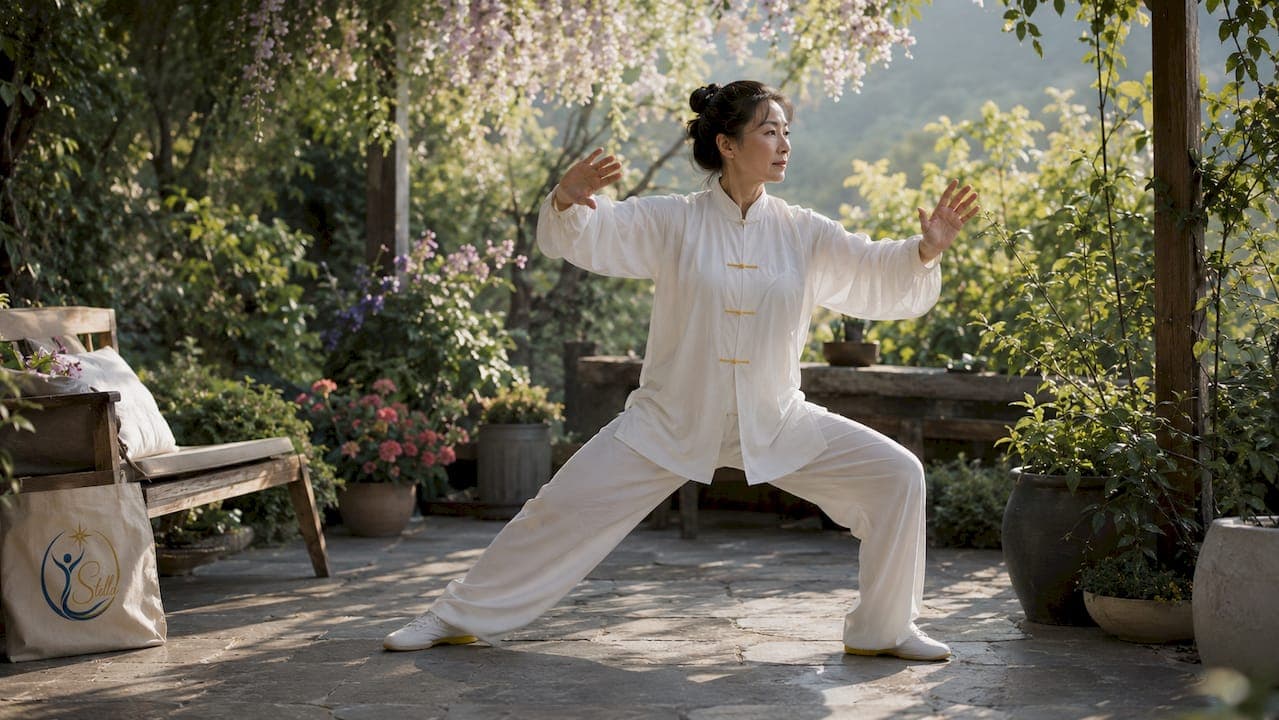
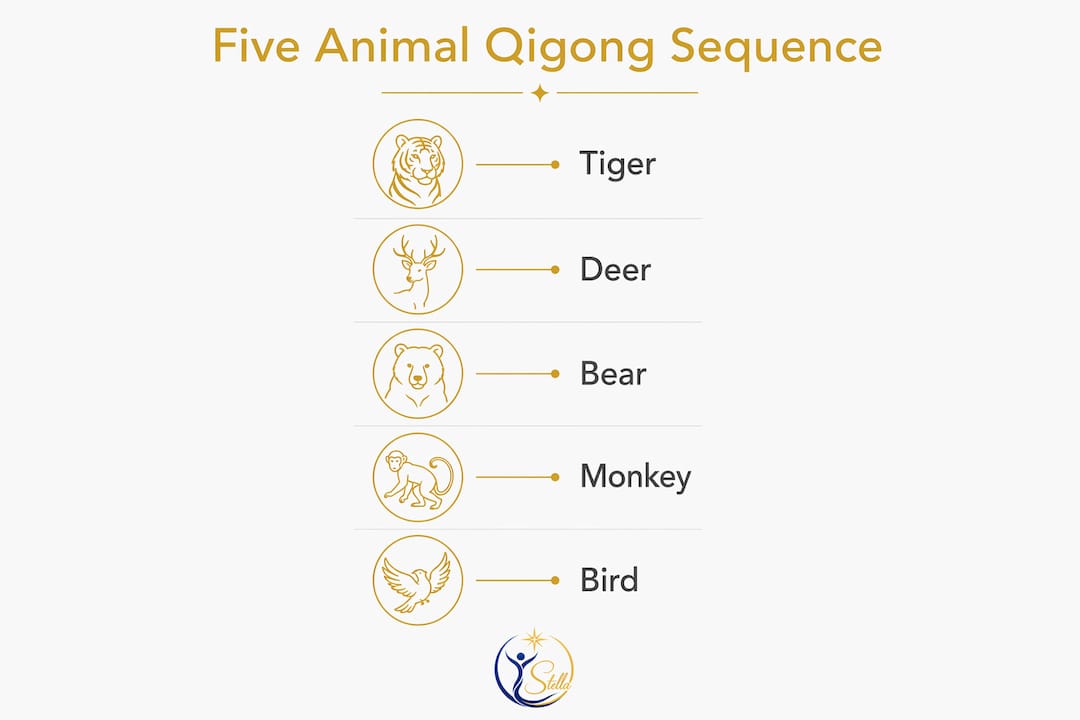
The five animal qigong digestion sequence is a traditional set of gentle movements designed to stimulate the spleen and stomach, improving digestive function through mindful motion and breath coordination. Known formally as Wu Qin Xi, this system is the oldest medical Qigong on record, developed by the physician Hua Tuo around 200 CE. It draws on five animal archetypes: Tiger, Deer, Bear, Monkey, and Crane. Each animal targets a specific organ system through the Five Elements framework, making the full sequence a complete approach to digestive and systemic health. Qigongstar teaches this sequence as a core part of its online wellness programs, with a particular focus on gut health and stress relief.
What role does each animal play in the five animal qigong digestion sequence?
Each animal in Wu Qin Xi corresponds to one of the Five Elements and a pair of organs. Each animal targets specific organs through movements designed to stimulate those systems directly. This is not symbolic. The physical mechanics of each form compress, stretch, and rotate the body in ways that activate the corresponding organ tissue and energy pathways.
Here is how each animal connects to digestion and overall health:
- Tiger (Wood element): Targets the liver and gallbladder. Tiger movements involve powerful stretching and clawing actions that release tension in the sides of the torso, supporting bile flow and liver detoxification. A sluggish liver directly impairs fat digestion.
- Deer (Water element): Targets the kidneys and bladder. Deer movements use gentle spinal twists and hip rotations that nourish kidney energy, which Chinese Medicine considers the root of all bodily vitality. Strong kidney energy supports the digestive fire below the navel.
- Bear (Earth element): Targets the spleen and stomach, the two organs most central to digestion. Bear movements use grounded, heavy swaying and rolling to physically massage the abdominal organs. This is the anchor form for anyone focused on gut health.
- Monkey (Fire element): Targets the heart and small intestine. The small intestine separates nutrients from waste after the stomach breaks food down. Monkey's quick, playful movements stimulate this separation function and support nutrient absorption.
- Crane (Metal element): Targets the lungs and large intestine. Crane's expansive, lifting movements open the chest and support the downward movement of the large intestine, which governs elimination. Poor elimination is one of the most common digestive complaints.
The sequence works as a system. Removing one animal breaks the Five Element cycle and leaves one organ pair without direct stimulation.
How to perform the Bear form for digestive health

The Bear form is the most direct qigong digestion exercise in the entire sequence. Its movements physically massage the stomach and spleen through slow, grounded body mechanics that no other animal replicates.
Setting your stance
Stand with your feet wider than shoulder width. Soften your knees so they carry your weight without locking. Let your arms hang loosely at your sides, slightly rounded as if holding a large ball. Your jaw is relaxed. Your gaze is soft and slightly downward. This grounded, heavy posture is the Bear's defining quality.
The Bear Sway
- Shift your weight slowly to the right foot, letting your left heel lift slightly.
- Allow your torso to tilt gently to the right as the weight transfers.
- Pause for one breath at the end of the shift.
- Slowly transfer your weight back to the left, tilting the torso left.
- Repeat Bear Sways 3–5 times on each side, moving as if you are a large animal settling into soft earth.
The Bear Roll
- Begin with your weight centered between both feet.
- Initiate a slow circular rotation from your waist, not your shoulders.
- Let the rotation travel upward through your torso in a gentle rolling wave.
- Complete the circle and reverse direction.
- Repeat Bear Rolls 3 times in each direction, keeping the movement continuous and unhurried.
The key to the Bear Roll is that the waist drives everything. Your limbs follow. This internal rotation rhythmically compresses and releases the stomach and spleen, creating a gentle internal massage effect.
Breathing for the Bear form
Use abdominal breathing throughout. On the inhale, let your lower belly expand outward toward your hands. On the exhale, draw the belly gently back toward the spine. Abdominal breathing for 5–10 minutes daily improves vagal tone and shifts the body into a parasympathetic state, which is the state in which digestion actually functions well. Most people eat and digest in a sympathetic, stress-activated state. The Bear form corrects this.
Pro Tip: Place one hand lightly on your lower abdomen during Bear Rolls. You should feel a gentle rolling sensation under your palm as the waist drives the movement. If you feel nothing, slow down further and reduce the range of motion until the internal quality returns.
How to integrate the full sequence into your daily wellness routine
The full Five Animal Frolics sequence takes 20–30 minutes and includes an opening standing meditation and a closing integration to settle the Qi after movement. Each animal has two movements, practiced with 2–4 repetitions on each side. That structure gives you a complete digestive health qigong routine without requiring a large time commitment.
A practical weekly progression for beginners looks like this:
- Week 1: Practice only the Bear form daily. Learn the Sway and Roll thoroughly before adding other animals. Ten minutes of Bear form alone produces measurable digestive benefit.
- Week 2: Add the Tiger form before Bear. Tiger's liver-stimulating movements prepare the body for the deeper abdominal work of Bear.
- Week 3: Add the Crane form after Bear. Crane's large intestine connection completes the digestion-to-elimination arc.
- Week 4: Add Deer and Monkey to complete the full sequence. Practice all five animals in the traditional order: Tiger, Deer, Bear, Monkey, Crane.
The traditional order follows the Five Element generation cycle. Each element feeds the next, so the sequence builds energy progressively rather than scattering it.
| Animal | Element | Primary organ focus | Digestive role |
|---|---|---|---|
| Tiger | Wood | Liver and gallbladder | Supports bile flow and fat digestion |
| Deer | Water | Kidneys and bladder | Nourishes digestive root energy |
| Bear | Earth | Spleen and stomach | Direct abdominal massage and Qi building |
| Monkey | Fire | Heart and small intestine | Stimulates nutrient absorption |
| Crane | Metal | Lungs and large intestine | Supports elimination and bowel regularity |
Structured Qigong routines that include abdominal rotation and breathing reduce fatigue and gastrointestinal discomfort in people with chronic digestive issues. Consistency matters far more than session length. Twenty minutes practiced daily outperforms a one-hour session done twice a week.
Common mistakes when practicing the five animal movement sequence
Most people who struggle with this practice make the same handful of errors. Catching them early saves months of frustration.
- Moving too fast. Speed kills the internal quality of every animal form. The Bear especially requires a pace that feels almost uncomfortably slow. If you finish a Bear Roll in under ten seconds, you are moving too fast.
- Skipping the Monkey form. The Monkey feels silly. Its quick, light movements contrast sharply with the Bear's gravity. Many people drop it. Skipping the Monkey disrupts the Five Element cycle and leaves the small intestine without stimulation, which directly impairs nutrient absorption.
- Treating it as fitness. Wu Qin Xi is not exercise in the conventional sense. The goal is Qi regulation, not muscular fatigue. Slow, consistent, intentional practice synchronized with breathing produces digestive benefit. Pushing harder does not.
- Shallow chest breathing. Chest breathing keeps the body in a mild stress state. The abdominal breathing pattern is not optional. It is the mechanism through which the parasympathetic nervous system engages and digestion activates.
- Focusing only on limb position. Correct hand placement means nothing if the waist is not initiating the movement. The internal rolling sensation driven by the waist is the actual therapeutic mechanism of the Bear form.
"Movement prevents disease. The Bear form aims to digest grain Qi and ensure smooth blood flow to the digestive center, preventing stagnation." This principle from Hua Tuo's original teaching reminds us that the goal is internal circulation, not external performance.
Pro Tip: Before each Bear Roll, take three slow abdominal breaths and consciously soften your belly. A tense abdomen blocks the internal rolling sensation entirely. Softening first makes the difference between a mechanical movement and a genuine internal massage.
Key takeaways
The five animal qigong digestion sequence works because each animal directly stimulates a specific organ pair, and the Bear form provides the most targeted abdominal massage of any gentle movement practice in the Wu Qin Xi tradition.
| Point | Details |
|---|---|
| Bear form is the digestive anchor | Practice Bear Sways and Rolls daily to directly massage the spleen and stomach. |
| Full sequence preserves organ balance | Skipping any animal, especially Monkey, disrupts the Five Element cycle and reduces digestive benefit. |
| Abdominal breathing is non-negotiable | Belly breathing activates the parasympathetic state that makes digestion possible during practice. |
| Slow movement outperforms fast movement | Intentional, waist-driven movement produces internal organ stimulation that speed eliminates. |
| Consistency beats intensity | Twenty minutes daily builds more digestive benefit than occasional long sessions. |
What daily Bear form practice taught me about digestion
I started practicing the Bear form specifically for bloating and sluggish digestion after years of trying dietary fixes that only partially worked. What surprised me was how quickly I noticed a change, not in symptoms first, but in body awareness. Within two weeks of daily Bear Rolls, I could feel the difference between a belly that was held tight and one that was genuinely relaxed. That distinction turned out to be everything.
The internal rolling sensation that the Bear form builds is subtle at first. You will doubt whether you are doing it correctly. Slow down more than feels necessary, and the sensation will find you. Once you feel it, you cannot unfeel it, and the practice becomes self-correcting.
What I have found over years of teaching this sequence is that people who practice all five animals consistently report better results than those who isolate the Bear. The Monkey form in particular, which most people resist, seems to sharpen the whole system. The playfulness it requires also softens the mental grip that stress places on the gut. That connection between mental ease and digestive ease is real, and the full sequence addresses both.
If you are new to this practice, give yourself four weeks before judging the results. The first week feels mechanical. The second week feels awkward. By the third week, something shifts, and you begin to feel the practice from the inside rather than performing it from the outside. That shift is where the real benefit lives.
— Stella
Qigongstar's Five Animal Qigong program for digestive wellness
Qigongstar offers a guided online program built around the complete Five Animal Qigong sequence, with dedicated instruction on the Bear form and its digestive applications. The program is designed for beginners and experienced practitioners alike, with on-demand access so you can practice at your own pace.
If you are ready to build a consistent digestive health practice with expert guidance, Qigongstar's Five Animal Qigong course walks you through every animal form, every breath pattern, and every common correction. For those also dealing with IBS or chronic gut discomfort, the Qigong for IBS relief resource offers targeted support alongside the full sequence. Both are available through Qigongstar's online platform, accessible from anywhere, at any time.
FAQ
What is the five animal qigong digestion sequence?
The five animal qigong digestion sequence, formally called Wu Qin Xi, is a medical Qigong system developed around 200 CE that uses five animal-inspired movement forms to stimulate specific organ systems and improve digestive function.
Which animal form is best for digestion?
The Bear form most directly supports digestion by targeting the spleen and stomach through grounded swaying and rolling movements that physically massage the abdominal organs.
How long should I practice each day?
The full sequence takes 20–30 minutes, but beginners can start with 10 minutes of Bear form daily and add the remaining animals over four weeks as they build familiarity.
Can I skip animals I find difficult?
Skipping any animal, particularly the Monkey, disrupts the Five Element cycle and reduces the sequence's overall digestive and systemic benefit. Practice all five for full effect.
Does qigong actually help digestion?
Yes. Structured Qigong routines that combine abdominal rotation with breath coordination reduce gastrointestinal discomfort and fatigue in people with chronic digestive issues by activating the parasympathetic nervous system.