
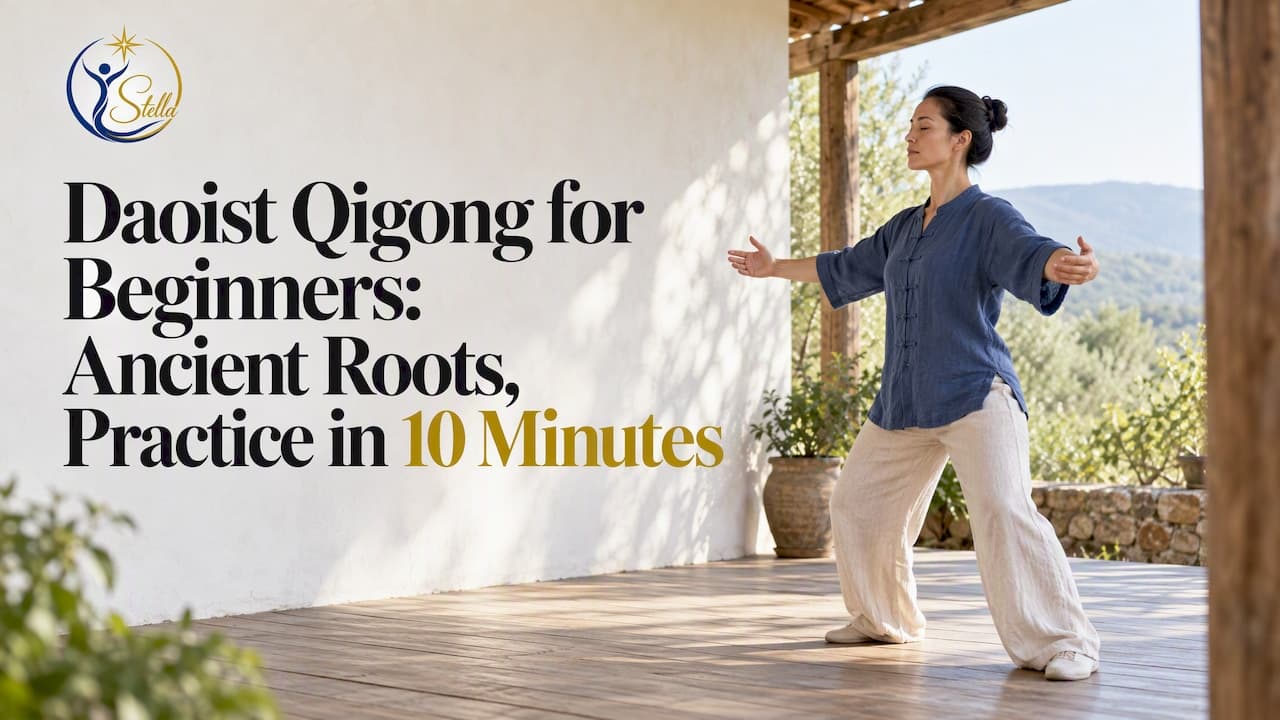
Daoist qigong is a gentle practice that joins slow movement, abdominal breathing, and a quiet, focused mind for self-cultivation and wellbeing. A systematic review of randomized trials found that regular practice can ease stress and anxiety in healthy adults. Try it now: stand softly, breathe low into your belly, and sway your arms gently.
TL;DR:
- Practice for 10 minutes three to five times weekly, since reported stress and anxiety benefits appeared after one to three months of consistent participation.
- Start with natural breathing, then try steady and abdominal breathing; avoid forceful methods and breath holds until the basics feel effortless, ideally with a qualified teacher.
- Use a chair or bed if standing is difficult; begin with a few repetitions, adding time only when movement feels easy and breathing stays smooth.
- Seek medical advice before starting if you have uncontrolled high blood pressure, glaucoma, recent surgery, or pregnancy; get emergency care for chest pain, fainting, or sudden pain.
Table of Contents
- What is Daoist qigong and how does it differ from other styles?
- Where did Daoist qigong come from?
- What are the core principles: posture, abdominal breathing, and mental focus?
- Which breathing methods should beginners start with?
- What does a 10-minute beginner Daoist qigong routine look like?
- How can you adapt qigong to your body and build a habit?
- When should you stop, and when should you ask a doctor?
- Why can you trust this guide?
- What do we think matters most when you begin?
- How can our online classes help you begin?
- FAQ
- Sources
What is Daoist qigong and how does it differ from other styles?
Daoist qigong is a family of exercises rooted in Daoist ideas about living in harmony with nature, conserving vitality, and cultivating the self over a lifetime. If you have ever watched someone move slowly in a park while breathing deeply, you have seen something close to it. The movements look simple. What happens inside them is the point.
Every session rests on three pillars, which we return to throughout this guide:
- Body: a relaxed, upright posture and slow, rounded movements that never force a joint.
- Breath: deep, quiet breathing that moves the belly rather than lifting the chest.
- Mind: gentle attention on one focal point, such as the lower abdomen or the feeling of your hands moving through space.
What sets the Daoist approach apart is its aim. Some qigong styles lean toward fitness, athletic conditioning, or martial power. Daoist practice leans toward self-cultivation and longevity: settling the nervous system, softening tension, and building a steady inner calm that follows you into daily life. Strength and flexibility often improve along the way, but they are not the goal.
For you as a beginner, this has practical consequences. Progress comes from relaxing rather than pushing. The Chinese word song describes this loose, open, unhurried state, and it is the quality you will practice more than any single posture. Expect to repeat the same few movements many times. Repetition is how the body learns to let go, and it is why a short routine done often beats a long one done rarely.
You do not need special fitness, flexibility, or equipment. You need a little floor space, comfortable clothes, and willingness to move slowly. Within a few sessions, most people notice their shoulders dropping and their breath lengthening, which is a soothing sign that the practice is already working with you.
Where did Daoist qigong come from?
Modern Daoist qigong grew from a much older practice called Daoyin. A scholarly review of Dao Yin, also known as qigong traces its origins, development, and clinical uses, and it gives us a trustworthy thread to follow. Here is a brief timeline built from that review:
- Early roots: The word Daoyin first appears in the Zhuangzi, a text from the 4th century BCE. It describes expelling old breath, taking in fresh breath, and imitating the movements of animals.
- Medical manuscripts: Daoyin references appear in early medical manuscripts, where movement and breathing were treated as ways to keep the body supple and circulation moving.
- The Daoyin Jing: Later writings, including the Daoyin Jing, organized exercises into more formal sets, a pattern that helped practices pass from teacher to student.
- From therapy to cultivation: Over the centuries, exercises that began as health maintenance were absorbed into Daoist self-cultivation, where they were paired with meditation and a philosophy of balance.
- Modern qigong: The name "qigong" became the common label for these arts, and the review documents how they now sit alongside clinical research on stress, pain, and wellbeing.
Two ideas from this history help beginners. First, the animal imitation in early Daoyin is still alive today in sets such as Five Animal Qigong, which we teach, where you move like a tiger, deer, bear, monkey, and crane to wake up different qualities of motion. Second, the pairing of breath and movement is not a modern invention. People have been combining them since ancient times, which is a good reason to approach the practice with patience rather than hurry.
You do not need to memorize any of this to practice well. Think of the history as the soil: it explains why the exercises feel the way they do, slow, rounded, and breath-led, and it shows that the aim has long been to feel more at home in your own body.
What are the core principles: posture, abdominal breathing, and mental focus?
The systematic review mentioned above describes qigong as three regulated elements working together: posture, deep abdominal breathing, and focused concentration or visualization. Each one is simple on its own. Together they create the calm, spacious feeling people often describe after a session.

Posture: alignment and song
Stand with your feet about shoulder-width apart and your knees slightly soft, never locked. Let your tailbone drop, lengthen the back of your neck, and imagine a thread lifting the crown of your head. Release your shoulders away from your ears and let your arms hang as if they were heavy and warm.
- Keep your weight evenly spread across both feet.
- Move through a comfortable range only, with no stretching to the edge of discomfort.
- Check for hidden tension in your jaw, hands, and belly, then soften it.
Abdominal breathing
Rest one hand on your lower belly. Inhale gently through your nose and let the belly swell outward a little, then exhale and let it settle back. The chest stays quiet. Keep the breath smooth and unforced, with no gulping and no holding.
Mental focus
Choose one gentle anchor. Many beginners rest attention on the lower abdomen, an area Daoist teachers often call the dantian. Others follow the feeling of their palms. If your mind drifts to your to-do list, notice it and return, without scolding yourself. That return is the practice.
Putting them together
Begin with posture, add the breath, then let your attention follow the movement. When your arms rise, let the inhale rise with them. When they lower, let the exhale carry them down. If you are unsure which element to work on, start with relaxation. A relaxed body breathes better, and a settled breath quiets the mind.
Pro Tip: Keep your exhale even and slightly longer than your inhale, and never pause to hold your breath between movements. A steady, flowing breath is the clearest sign you are moving at the right speed.
Which breathing methods should beginners start with?
Daoist qigong uses several breathing styles, and not all of them suit a first week. Here is how we suggest sequencing them.
Natural breathing is where nearly everyone starts. You simply breathe as you normally would while you move, and you pay quiet attention to it. This removes the pressure to "do it right" and lets your body show you its own rhythm.
Regular, steady breathing comes next. Here you smooth the breath so that the inhale and exhale are roughly the same length, quiet enough that someone beside you would barely hear it. This is the base for most gentle routines.
Abdominal breathing deepens the practice. Try this exercise:
- Stand or sit tall and place one hand on your lower belly and the other on your chest.
- Inhale slowly through your nose and feel the belly hand rise while the chest hand stays mostly still.
- Exhale gently and feel the belly draw softly back toward the spine.
- Repeat for ten slow breaths, then let the breath return to normal.
If you cannot feel the belly move at first, lie on your back with your knees bent. Gravity makes the diaphragm's movement easier to sense, and you can then carry the feeling into standing.
Nose and mouth patterns vary by exercise. In still, seated practice, both inhale and exhale usually go through the nose, keeping the breath quiet and cool. In flowing, dynamic movement, some teachers have students breathe in through the nose and release the exhale softly through the mouth, which can feel freeing when your arms are sweeping outward. Either way, keep the sound minimal and the effort low.
A word of caution about louder or more forceful methods. Some Daoist traditions include active breathing, such as short sharp exhalations or breath holds. We recommend leaving these aside until the basics feel effortless, ideally with a qualified teacher watching. Gentle, natural breathing already carries most of the benefit, and your lungs and nervous system will thank you for going slowly.
What does a 10-minute beginner Daoist qigong routine look like?
This sequence is a short beginner routine. Move slowly, breathe through your nose, and stop any movement that causes pain. If you would like to see similar moves broken down in more detail, our guide to the first six beginner movements and our 10-minute beginner sequence pair well with it.
- Settle. Stand with feet shoulder-width apart, knees soft, hands resting at your sides. Close your eyes or lower your gaze. Take slow abdominal breaths, letting your shoulders drop a little more on each exhale.
- Swaying arms. Shift your weight gently from one foot to the other and let your arms swing loosely, like ribbons, with the sway. Keep the breath natural. Aim for slow swings, feeling the spine and ribs soften.
- Gentle twist. Let your torso rotate to the right, letting the left arm wrap loosely toward your right hip while the right arm swings back. Then rotate left. Inhale in the center, exhale as you turn. Do turns on each side, moving only as far as feels easy.
- Knee bends. Place your hands in front of your lower belly. Inhale and rise slightly, exhale and bend your knees a little, as though sinking into soft ground. Keep your back long and your knees tracking over your toes. Repeat gently, going only as low as is comfortable.
- Opening the chest. Inhale and sweep your arms out and up in a wide, rounded arc, opening the chest like a bird spreading its wings. Exhale and lower your hands slowly in front of the body, palms facing down, as if pressing gently on water. Repeat gently.
- Grounding and rest. Return your hands to your lower belly. Take slow breaths, then sit on a chair or the floor for a short rest. Notice warmth, tingling, or quiet in the hands and belly. Open your eyes slowly.
Seated version: Every step above works in a sturdy chair. Sit tall with both feet on the floor, let the arms sway in front of you, twist from the waist, and replace knee bends with a gentle forward-and-back rock of the pelvis.
How often to practice: Daily is ideal, but three to five times a week is a good rhythm. The systematic review we cited earlier notes that stress and anxiety benefits appeared in healthy adults after one to three months of consistent participation, so consistency matters more than intensity. Start with fewer repetitions and add more as your body asks for them. For a longer plan that builds on this one, our daily qigong routine for stress reduction is a natural next step.
How can you adapt qigong to your body and build a habit?
Qigong is welcoming by design. UK exercise-medicine guidance on moving in ways that suit any ability stresses that people can begin gently and that chair-based or bed-based routines are perfectly acceptable adaptations. The priority is steady, comfortable engagement, adjusted for pain or limitation.
Chair and bed options
- Swap standing sways for seated sways, letting your arms swing as your torso shifts side to side.
- Do twists from a chair with your hands on your thighs or crossed over your chest.
- Replace knee bends with slow, small rocking movements of the pelvis or gentle ankle circles.
- In bed, lie on your back with knees bent and practice abdominal breathing, then add slow arm arcs overhead and back down.
Scaling gradually
Start with a few repetitions of each movement and gradually add more. Add time only when the movement feels easy and the breath stays smooth. Never push through pain, and never hold your breath to finish a set. If you tire, return to simple standing or seated breathing for a few moments.
Habit tips
- Pick a short window and protect it.
- Anchor practice to something you already do, such as after brushing your teeth or before your morning drink.
- Keep a simple log of date, length, and how you felt. A line or two is enough, and it shows your progress over weeks.
Pro Tip: Use brief micro-practices, such as abdominal breaths and a few arm sways between meetings. Small, frequent sessions can make it easier to build a habit than an occasional long session.
When should you stop, and when should you ask a doctor?
Qigong is gentle, but a little care keeps it that way. If you notice any of the following, seek immediate emergency care:
- Sharp or sudden pain in a joint, muscle, or your back.
- Severe dizziness, light-headedness, or fainting.
- New or worsening chest pain, or unusual shortness of breath.
Please check with a doctor or other health professional before starting if you have uncontrolled high blood pressure, glaucoma, a recent surgery, or are pregnant. They can tell you which movements and breathing styles are suitable for you.
A few simple rules protect everyone:
- Never force a breath hold or strain the breath.
- Choose seated options if you feel unsteady on your feet.
- Progress slowly and let comfort set the pace.
If something feels wrong, rest, breathe normally, and return only when you feel steady.
Why can you trust this guide?
We write about qigong from lived practice and from the research cited here. Here is what stands behind this article and the classes we offer:
- Qigongstar.com teaches White Tiger Qigong and Five Animal Qigong, with both live and on-demand classes.
- Our instruction is led by a White Tiger Qigong Level 3 certified instructor who is also accredited by Yoga Alliance.
- Our approach focuses on gentle movement, breath regulation, and stress and digestive wellness for modern, busy lives.
- Where we make historical or clinical claims, we link the published review, so you can read the evidence for yourself.
When you are ready for next steps, our qigong guide for complete beginners and our online qigong classes are the best places to continue.
What do we think matters most when you begin?
Most beginner advice buries you in terminology: meridians, energy centers, dozens of named forms. We think that gets the order backward. The evidence we found supports something plainer. Relaxed posture, quiet abdominal breathing, and gentle attention, practiced regularly, may help ease stress. That is a big enough promise for week one.
What is overrated, in our view, is perfection. Beginners often worry they are holding a hand wrong or counting a repetition incorrectly, and that worry quietly cancels the very relaxation they came for. Small errors in shape matter far less than whether you are soft, slow, and breathing smoothly. Equally overrated is the idea that you must stand for long sessions. Chair practice and brief breaks are not lesser versions of qigong. They are often the versions people actually keep doing.
What deserves priority is consistency and kindness toward yourself. Choose a short routine, practice it regularly, and let the history and philosophy deepen later, as curiosity grows. Treat any theory about energy as a lens you can explore, not a belief you must adopt on day one. The practice proves itself in how you feel afterward, calmer shoulders, longer breath, a quieter mind.
— Stella
How can our online classes help you begin?
If you would like someone to watch your form and tailor each step to your body, we are happy to guide you. Here is what suits beginners:
- Qigong for Stress Relief and Digestive Wellness: a self-paced online course, £116 one-off, for calming stress and supporting gut comfort.
- 30-Min Clarity Session: a focused one-to-one session, £85 one-off, ideal for a first conversation and a personal starter routine.
- Group Qigong Classes: a friendly way to practice alongside others, with live pacing and encouragement.
In a live session, you receive gentle corrections, sensible progressions, and chair-friendly or low-impact modifications whenever you need them. See every option and book on our online qigong classes page.
When you are ready, choose the session that feels right and take your first guided step with us.
FAQ
What are the five principles of qigong?
Different teachers list them differently, but the most common set is relaxation, posture, breath, mindful attention, and gentle, repeated movement. Together they describe the body, breath, and mind pillars used in the qigong stress-and-anxiety review.
What are the three golden rules of qigong?
A simple version is: relax, breathe slowly, and focus gently. Relax the body first, let the breath become smooth and abdominal, then rest your attention on one point or on the movement itself. Practice daily or several times a week.
What is a good qigong routine for beginners?
Start with a short sequence: settle with abdominal breathing, sway the arms, add a gentle twist and soft knee bends, open the chest, and finish with grounding breaths. A short routine can be enough, and a seated version is an option.
Who should not do qigong?
Anyone with sharp pain, fainting, or chest pain should seek immediate emergency care. People with uncontrolled high blood pressure, glaucoma, a recent surgery, or pregnancy should check with a health professional before beginning, and everyone should avoid forced breath holding.
Sources
- Managing stress and anxiety through qigong exercise in healthy adults: a systematic review and meta-analysis of randomized controlled trials
- Everybody