
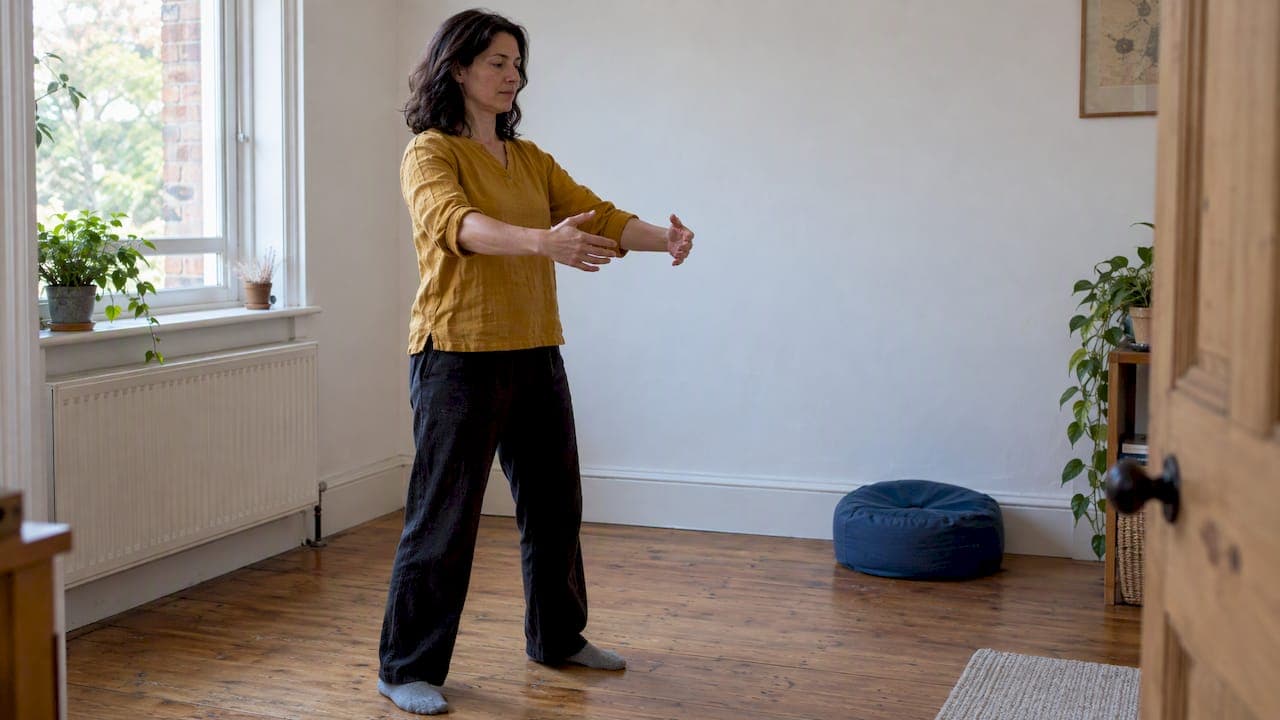
Yes, regular short Zhan Zhuang standing practice can help ease anxiety for many people as a gentle, complementary self-care tool, though it works alongside professional support rather than replacing it. If self-help steps like this one are not enough, the NHS advises seeing a GP. Right now, you can try a 60 to 90 second standing micro-practice: feet apart, knees soft, breath slow.
TL;DR:
- Practicing Zhan Zhuang for 60 to 90 seconds daily can help reduce anxiety, with more consistent sessions of 20 to 40 minutes three to four times weekly showing clearer benefits.
- Correct posture involves feet shoulder-width apart, soft knees, relaxed arms, a straight spine, and slow, deep breathing, which supports nervous system regulation.
- Research indicates traditional Chinese exercises like Qigong can improve autonomic regulation and decrease anxiety symptoms, especially after 12 to 16 weeks of regular practice.
- Beginners should build tolerance gradually, starting with short micro-practices and increasing duration over four to twelve weeks, focusing on consistency for optimal results.
- Anyone with balance issues, joint pain, or cardiovascular conditions should consult a healthcare professional before starting standing meditation routines.
Table of Contents
- How to Do Zhan Zhuang: Step-by-Step Posture, Breathing, and Quick Micro-Practices
- Why Standing Meditation Helps: Mechanisms and What the Research Shows
- Practice Plans: Starter Sessions, a 4-Week Build, and a 12-Week Target
- Safety, Contraindications, and When to See a GP
- Why Learn With Stella at QigongStar: Courses and Practice Support
- A Short Teaching Note From Stella
- Try Guided Classes or a Clarity Session
- FAQ
- Sources
How to Do Zhan Zhuang: Step-by-Step Posture, Breathing, and Quick Micro-Practices
Zhan Zhuang means "standing like a post," and the beauty of it is that you need nothing but a quiet patch of floor and a few calm minutes. We walk you through the classic "hugging the tree" stance, the posture most teachers use as a foundation for anxiety-focused practice.
- Plant your feet shoulder-width apart, toes pointing forward, weight settled evenly between both feet.
- Soften your knees with a gentle bend, as if you were about to sit on a tall stool, keeping your weight centered over your heels and the balls of your feet.
- Round your arms in front of your chest as though embracing a tree trunk, palms facing inward, elbows hovering below shoulder height.
- Shape your hands softly, fingers slightly curled, wrists relaxed rather than locked or flexed.
- Lengthen your spine gently upward, tuck your chin slightly, and let your jaw loosen.
- Rest your gaze on a point a few feet ahead, unfocused, rather than staring hard at anything.
- Breathe low and slow, letting your belly expand on the inhale and soften on the exhale, aiming for a pace that feels unhurried rather than counted.
Hold this shape for whatever time feels sustainable, even if that is only 30 seconds at first. The posture itself does quiet work: it asks your body to be upright without being rigid, alert without being braced, which is often the opposite of how anxiety holds us.
For acute anxiety, you do not need the full stance. Try this 60 to 90 second micro-practice: stand with feet hip-width apart, round your arms loosely in front of you, close your eyes if that feels safe, and take six slow breaths, counting four seconds in and six seconds out. Notice your feet on the ground before you open your eyes again. Our performance anxiety routines use a similar pattern for moments before a stressful event, and our standing meditation guide goes deeper into posture mechanics if you want more detail.
Pro Tip: If your arms start to shake or ache within the first minute, drop them lower, closer to your waist, rather than giving up on the stance entirely.
A few common mistakes show up again and again among beginners:
- Overgripping the hands, which tightens the whole arm. Soften your fingers and let the elbows hover rather than lock.
- Locking the knees, which blocks the gentle sway standing meditation relies on. Keep a soft, springy bend throughout.
- Holding the breath when concentrating hard on form. Return attention to slow, low breathing whenever you notice this.
Why Standing Meditation Helps: Mechanisms and What the Research Shows
Anxiety often shows up in the body before it shows up in the mind: shoulders creep up, jaws clench, breath turns shallow and fast. Zhan Zhuang works, where it works, by interrupting that pattern. The upright but unbraced posture asks your nervous system to let go of chronic guarding, while slow diaphragmatic breathing supports a shift toward the parasympathetic, rest-and-digest side of your autonomic nervous system rather than the fight-or-flight sympathetic side. Holding still while paying attention to breath and body also trains a kind of sustained, non-judgmental focus that overlaps with mindfulness practice, which may help reduce the racing, looping quality of anxious thought.

The research base, while still developing, gives this approach some real support. A randomized trial on three-circle post standing qigong, a classic Zhan Zhuang form, tested outcomes including the Self-Rating Anxiety Scale alongside physiological measures like heart rate variability and EEG patterns in college students, linking the practice to measurable shifts in autonomic regulation. A 2025 network meta-analysis of traditional Chinese exercises found that practices including Qigong and Tai Chi can reduce anxiety and depression symptoms across trials, though the authors note that heterogeneity in study design and protocols limits firm conclusions.
A separate 2025 review in Medicine found that anxiety interventions using traditional Chinese exercises often showed their largest effects with programs lasting 12 to 16 weeks, sessions of roughly 40 to 60 minutes, and a frequency of about 3 to 4 times per week, though the authors caution that evidence quality varies across the trials pooled.
A few honest caveats belong here:
- Many trials are small, short, and conducted in specific populations like students, limiting generalizability.
- Protocols vary widely between studies, so a standardized "dose" is not established.
- Most reviews recommend more rigorous trials before considering Zhan Zhuang as more than a promising complementary tool.
Practice Plans: Starter Sessions, a 4-Week Build, and a 12-Week Target
Consistency matters more than intensity here. A realistic plan lets you build tolerance for standing still, which is itself a skill, before asking your body to hold the posture for longer stretches.
- Starter phase (week 1): Practice a 60 to 90 second micro-stance once or twice daily, building toward one 5-minute session each day as your legs and attention adjust.
- 4-week progression: Add roughly 2 to 3 minutes per week to your main session, working toward 15 minutes by the end of week four, and finish each session with a 2 to 3 minute seated consolidation to let sensations settle before you move on with your day.
- 12-week plan: Aim for sessions of 20 to 40 minutes, 3 to 4 times per week, which aligns with the duration and frequency ranges where research on traditional Chinese exercises has reported its clearest effects for anxiety. Track a simple daily anxiety rating from 0 to 10 alongside sleep quality to notice patterns over the weeks.
Frequency matters differently depending on what you are treating: anxiety-focused research tends to show benefit at a more moderate, 3 to 4 times weekly cadence, while depression-focused protocols in the same literature often lean toward daily practice. If anxiety is your main concern, the moderate pace is a reasonable place to start. Our 12-week benefits guide breaks down what measurable progress can look like across a full quarter of home practice.
Pro Tip: Pair your standing session with one NHS-recommended self-help technique, like a short breathing exercise before bed, rather than treating Zhan Zhuang as a stand-alone fix.

Safety, Contraindications, and When to See a GP
Standing meditation is gentle, but it is not risk-free for everyone. A short checklist keeps practice safe:
- Balance or vertigo issues: practice near a wall or sturdy chair you can touch if needed.
- Knee, hip, or back pain: shorten sessions and raise your stance slightly rather than bending deeply.
- Cardiovascular conditions: check with your GP before starting any new physical practice, including gentle standing exercises.
- Dizziness, chest pain, or fainting during practice: stop immediately and rest.
If anxiety feels unmanageable, or if self-help steps like breathing exercises and standing meditation are not shifting things after a reasonable trial, the NHS recommends speaking with a GP, who can discuss talking therapies or other treatment options. Mention any mind-body practices you are already using. This gives your GP or therapist a fuller picture and helps them tailor support around what is already working for you.
Why Learn With Stella at QigongStar: Courses and Practice Support
Learning Zhan Zhuang from guided instruction, rather than piecing it together alone, tends to shorten the path to comfortable, correct practice. Our course offerings are built around the kind of measurable, beginner-friendly progression this article describes.
- Short clarity sessions can provide quick, focused feedback on posture or breathing.
- Longer deep dive sessions work well for building a personalized plan around your specific anxiety patterns.
- On-demand courses suit those who want to move through a structured program at their own pace.
Our online anxiety routines collect research-aware micro-practices you can try between sessions, and students working with guided feedback often find it easier to stay consistent through the full progression outlined above.
A Short Teaching Note From Stella
In the early weeks of standing practice, most people notice their legs shake before they notice their mind settle. That is normal, and it passes. What changes first is subtle: a slightly longer pause before reacting to a stressful text, a breath that drops lower without you forcing it. Be patient with the small wins. Try this tonight: stand for 90 seconds, arms rounded, breathing low, and notice one thing that feels different afterward.
— Stella
Try Guided Classes or a Clarity Session
If you have tried the posture above and want sharper feedback on your form, or a plan built around your own schedule, guided instruction tends to close that gap faster than practicing alone. We built our course formats around exactly the progression this article walks through, from first stance to a full 12-week plan.
- Troubleshooting technique: a 30-Min Clarity Session for £85 one-off helps you correct alignment issues before they become habits.
- Building a personalized plan: a 60-Min Deep Dive Online Session for £145 one-off maps a practice schedule around your specific stress patterns.
- Self-paced progress: our Qigong for Stress Relief and Digestive Wellness course, £116 one-off, suits readers who prefer working through structured material at their own pace.
| Offer | Format | Price |
|---|---|---|
| Qigong for Stress Relief and Digestive Wellness | Self-paced course | £116 one-off |
| 30-Min Clarity Session | Online, one-on-one | £85 one-off |
| 60-Min Deep Dive Online Session | Online, one-on-one | £145 one-off |
| 60-Min Face-to-Face Qigong | In-person, one-on-one | £165 one-off |
If chatting live appeals more to you before committing, a 60-Min Face-to-Face Qigong session at £165 one-off gives you the same personalized feedback in person. Whichever format fits, you can see the full range of online courses and classes and book directly from there.
This article is general information, not a substitute for advice from a qualified doctor. Consult a qualified healthcare professional about your own circumstances before acting on anything here.
FAQ
How long should I practice Zhan Zhuang each day?
Start with 60 to 90 seconds at a time and build toward a daily 5-minute session over the first week. Research on traditional Chinese exercises suggests the clearest anxiety benefits tend to appear with sessions lasting 20 to 40 minutes, practiced 3 to 4 times weekly, once you have built up tolerance over several weeks.
Can qigong help with anxiety?
Qigong practices, including standing forms like Zhan Zhuang, show reductions in anxiety measures across several trials, according to a 2025 network meta-analysis of traditional Chinese exercises. Results vary between studies, so qigong works best as a complementary self-help tool rather than a replacement for professional care when anxiety is severe.
What are the health benefits of practicing Zhan Zhuang?
Beyond anxiety support, standing meditation research points toward shifts in autonomic regulation, measured through markers like heart rate variability in trials of three-circle post standing qigong. Many practitioners also report better posture awareness and a steadier breathing pattern with consistent practice.
Does tai chi reduce anxiety?
Tai chi belongs to the same family of traditional Chinese exercises studied alongside Qigong, and the 2025 network meta-analysis found reductions in anxiety symptoms across these practices as a group. Effects vary by study and protocol, so results should be read as promising rather than guaranteed for any one person.
When should I see a GP about anxiety instead of just self-help?
The NHS advises seeing a GP if self-help steps like breathing exercises or meditation are not working, or if anxiety feels unmanageable. A GP can discuss talking therapies and other treatment options alongside any self-care practices you already use.
Sources
- Get help with anxiety, fear or panic - NHS
- The effect of Three-Circle Post Standing (Zhanzhuang) qigong on the physical and psychological well-being of college students
- Network meta-analysis of traditional Chinese exercises and other interventions for anxiety and depression (Frontiers in Public Health, 2025)
- Exploring the benefits of traditional Chinese exercises on anxiety and depression (Medicine, 2025)