
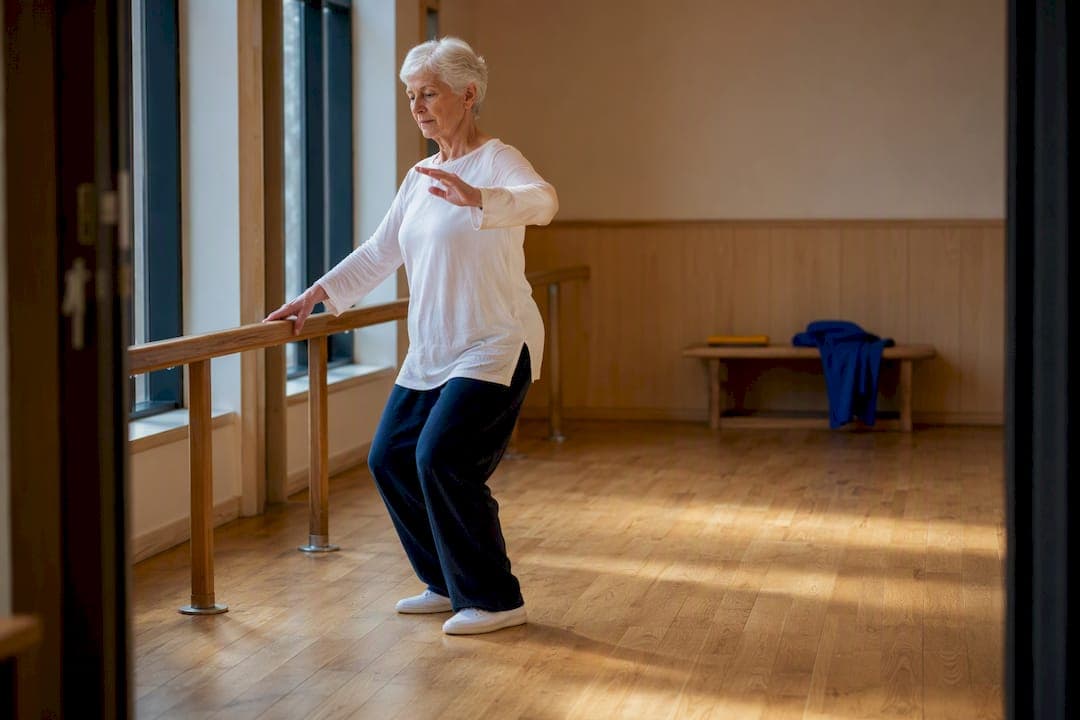
Qigong is a safe, low-impact practice that the best evidence shows can reduce joint pain and improve mobility for many people when done gently and consistently. Systematic reviews and NHS guidance both point the same way: movement helps, and qigong offers one of the softest entry points available. Try the 5-minute routine below, and if any movement brings on joint pain rather than muscle fatigue, stop and rest.
TL;DR:
- Qigong offers the strongest evidence for improving pain, stiffness, and function in knee osteoarthritis, with some moderate-to-high certainty results.
- Evidence for inflammatory joint conditions like rheumatoid arthritis remains mixed, making qigong a gentle supplement rather than a primary treatment.
- Practice should be gentle, paced, and modified to avoid joint pain, with modifications such as sitting, shrinking movement ranges, or slowing movements.
- Benefits typically appear within four to eight weeks of regular practice, with the full effect usually seen after 12 weeks of consistent sessions.
- Qigong is low-risk, with muscle soreness being the main temporary side effect, and sharp joint pain indicates it is time to stop or modify movements.
Table of Contents
- What the research says about qigong and joint pain
- Three ready-to-do qigong routines for joint pain
- How to adapt qigong for sore joints and know when to stop
- How often to practice and when to expect improvements
- How QigongStar's courses and classes support joint pain
- Staying consistent, patient, and pain-aware
- Next steps: try a class or the guided course
- Key studies and official guidance to read next
- Sources
- FAQ
What the research says about qigong and joint pain
The evidence base for qigong and joint health has grown steadily, and it points in a consistent, reassuring direction. A review published on PMC concluded that qigong may be useful as an adjunct for adults with arthritis, helping reduce pain and improve quality of life, with low risk when the movements are adapted to the person practicing them. That word "adjunct" matters. Qigong is not positioned as a replacement for medical care, but as a gentle companion to it.
The strongest signal comes from an umbrella review of meta-analyses published in the BMJ, which looked across many studies of traditional Chinese exercises, including qigong and tai chi. It found that these practices significantly improve physical function and ease pain and stiffness in knee osteoarthritis, with several of these associations reaching moderate to high certainty. That is a meaningfully strong finding in a field where much of the supporting research is smaller and more mixed.
Individual trials add texture to that picture. A Baduanjin qigong trial for knee osteoarthritis found that a 12-week program, practiced three times a week for 40 minutes, improved knee proprioception (your body's sense of joint position) and reduced pain while improving function scores in older adults. Proprioception tends to get overlooked in conversations about arthritis, yet it shapes how confidently and safely a joint moves through daily tasks like climbing stairs or rising from a chair.
Where the evidence gets thinner is with inflammatory conditions such as rheumatoid arthritis, where results across studies are more mixed and the case is less settled than it is for knee osteoarthritis. This unevenness is worth holding onto: qigong's benefits are best supported for degenerative joint pain, and less certain for autoimmune joint disease, though it may still offer value there as a gentle complement to standard treatment.
This lines up with how clinical guidance frames exercise generally. NHS guidance on osteoarthritis recommends regular gentle exercise and stresses that movement does not typically harm joints, a point worth repeating because so many people quietly believe the opposite. The advice is to start gently, pace yourself, and get professional input if a flare or a new symptom appears.
Put together, the picture looks like this:
- Knee osteoarthritis has the strongest and most consistent supporting evidence for pain, stiffness, and function.
- Rheumatoid arthritis and other inflammatory conditions show mixed results, so qigong is best framed there as a gentle complement rather than a primary treatment.
- Clinical guidance across arthritis care recommends staying active, with qigong fitting naturally into that advice as a low-impact option.
Research shows encouraging evidence from the BMJ umbrella review, which rated the evidence for improved physical function in knee osteoarthritis as moderate to high certainty, a level of confidence that is genuinely rare in complementary movement research. For anyone whose knees have quietly limited what they do each day, that is a meaningful thread to pull on.
Three ready-to-do qigong routines for joint pain
You do not need special equipment or a studio to begin. Each of these routines can be done in regular clothes, in a small patch of floor space, and adjusted the moment something does not feel right in a joint.
- The 5-minute micro routine (standing or seated). Begin with soft knee circles, hands resting just above the kneecaps, tracing slow loops in each direction for a minute. Move into shoulder rolls, breathing in as the shoulders lift and out as they drop back, then finish with gentle wrist and ankle rotations, letting each joint move through its comfortable range rather than its maximum one.
- The 10-minute full-body flow. Start with a minute of slow, deep breathing to settle the nervous system, then move through linked, flowing arm sweeps that shift your weight gently from one foot to the other, mimicking the swaying quality often seen in Tai Chi and Baduanjin. Keep your knees soft, never locked, and let your gaze travel with your hands to support balance and proprioception.
- The 15-minute focused routine with joint variants. Spend the first five minutes on whichever joint troubles you most: slow, small squats for knees and hips, gentle finger stretches and fist-opening sequences for hands, or arm circles kept below shoulder height for sore shoulders. Move into the flowing sequence from the 10-minute routine, then close with two minutes of stillness, breathing quietly and noticing how the practiced joint feels compared to when you started. Anyone with limited mobility can do the entire sequence seated, using a chair for support during the standing sections that would otherwise take the whole routine.
Pace matters more than precision here. Breathe in through the nose for roughly four counts and out for four to six, letting the exhalation be slightly longer, which tends to have a calming effect on the whole body. Keep movements slow enough that you could pause at any point without losing your balance, and treat any sharp discomfort as a signal to shrink the range of motion rather than push through it.
Pro Tip: If a movement causes a joint to feel worse rather than tired, halve the range of motion before you halve the routine altogether.
For deeper, condition-specific guidance, the gentle routines for arthritis guide walks through adaptations in more detail, and the 5-minute shoulder routine offers a focused sequence for shoulder pain specifically.

How to adapt qigong for sore joints and know when to stop
Muscle soreness and joint pain are not the same thing, and learning to tell them apart is one of the most useful skills you can bring into any gentle movement practice. Muscle soreness tends to feel like a dull, generalized ache that eases within a day or two. Joint pain is sharper, often localized to one spot, and can come with swelling, warmth, or a feeling of instability. The essential rule used by rehabilitation instructors is simple: stop at joint pain.
Muscle soreness is expected. Sharp joint pain is not.
Royal Orthopaedic Hospital / NHS guidance on osteoarthritis exercise
If a joint is having a rough day, you have options beyond skipping practice entirely.
- Sit instead of stand, using a sturdy chair to remove weight-bearing stress from hips and knees.
- Shrink the range of motion, moving a joint through the smallest comfortable arc rather than its full extension.
- Slow the tempo further, which reduces momentum and gives you more control near the edge of a joint's comfort zone.
- Swap dynamic movement for isometric holds, gently engaging the muscles around a joint without moving it, using a folded towel or cushion for support where helpful.
Certain signs call for more than a modification. Hot, visibly swollen joints, sudden sharp pain that was not there before, or systemic symptoms like fever alongside joint pain are reasons to pause practice and speak with a GP or physiotherapist rather than working around the discomfort. A physiotherapist can also help you tailor movements to a specific diagnosis, which is especially useful if you are managing more than one joint condition at once or recovering from a recent flare.
How often to practice and when to expect improvements

Most of the research behind qigong's benefits for joint pain follows a fairly consistent pattern. Trials on Baduanjin for knee osteoarthritis typically ran for 12 weeks, three sessions a week, with each session around 40 minutes, and some protocols in the wider research on traditional Chinese exercises range from 20 to 60 minutes per session across an 8 to 12 week span. Some participants in these trials reported early improvements within four to eight weeks, though the fuller gains in function and pain scores tended to build across the full course.
For daily life, that translates into a manageable plan rather than a rigid prescription:
- Practice a short micro-routine daily, even just 5 minutes, to keep joints moving and reduce morning stiffness.
- Add two to three longer sessions each week, in the 20 to 40 minute range, to build the deeper gains seen in trials.
- Track your progress simply, noting pain on a 0 to 10 scale, how far a joint moves comfortably, and whether daily tasks like stairs or jars feel easier over time.
A recurring pattern across trials on traditional Chinese exercises is that longer or more frequent practice tends to bring larger gains, and that guided or instructor-led formats tend to keep people practicing consistently for longer, which matters more than any single session's intensity.
How QigongStar's courses and classes support joint pain
Some online qigong courses and live sessions are built around the same gentle, adaptable movement this article describes, which makes them a natural fit for anyone managing joint pain who wants more structure than a self-taught routine. On-demand lessons let you move at your own pace and repeat any section as often as a joint needs, while private sessions allow real-time adjustment of a movement that a video simply cannot offer.
- On-demand courses suit readers who want to build a steady, self-paced habit around joints that vary day to day.
- 1:1 sessions suit readers who want a movement adapted live, particularly useful for a specific knee, hip, or shoulder concern.
- Group classes suit readers who find accountability and shared pace easier to sustain than practicing alone.
Instruction is sometimes delivered by instructors with White Tiger Qigong Level 3 certification and Yoga Alliance accreditation, grounding the guidance in recognized training standards rather than improvisation. For readers who want to explore the method behind the movements further, the White Tiger Qigong course page outlines the approach in more depth, and the full class and course library lists every current format.
Staying consistent, patient, and pain-aware
Progress with qigong rarely looks like a straight line, and that is worth expecting rather than fighting. Some days a knee cooperates fully; other days it asks for a smaller range and a slower breath. Both are part of the practice, not a failure of it.
What matters more than perfect form is showing up gently and often, and treating the "stop at joint pain" rule as a permanent companion rather than a beginner's caveat. If a joint keeps flaring despite careful practice, loop in a physiotherapist or your GP. Qigong works best alongside good medical care, never instead of it.
— Stella
Next steps: try a class or the guided course
If the routines above felt good in your body, the next step is guided practice that adapts to your specific joints rather than a generic script. QigongStar's online Qigong classes and courses offer exactly that: gentle sequences built for stress relief and overall wellness, with recorded lessons you can revisit as often as a joint needs and live formats where movements get adjusted in real time.
A sensible first step is a 30-Minute Clarity Session, a focused, one-off booking that lets you ask questions specific to your joints before committing to anything longer. For readers who prefer more depth from the outset, the 60-Minute Deep Dive Online Session covers more ground in a single sitting.
- 30-Min Clarity Session, a low-commitment way to get personalized guidance on your joints.
- 60-Min Deep Dive Online Session, for a fuller, more detailed first experience.
- Group Qigong Classes, for readers who prefer shared pace and accountability.
These are not the only reasonable ways to start with qigong, but they are a direct, instructor-led route if a guided hand appeals to you more than a self-taught video.
Key studies and official guidance to read next
For readers who want to look at the underlying evidence directly, these sources carry the most weight:
- The PMC review on qigong and arthritis and the Baduanjin knee osteoarthritis trial for condition-specific results.
- NHS guidance on osteoarthritis for safety-first exercise recommendations.
This article is general information, not a substitute for advice from a qualified doctor. Consult a qualified healthcare professional about your own circumstances before acting on anything here.
Sources
- Baduanjin Qigong trial results for knee osteoarthritis
- Qigong Exercise and Arthritis - PMC - NIH
- NHS — Osteoarthritis treatment: exercise guidance
FAQ
Is qigong good for arthritis?
Qigong can help many adults with arthritis, particularly knee osteoarthritis, by easing pain and improving function, according to a PMC review and a BMJ umbrella review of traditional Chinese exercises. Evidence is stronger for knee osteoarthritis than for inflammatory conditions like rheumatoid arthritis, so it works best as a gentle complement to medical care rather than a replacement for it.
What are the negative side effects of qigong?
Qigong is generally low-risk, and a systematic review of qigong therapy found that mild muscle soreness was the main reported effect, with serious adverse events being rare when practiced gently and with appropriate modification. The main caution is to stop any movement that brings on sharp joint pain rather than ordinary muscle fatigue.
What exercise is good for painful joints?
NHS guidance recommends regular gentle exercise for joint pain, starting slowly and pacing activity rather than avoiding movement altogether. Low-impact options like qigong, tai chi, swimming, and gentle strength work all fit this approach, and a physiotherapist can help tailor the choice to your specific joints.
What do Chinese people do for arthritis?
Traditional Chinese exercises such as qigong, Baduanjin, and Tai Chi have long been used alongside other approaches to support joint health, and modern research has since studied these practices for their effects on pain and function. A BMJ umbrella review found that these exercises improve physical function and reduce pain and stiffness in knee osteoarthritis, with some findings reaching moderate to high certainty.
How long before qigong helps with joint pain?
Some people notice early changes within four to eight weeks of regular practice, while fuller improvements in pain and function tend to build across a 12-week course of practice, typically three sessions a week. A steady mix of daily short practice and a few longer weekly sessions tends to support the most consistent progress.