
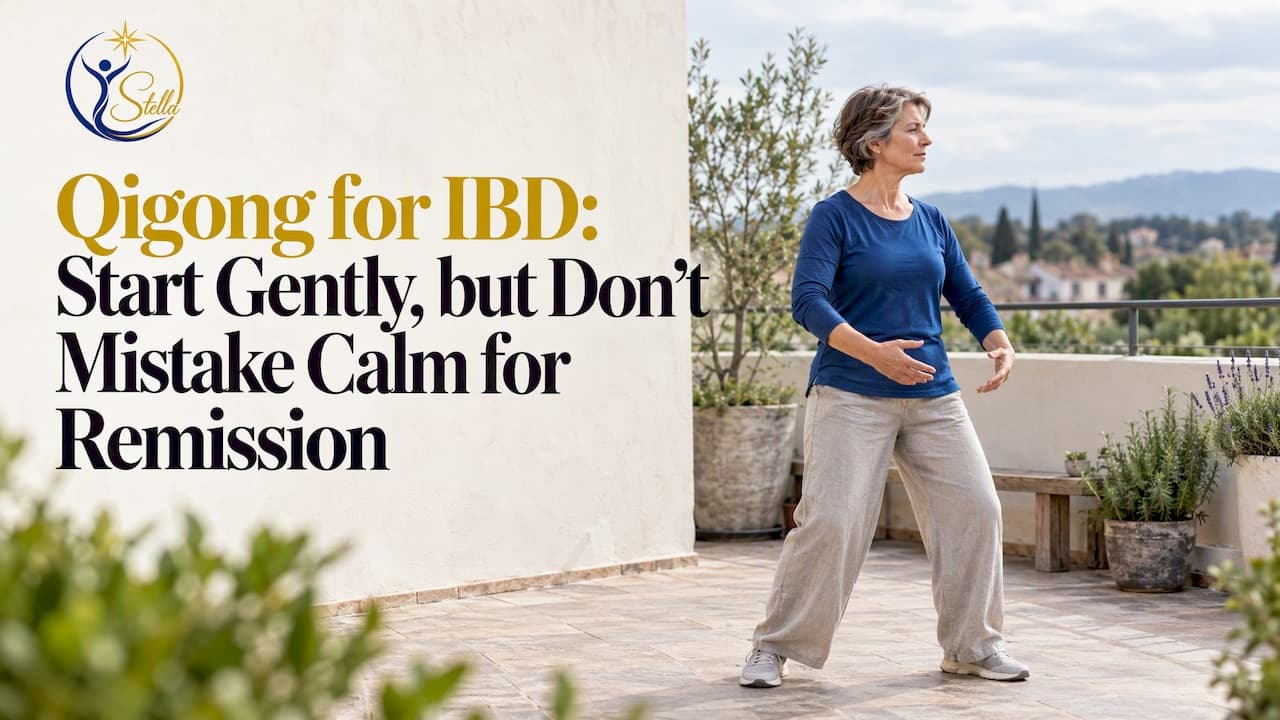
Gentle qigong is likely to ease stress, fatigue and the sense of overwhelm that often rides alongside inflammatory bowel disease, and many people find it soothing to body and mind alike. It is not proven to calm inflammation or bring on remission, so we see it as a calming companion to your prescribed care rather than a substitute for it. Below, we walk through what the evidence actually shows, how to start safely, and a few gentle moves you can try today.
TL;DR:
- A 2015 pilot of 29 people with IBD found less anxiety and better quality of life, but no control group limits claims about cause.
- Start with five to ten minutes, three to four days weekly, and increase only after a week or two of stable symptoms.
- During flares, limit practice to three to five minutes of seated breathing or arm movements; stop for bleeding, fever, severe pain, or signs of dehydration.
- Crohn's & Colitis UK recommends 150 minutes of moderate activity weekly when symptoms allow, but advises avoiding strenuous exercise for several weeks after surgery.
Table of Contents
- What the research on qigong and IBD actually shows
- How gentle movement may ease symptoms without treating the disease
- A safe starter plan for your first weeks of practice
- Bringing qigong into conversation with your IBD care team
- How Stella and QigongStar support safe, tailored practice
- Which qigong styles suit people living with IBD
- Breathing techniques that support digestion and calm
- Adjusting your practice through flares and remission
- A practitioner's honest view on what to expect
- Start gently with guided support built for digestive wellbeing
- FAQ
- Sources
What the research on qigong and IBD actually shows
The evidence base for qigong in inflammatory bowel disease is still small, and honesty about that matters more to us than making bold promises. What we have points toward comfort and calm rather than cure, and every reputable source agrees that larger, controlled studies are needed before anyone can call qigong a treatment for the disease itself.
A 2015 pilot study looked at a nine-week relaxation-response mind-body intervention in people with IBD and irritable bowel syndrome. Among the 29 people with IBD in the study, researchers reported improvements in pain catastrophizing, anxiety and disease-specific quality of life, and they noted changes in the expression of 1,059 genes in the IBD group. That sounds dramatic, and in some ways it is encouraging, but the study had no control group, which means we cannot say the practice alone caused those shifts rather than time, attention or other factors. Some benefits did persist at short-term follow-up, which is a hopeful sign worth watching rather than a settled conclusion.
A broader 2020 review placed qigong and tai chi in context as moderate mind-body physical activities that may help with fatigue, depression, pain and quality of life in people with IBD. The 2020 review suggested a research dose of one 30-minute qigong session weekly for eight weeks as a study parameter, but the authors were careful to note that this is not a clinical prescription, and the underlying mechanisms are not yet proven. We appreciate that caution, because it mirrors how we talk about qigong ourselves: as a supportive practice, never a clinical treatment.
More recent work has started to probe whether gentle movement might touch disease activity itself, not just how people feel day to day. A small randomized pilot studied abdominally targeted physical exercises in 26 patients and found higher remission rates among those with Crohn's disease in the intervention group, along with stable fecal calprotectin levels compared with an increase in the control group. The trial was short and the sample was small, so we read this as a promising direction for future research rather than a settled finding, but it does suggest that carefully targeted movement deserves a closer look.
Patient organizations frame activity in practical, reassuring terms. Crohn's & Colitis UK states that being active is generally safe, can ease fatigue and lift mood, and recommends that adults aim for 150 minutes of moderate activity a week when health and symptoms allow. The same guidance advises holding off on strenuous exercise for several weeks after surgery, a caution we carry into every recommendation we make for post-operative readers.
What this body of evidence tells us, taken together:
- Uncontrolled pilot work hints at meaningful wellbeing gains, but cannot prove cause and effect.
- Reviews describe qigong as a moderate, supportive activity for fatigue, mood, pain and quality of life, not a disease-modifying treatment.
- Small randomized trials on targeted exercise show early promise for biomarkers like fecal calprotectin, though sample sizes remain modest.
- National guidance supports regular moderate activity for most people with IBD, with clear pauses around surgery and flares.
Small trials and reviews suggest qigong-style movement may ease fatigue and improve quality of life in IBD, though the research base remains too limited to call it proven.
How gentle movement may ease symptoms without treating the disease
Stress and gut symptoms feed each other in a loop that anyone with IBD knows well. When the nervous system is on high alert, the gut tends to amplify sensations of pain, urgency and discomfort, even when inflammation itself has not changed. Gentle qigong works mainly on that loop: slow movement paired with steady breathing calms the stress response, and a calmer nervous system often means the same physical sensations feel less overwhelming.
This is a meaningful shift even though it does not touch inflammation directly. The outcomes most likely to improve with regular practice include:
- Anxiety and the background hum of worry that so often accompanies a chronic condition.
- Fatigue, which responds well to gentle, rhythmic movement even when energy feels scarce.
- Sleep quality, often disrupted by pain, urgency or racing thoughts.
- Perceived pain intensity, shaped as much by nervous system state as by tissue signals.
- General quality of life, including mood, confidence and a sense of agency over the body.
Evidence for measurable changes in inflammation is thinner, and we want to be plain about that rather than imply otherwise. The 2015 pilot's genomic findings are intriguing, but uncontrolled, small studies cannot separate a true biological effect from chance or other influences. We see these results as a reason for curiosity and further research, not a basis for promising that gentle movement will change lab markers.
Many people tell us that qigong does not erase their symptoms, but it changes their relationship to them: less bracing, more breathing room, and a steadier sense of control over the day ahead.
That shift, subtle as it sounds, is often what makes the biggest difference in daily life with a chronic condition.
A safe starter plan for your first weeks of practice
Starting small protects both your energy and your confidence, and it gives your body a fair chance to tell you how it feels about this new habit. We built this plan around the same caution that national guidance recommends: begin gently, watch how your body responds, and let stability guide any increase in intensity.
- Begin with five to ten minutes of practice, seated or in a supported standing position, on three to four days a week.
- Open each session with a gentle warm-up: shoulder rolls, soft neck turns and slow weight shifts to settle into your body.
- Move through five to ten minutes of slow, flowing qigong movement paired with natural, unforced breathing.
- Close with one to three minutes of stillness or seated relaxation, letting the breath settle before you stand up.
- Increase duration or frequency only after a week or two of stable symptoms, adding small amounts rather than doubling up.
Favor movements low on abdominal compression and twisting, since these can feel uncomfortable during active symptoms. Seated versions of most flowing sequences work well, and gentle arm and shoulder circles, soft spinal waves and slow walking meditations are kinder starting points than deep squats or vigorous twisting forms.
Watch for red-flag symptoms that call for medical review rather than modification: bleeding, fever, severe abdominal pain, signs of dehydration or any sudden, persistent worsening. These are not signals to push through, and we would never suggest otherwise.
Pro Tip: Practice on a lower-symptom day and choose a spot within easy reach of a toilet, so your attention stays on the movement rather than on logistics.
For more structured routines once you are ready, our longer guides on qigong for IBS and a gentle warm-up sequence with seated options offer a natural next step.
Bringing qigong into conversation with your IBD care team
Qigong works best as a companion to your medical care, not a replacement for it, and your clinical team can help you fit it around your specific situation. A short conversation before you start can save you guesswork later, especially if you are recovering from surgery or managing a flare.
Useful questions to bring to a clinic visit or GP appointment include whether any movement is off-limits right now, how long to wait after a recent operation before resuming gentle practice, and whether any medications affect your energy, balance or hydration in ways that matter for a movement practice.
It helps to track two separate kinds of outcomes rather than lumping them together:
- Wellbeing measures: sleep quality, anxiety levels, fatigue, mood and your general sense of coping.
- Disease-activity markers: bleeding, stool frequency and consistency, abdominal pain, fever and any lab results your clinician monitors, such as fecal calprotectin.
Keeping a short practice log, noting how you felt before and after each session, gives your clinician something concrete to look at rather than a vague impression. Share that log at appointments, and treat any bleeding, fever, severe pain or steady worsening as a reason to contact your care team promptly rather than waiting to see if gentle movement helps on its own.
How Stella and QigongStar support safe, tailored practice
We built our teaching around the belief that gentle movement should adapt to you, not the other way around. Our instruction comes from experience with qigong training, and we bring that together with an understanding of how modern, often stressful professional life intersects with digestive health.
Different formats suit different starting points. On-demand micro-lessons work well if you want to try the short starter sessions we outlined above on your own schedule, fitting a few gentle minutes into a lunch break or a quiet evening. Live classes give you the chance to have your movements observed and adjusted in real time, which matters if you are managing fatigue, recovering from surgery or simply want more confidence that you are moving safely. One-to-one sessions suit more complex situations, where a personalized routine built around your specific symptoms and energy levels makes the biggest difference.
If you are new to gentle movement and feeling your way through a flare or persistent fatigue, starting with a short on-demand lesson lets you test the waters without pressure. If your situation involves recent surgery, significant pain, or you simply want a routine shaped around your exact circumstances, live or one-to-one support gives you that closer guidance.
Which qigong styles suit people living with IBD
Not every qigong style suits every body, and that is especially true when digestive symptoms are part of the picture. Flowing, low-impact forms that emphasize gentle weight shifts and soft spinal movement tend to feel more comfortable than styles built around deep stances or vigorous twisting.
Five Animal Qigong, with its slow, expressive movements inspired by animal postures, offers variety without demanding intensity, and many of its sequences adapt easily to a seated position. White Tiger Qigong brings a similar gentleness, with movement sequences that can be scaled up or down depending on your energy that day. Both styles share an emphasis on breath and flow over strength or speed, which makes them a kinder match for a digestive system that may already feel sensitive.
Whichever style you try, the goal is the same: smooth, unforced movement that leaves you feeling calmer rather than depleted. If a particular sequence increases discomfort or urgency, that is useful information, not a failure, and it simply points you toward a gentler variation or a shorter session.
Breathing techniques that support digestion and calm
Breath is often the quiet engine behind qigong's calming effect, and it deserves attention on its own. Slow, diaphragmatic breathing, where the belly rises gently on the inhale and softens on the exhale, encourages the nervous system to shift out of high alert and toward rest, which is where digestion tends to function more comfortably.
A simple technique to try: inhale slowly through the nose for a count of four, letting the breath settle low rather than high in the chest, then exhale for a count of six, letting the exhale be longer than the inhale. This longer exhale is a reliable way to cue the body toward calm. Keep the belly soft rather than tense, especially if abdominal pressure feels uncomfortable that day.
Pair this breathing with slow, small movements rather than holding the breath or forcing a deep stretch. The goal is steady, natural rhythm, not maximum lung capacity, and a few minutes of this kind of breathing alone, even without the accompanying movement, can offer a moment of relief on a difficult day. For additional calming support, a topical option like magnesium balm applied before bed can complement a breath-focused wind-down routine.
Adjusting your practice through flares and remission
Your body's needs shift as your disease moves through active and quieter phases, and your qigong practice should shift with it. During a flare, shorter sessions make more sense: three to five minutes of seated breathing and the gentlest arm or shoulder movement, done on days when fatigue and discomfort allow it at all. Skipping a day entirely is a reasonable choice too, and we would rather you rest than push through.

During remission, when energy and symptoms are more stable, you can gradually lengthen sessions, add more movement variety and experiment with a wider range of postures, including some gentle standing sequences if seated practice has felt limiting. Even then, progress slowly, watching for any return of urgency, pain or fatigue as a signal to scale back rather than push forward.
Our shorter, symptom-specific routines, including a gentle sequence for bloating and a brief routine for diarrhea, offer useful starting points for adapting practice to whatever phase you are in.
A practitioner's honest view on what to expect
We will not promise that qigong changes your disease. What we see, again and again, is that consistency beats intensity, and that a few quiet minutes most days do more for how people feel than one ambitious session a week. Listening to your body is not a cliché here: it is the entire method.
The common wins we hear about are better sleep, calmer days and a little more patience with a condition that demands plenty of it. None of that replaces your medication or your care team's guidance, and we never suggest otherwise.
If you try the micro-session above and want it adapted to your exact situation, we would be glad to help you shape something that fits.
— Stella
Start gently with guided support built for digestive wellbeing
Trying a new practice alone can feel uncertain, especially when you are managing a chronic condition, and that uncertainty is exactly where guided instruction earns its keep. We built our course formats around the same safety-first approach described throughout this article, so you are never guessing about pacing or modifications.
- Qigong for Stress Relief and Digestive Wellness: a structured, on-demand course if you want to work through the starter plan with full guidance at your own pace. Current prices are available on the pricing page.
- 30-Min Clarity Session: a focused introduction, well suited to beginners who want a taste of personalized instruction before committing further. Current prices are available on the pricing page.
- 60-Min Deep Dive Online Session: a longer one-to-one format for more complex situations, including adapting practice around flares or recent surgery. Current prices are available on the pricing page.
- Group Qigong Classes: a supportive, shared setting for people who enjoy practicing alongside others; pricing details are available on the website.
If your symptoms are currently active or you are recovering from a procedure, check with your IBD team before beginning any new activity. When you are ready to start, explore our online qigong classes and find the format that fits where you are right now.
This article is general information, not a substitute for advice from a qualified doctor. Consult a qualified healthcare professional about your own circumstances before acting on anything here.
FAQ
Can colitis make you emotional?
Yes, living with ulcerative colitis commonly brings emotional strain, including anxiety, low mood and frustration tied to unpredictable symptoms and fatigue. Stress-management approaches, including calming mind-body practices, are considered a valid part of self-management alongside medical treatment.
What are the negative side effects of qigong?
Gentle qigong is generally considered safe for most people, with feasibility studies reporting high adherence and few negative effects. The main caution is overdoing movement during a flare or soon after surgery, so starting with short, seated sessions and easing in gradually helps you avoid unnecessary strain.
How to treat IBD holistically?
A holistic approach to IBD usually pairs prescribed medical treatment with supportive habits like stress management, gentle movement, sleep support and attention to diet, rather than replacing medication. Crohn's & Colitis UK includes activity and coping strategies within its broader self-help guidance for people living with the condition.
What should you not eat with IBD?
Trigger foods vary significantly from person to person, so there is no single list that applies to everyone with IBD. Many people find it helpful to track meals alongside symptoms and work with a dietitian or their IBD team to identify personal patterns rather than following generic restrictions.
Sources
- Genomic and Clinical Effects Associated with a Relaxation Response Mind-Body Intervention in Patients with Irritable Bowel Syndrome and Inflammatory Bowel Disease
- Opening a Window on Attention: Adjuvant Therapies for Inflammatory Bowel Disease
- Being active with Crohn's or Colitis — Crohn’s & Colitis UK