
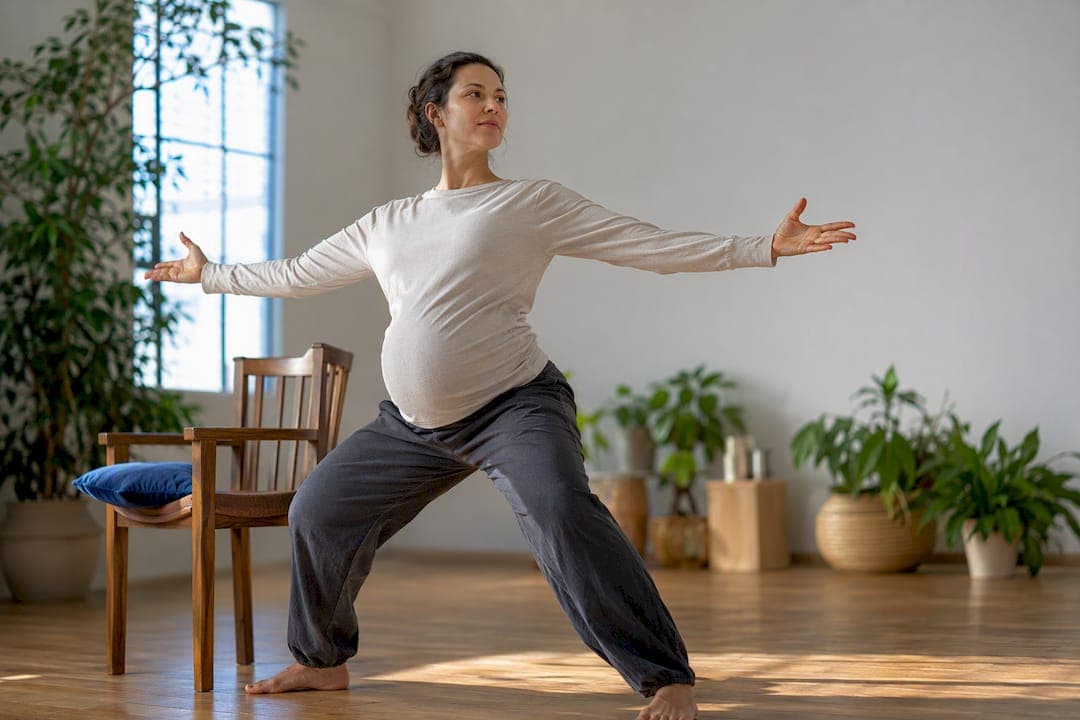
Yes, qigong is generally safe during pregnancy when you adapt the movements and get clearance from your GP or midwife first. Randomized controlled trials on Baduanjin and Sheng Zhen Gong style practice show reduced anxiety and stress with no adverse effects reported in low-risk pregnant groups. If your pregnancy is considered high-risk, or you're new to exercise altogether, talk to your care provider before you begin.
TL;DR:
- Qigong practice, including Baduanjin and Sheng Zhen Gong, is generally safe during low-risk pregnancy when movements are adapted and cleared by a healthcare provider.
- Movements to avoid include deep squats, jumps, vigorous abdominal compression, prolonged lying flat, fast rotational twists, and breath-holding, especially after the 16th week of pregnancy.
- Short, breath-focused sessions of 9 to 15 minutes daily or 20 to 30 minutes three times a week are recommended, with modifications for balance, abdominal pressure, and support.
- Women with high-risk pregnancies or conditions like active bleeding or uncontrolled hypertension should seek medical advice before practicing qigong.
- Larger, multicenter studies are underway to strengthen evidence, but current data supports safety for low-risk pregnancies with appropriate adaptations.
Table of Contents
- Is Qigong Safe During Pregnancy? What the Evidence Actually Shows
- Which Qigong Moves Should You Avoid While Pregnant?
- What Does a Safe Prenatal Qigong Session Look Like?
- When Should You Avoid Qigong or Stop a Session Immediately?
- How Do You Choose a Safe Prenatal Qigong Class?
- How Qigongstar Supports Safe Prenatal Practice
- An Instructor's Honest Take on Prenatal Qigong
- Ready to Practice Qigong Safely During Pregnancy?
- Sources
- FAQ
Is Qigong Safe During Pregnancy? What the Evidence Actually Shows
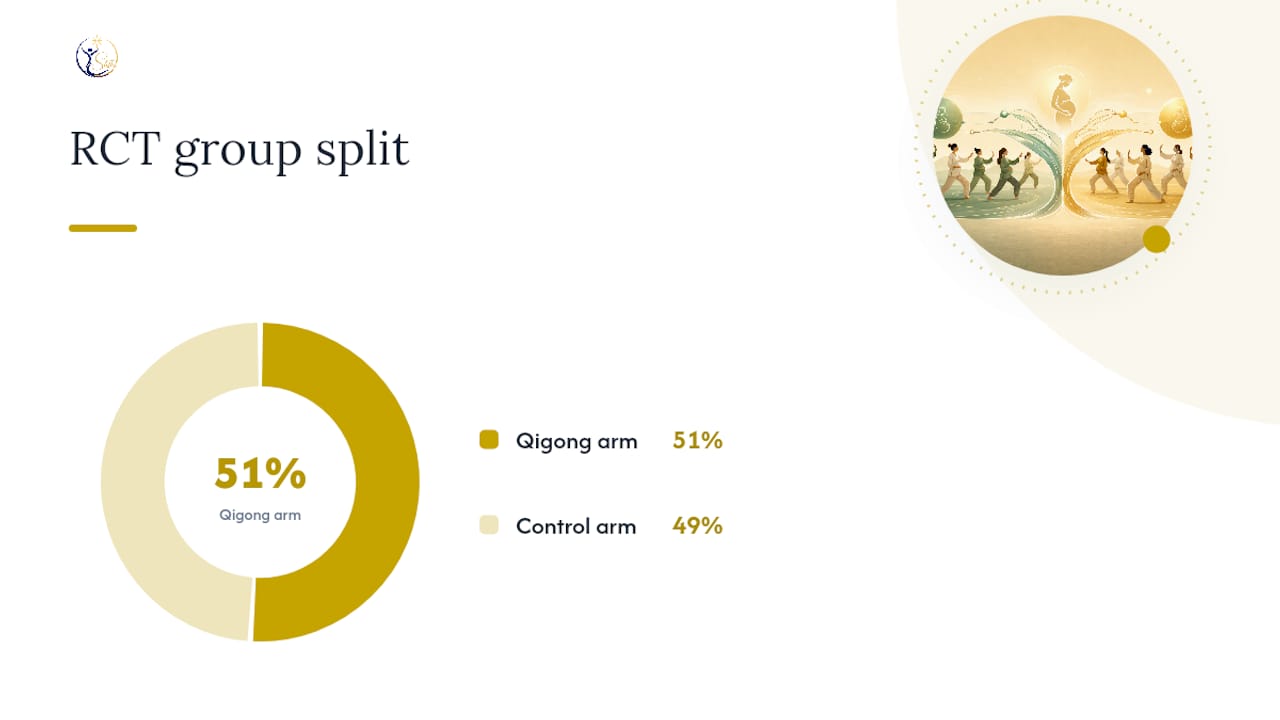
The strongest evidence for qigong safety in pregnancy comes from a multicenter randomized controlled trial involving 102 pregnant women, split into a 52-person qigong group and a 50-person control group that received routine prenatal counseling. Participants in the qigong arm practiced Baduanjin, one of the oldest and gentlest qigong forms, for 30 to 45 minutes, three times a week, starting around the 27th week of pregnancy on average.
The results were notable, not just for what improved but for what didn't happen. Anxiety and stress scores dropped significantly in the qigong group, exercise self-efficacy rose, and blood pressure increases over the study period were smaller than in the control group. No adverse effects were reported among participants doing the qigong practice. The trial's own registration, listed under clinical trial NCT07023978, describes a structure worth understanding: participants received Zoom sessions plus face-to-face training, then continued with home practice while researchers tracked blood pressure, metabolic markers, and validated anxiety and stress scales throughout.
Baduanjin isn't the only form with trial data behind it. A 2025 study in Complementary Therapies in Medicine found that low-intensity qigong reduced pregnancy-related anxiety and stress while producing measurable maternal cardiovascular benefits, with no signs of harm to the fetus. Separately, a randomized trial of Sheng Zhen Gong, a slower, meditative qigong style built around open-hearted breathing patterns, found that regular practice lowered maternal blood pressure and improved well-being in 89 women, with no changes detected in fetal Doppler measurements.
A broader safety review published in Medicine backs up what these smaller trials suggest: qigong is broadly safe when practiced as a low-intensity, adapted mind-body exercise, though the review authors note that study quality and scope still vary quite a bit across the field.
What the numbers tell us, and what they don't:
- 102 women in the flagship Baduanjin trial, with meaningful reductions in anxiety and stress and no adverse events reported
- 89 women in the Sheng Zhen Gong trial showed lower blood pressure and improved well-being with no fetal harm detected
- Every trial mentioned here excluded high-risk pregnancies, so the safety data speaks to low-risk populations specifically
The evidence gap worth knowing about: these trials are still relatively small, geographically concentrated, and none of them include women with complications like preeclampsia, placenta previa, or uncontrolled gestational diabetes. That's exactly why a multicenter RCT protocol is now underway across 11 institutions, planning to enroll 1,062 participants using a modified seated Baduanjin program designed specifically to avoid abdominal compression and deep squats. Larger, more rigorous evidence is coming. For now, what exists points in a reassuring direction for low-risk pregnancies, without claiming to answer every question.
Qigong's benefits for stress and nervous system resilience are well documented outside pregnancy too, which helps explain why researchers keep circling back to it as a candidate for prenatal mental health support.
Which Qigong Moves Should You Avoid While Pregnant?
Not every qigong movement translates safely to a changing body. Standard prenatal exercise guidance is consistent on this point: certain positions and intensities raise the risk of reduced blood flow, excess abdominal pressure, or loss of balance, and they're worth setting aside for the length of your pregnancy.
Movements and positions to avoid:
- Deep squats that push the knees far past the toes or hold a low position for an extended time
- Jumps or any movement involving both feet leaving the ground
- Vigorous abdominal compression, including forward bends that press directly on the belly
- Prolonged lying flat on your back, especially past the middle of pregnancy
- Intense dynamic torso twisting, particularly fast rotational movements
- Breath-holding or straining, sometimes called "bearing down," during any pose
Each of these carries a specific reason for concern. Deep squats and jumps strain joints already loosened by relaxin, the hormone that softens ligaments in preparation for birth. Lying flat on your back for long stretches can compress the vena cava, the large vein returning blood to your heart, which is why supported standing positions tend to replace floor work as pregnancy progresses. Breath-holding raises intra-abdominal pressure in a way that gentle, breath-first qigong is specifically designed to avoid.
The good news: qigong adapts unusually well. Most forms can be modified into seated or supported standing versions without losing their calming, breath-centered quality. Smaller ranges of motion still deliver the circulation and stress-relief benefits; you're simply trading amplitude for stability. Isometric holds that would otherwise engage the core hard should be softened or skipped, replaced by longer, slower breath cycles instead.
Trimester timing matters here too. Early pregnancy generally allows more movement variety, since balance and abdominal pressure are less of a concern. After roughly 16 weeks, most instructors shift students toward chair-based or supported standing sequences, both to protect balance as your center of gravity moves forward and to sidestep vena cava compression from any reclined positions.
Pro Tip: If a movement asks you to hold your breath, brace your abdomen, or drop into a deep bend, pause and ask your instructor for the seated or standing alternative. A qualified prenatal instructor should offer one without you having to ask twice.
Keep sessions short and consistent rather than long and intense. A 15-minute daily practice beats an occasional hour-long class for both safety and sustainability. And always stop if you notice dizziness, unusual shortness of breath, or any of the warning signs covered further down this article.
What Does a Safe Prenatal Qigong Session Look Like?
A well-built prenatal qigong session follows a simple shape: gentle warm-up, breath-centered core practice, and a quiet closing. You don't need an hour to get the benefit. Research on Baduanjin-style programs suggests sessions as short as 9 to 15 minutes daily can be just as valuable as longer, less frequent ones, and often safer for a body managing new demands.
A sample structure to follow:
- Warm-up (2 to 3 minutes): gentle shoulder rolls, ankle circles, and slow neck stretches to ease into movement without strain
- Core practice (5 to 8 minutes): breath-synchronized arm patterns and torso-lengthening movements, seated or in supported standing
- Closing (2 to 4 minutes): a seated meditation focused on slow, even breathing to settle the nervous system before you return to your day
Two session templates that work well for most low-risk pregnancies:
- A short daily practice of 9 to 15 minutes, ideal for busy days or later trimesters when stamina runs lower
- A longer session of 20 to 30 minutes, three times a week, for days when you're feeling energized and want a fuller practice
Pay attention to how your body responds rather than chasing a fixed intensity target. A simple gauge: you should be able to hold a conversation comfortably throughout the entire session. If you're breathless, lightheaded, or noticing unusual swelling afterward, scale back the next session and mention it to your midwife.
Breath-first pacing is what separates qigong from more cardio-driven prenatal workouts, and it's worth leaning into that difference rather than pushing for a harder version of the practice. A short daily breathing routine built around slow counts can anchor your practice even on days when full movement doesn't feel right.
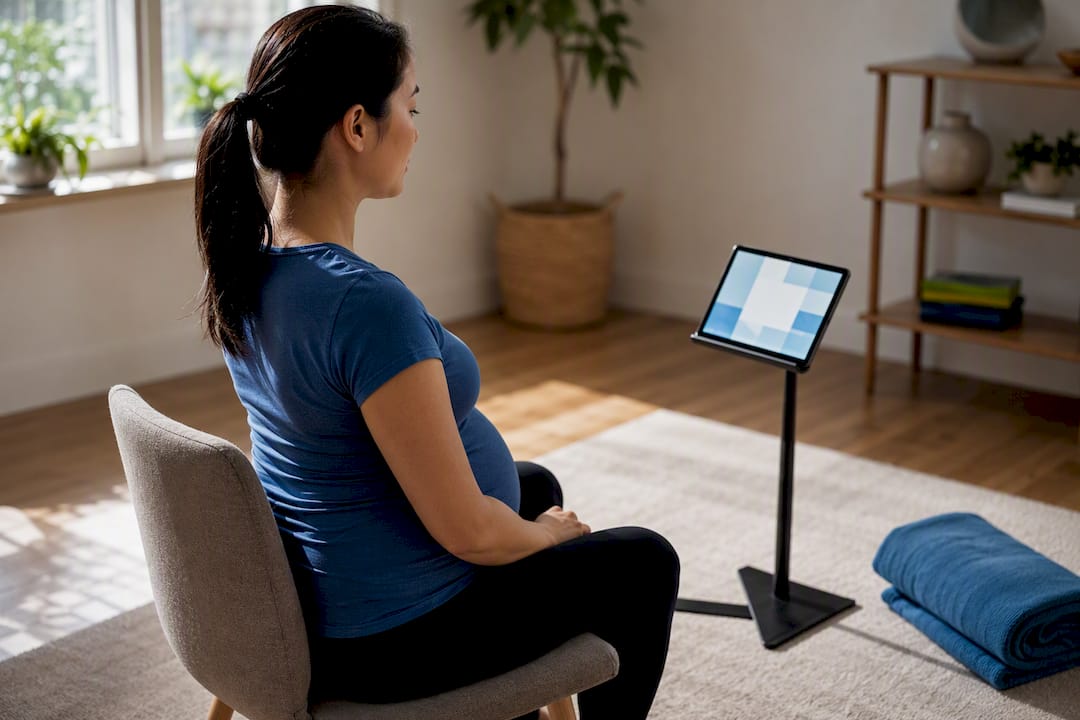
If you're following an online class, don't treat the video as a script you must complete exactly as shown. Pause when you need to, swap in a seated variant for any standing sequence that feels unstable, and don't hesitate to message an instructor for prenatal-specific modifications before your first session. A recorded class filmed for a general audience wasn't necessarily built with your third trimester in mind, and a quick question beforehand solves that.
When Should You Avoid Qigong or Stop a Session Immediately?
Every qigong trial reviewed here excluded high-risk pregnancies from participation, which is an important boundary. Safety data for low-intensity qigong applies to low-risk pregnancies specifically, not universally.
Conditions where you should get clearance before starting any qigong practice:
- Active vaginal bleeding or a history of bleeding in the current pregnancy
- Cervical insufficiency or a cervical cerclage in place
- Threatened miscarriage or preterm rupture of membranes
- Severe or uncontrolled high blood pressure
- Uncontrolled gestational or pre-existing diabetes
- Serious cardiac disease or a history of heart complications
If any of these apply to you, this doesn't necessarily rule out qigong forever. It means the decision belongs with your GP or midwife, who can weigh your specific case against what gentle movement might offer or complicate. Full contraindication details are worth reviewing on their own, and Qigongstar's contraindications guide breaks these down in more depth if you want a fuller picture before your first session.
Stop practicing immediately and contact your midwife, GP, or emergency services if you experience:
- Vaginal bleeding of any amount
- Chest pain or unusual heart palpitations
- Severe abdominal pain
- Dizziness, faintness, or a sudden headache
- Noticeably reduced fetal movement compared to normal
None of these signs should be pushed through or waited out until your next class. Stop, rest, and get in touch with your care provider the same way you would for any other pregnancy symptom. A qigong session can always resume another day; a warning sign shouldn't be ignored to finish one.
How Do You Choose a Safe Prenatal Qigong Class?
Not every qigong instructor has trained specifically for pregnancy, and that gap matters more than it might seem. A class built for general stress relief isn't automatically wrong for pregnancy, but it needs someone at the front of the room who knows the difference.
What to ask before you book a class or session:
- "Do you teach prenatal adaptations, or can you offer them if I ask?"
- "Have you worked with high-risk pregnancies, and how did you modify practice?"
- "Can I try a single session first before committing to a full course?"
What to look for beyond the answers themselves:
- Whether the instructor asks about your pregnancy status and any complications before class starts, not after
- A class size small enough that an instructor can actually watch for signs of fatigue or discomfort
- Clear emergency procedures in case something feels wrong mid-session
- A stated willingness to offer seated or supported-standing alternatives without you having to insist
Pro Tip: A genuinely prenatal-aware instructor will usually mention modifications before you even ask. If a class description doesn't mention pregnancy at all, that silence is worth a direct question before you sign up.
Online classes deserve a slightly different filter. Remote sessions can work well for prenatal qigong, especially in later trimesters when travel feels harder, but you lose the instructor's ability to watch your form in real time. Look for online options that include a visible seated variant, frequent "pause if you need to" cues, and a way to message the instructor directly with questions about your specific stage of pregnancy. In-person classes still offer an edge for anyone managing balance concerns or a higher-risk pregnancy that benefits from closer supervision.
How Qigongstar Supports Safe Prenatal Practice
The course library was built around the principle that gentle, breath-regulated movement should be accessible without guesswork, and that includes pregnant students navigating what's safe for their stage. The platform offers qigong programs rooted in Chinese medicine, alongside live virtual classes, on-demand modules, and one-to-one coaching for anyone who wants individualized modifications rather than a one-size-fits-all sequence.
What maps well to prenatal needs on the platform:
- On-demand modules you can pause, repeat, or scale down on lower-energy days
- Live classes where you can ask real-time questions about modifications
- One-to-one coaching sessions for pregnancy-specific adaptations beyond what a group class allows
- Instructors certified through the White Tiger Qigong School and Yoga Alliance, a certification pairing that reflects both traditional lineage training and recognized instructional standards
If you're pregnant and exploring the platform, look specifically for gentler, breath-focused modules rather than higher-intensity sequences, and consider requesting one-to-one adaptations if a group class doesn't offer the seated or supported-standing option you need. Short, consistent daily sessions, even just 10 to 15 minutes, tend to serve pregnant practitioners better than infrequent long ones.
An Instructor's Honest Take on Prenatal Qigong
Years of teaching gentle qigong to beginners and stressed-out wellness clients has shown me one consistent pattern: people either overestimate the risk of movement or underestimate how much a few smart adjustments change everything. Pregnancy amplifies both tendencies. The research backs a middle path: qigong, done gently and adapted honestly, is one of the calmer options available to a body under new pressure.
None of that replaces your GP or midwife's judgment about your specific pregnancy. If you're cleared for gentle movement, breath-based practice is worth trying, not because it's trendy, but because slowing the breath is one of the few things a tired, changing body can do without strain.
— Stella
Ready to Practice Qigong Safely During Pregnancy?
Both Five Animal Qigong and White Tiger Qigong were designed around gentle, breath-first movement, making them suitable starting points for pregnancy compared to higher-intensity fitness formats built for a general audience. Rather than guessing which YouTube sequence is safe to modify on your own, you get structured programs where the pacing is slow and movements avoid jumps, deep squats, or held abdominal bracing.
To find a prenatal-friendly starting point on the site, look for modules described as gentle or breath-focused within either course, and message an instructor directly if you want a seated variant confirmed before you begin. Both formats are available on-demand or live, so you can choose whichever fits your energy that week. If you'd rather start with individualized guidance, book a private session or explore the Five Animal Qigong course to request pregnancy-specific modifications from the start, or check the White Tiger Qigong course page if you prefer a more structured, instructor-backed format. And once you're planning for the postpartum stretch too, this postpartum self-care guide is a useful companion for what comes after.
This article is general information, not a substitute for advice from a qualified doctor. Consult a qualified healthcare professional about your own circumstances before acting on anything here.
Sources
- Effects of qigong for physical and psychological well-being in pregnancy: A multicenter randomized controlled trial
- Effects of qigong for physical and psychological well-being in pregnancy (CTIM, 2025)
- The adjunctive effect of a qigong (Baduanjin) intervention program on maternal and child health outcomes: a multicenter randomized controlled trial protocol
- Sheng Zhen Gong in pregnancy: The effects of a traditional low intensity exercise form on maternofetal health and wellbeing
FAQ
Is It Safe to Do Qigong During Pregnancy?
Yes, for most low-risk pregnancies, gentle qigong practiced with proper modifications is safe and shows benefits like reduced anxiety in randomized controlled trials. Get clearance from your GP or midwife first, especially if this is your first time exercising regularly.
What Exercises Should Be Avoided During Pregnancy?
Avoid deep squats, jumps, vigorous abdominal compression, prolonged lying flat on your back, intense torso twisting, and breath-holding during exertion. These raise the risk of reduced blood flow, joint strain, or excess abdominal pressure.
Who Should Not Practice Qigong During Pregnancy?
Women with active vaginal bleeding, cervical insufficiency, threatened miscarriage, severe uncontrolled high blood pressure, uncontrolled diabetes, or serious cardiac disease should get direct clearance from their care provider before starting, since these conditions were excluded from safety trials.
What Chinese Herbs Should I Avoid When Pregnant?
Many traditional Chinese herbs, including certain blood-moving or strongly warming formulas, aren't recommended during pregnancy without guidance from a qualified practitioner. Qigong itself involves movement and breath rather than herbal substances, but always check with your GP or midwife before combining any herbal approach with your prenatal care.
Can Pregnant Women Do Qigong Every Day?
Yes, short daily sessions of 9 to 15 minutes are often safer and more sustainable than infrequent long sessions, based on protocols used in current prenatal qigong trials. Listen to your energy levels and scale back on harder days.