
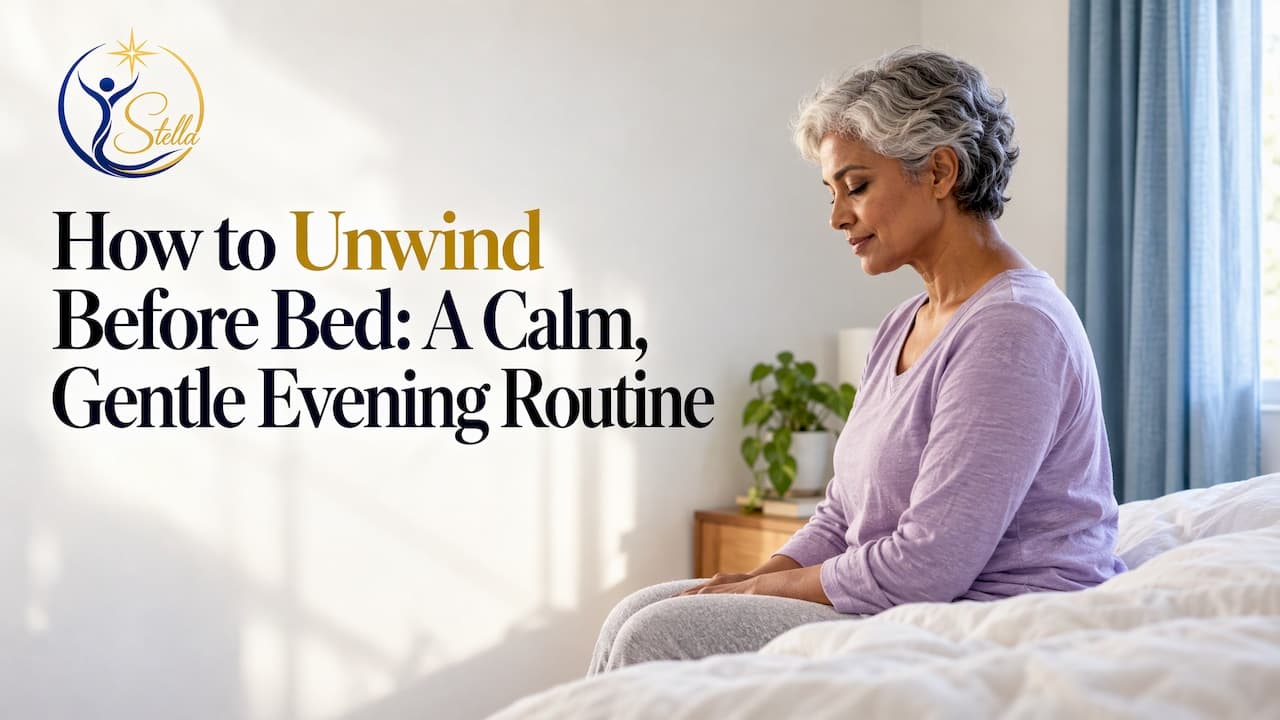
The best way to unwind before bed is to give your body a predictable, quiet hour in which it can switch from doing to resting. Dim the lights, put the screens away, slow your breathing and add a few minutes of gentle movement or writing to clear your head. None of it needs to be elaborate. What matters is repeating the same calm sequence most nights, so your nervous system learns the signal.
Below you will find the habits worth keeping, a step-by-step evening routine, breathing methods you can try in bed, and a short qigong sequence we teach for exactly this moment of the day.
Key Takeaways
- Start winding down an hour or two before bed, and keep the order of your evening roughly the same each night.
- Slow breathing, gentle stretching and writing down tomorrow's to-do list are simple, low-cost ways to soothe a busy mind.
- Heavy meals, alcohol, caffeine and bright screens late in the evening can all work against you.
- If you are not drifting off, get up and do something quiet rather than lying there frustrated.
- Slow, mindful qigong movements make a natural bridge between a busy day and a restful night.
Why Your Body Needs a Wind-Down
Most of us expect to go from emails, dinner and the news straight into deep sleep. The body rarely works that way. Stress, light and stimulation keep the system alert, and it takes time to let that alertness ease.
Adults need at least seven hours of sleep a night, according to CDC guidance on getting enough sleep. Reaching that number is much easier when the hour before bed is gentle rather than rushed. A wind-down is not a luxury. It is the bridge between the day you had and the night you want.
The same logic applies to people who feel wired and tired at once, which is common with long working days or burnout. If that sounds like you, our guide to calm routines for unwinding after work is a good companion to this article, because a better evening often begins at the end of the working day.
Three Jobs of a Good Evening Routine
It helps to think of an evening routine as doing three things. One sleep-focused physician, speaking on a podcast in 2026, describes them as setting the clock through consistency, lowering arousal so the nervous system can downshift, and protecting the sleep environment.
That gives you a useful way to build your own routine:
- Set the clock. Go to bed and get up at roughly the same times. NIOSH sleep guidance notes that sleeping at about the same times every day helps improve sleep.
- Lower the volume. Choose activities that slow your body: breathing, stretching, warm water, quiet music, writing.
- Protect the room. Make your bedroom a place that invites rest, not one that competes for your attention.
Every idea in this article fits one of those three jobs. If you only have energy for one, pick the one that feels easiest and build from there.
A Simple Wind-Down Timeline
You do not need a perfect schedule. Here is a gentle framework you can adapt to your own bedtime.
| When | What to do | Why it helps |
|---|---|---|
| 2 to 3 hours before bed | Finish your last big meal, and stop caffeine and alcohol | Heavy meals and stimulants can keep the body busy |
| About 2 hours before | Close the laptop and wrap up work | Gives your mind time to leave the day behind |
| About 1 hour before | Switch off screens, dim the lights, start your routine | Reduces light and stimulation |
| 30 to 45 minutes before | Warm bath or shower, gentle movement, breathing | Eases tension in the body |
| 10 minutes before | Write a to-do list or a few lines of thanks, then lights out | Clears your mind so it stops rehearsing tomorrow |
This is a close cousin of the viral "3-2-1" idea, which we look at next.
What the 3-2-1 method means
The 3-2-1 method is a countdown rule that went viral on social media. Three hours before bed, you stop big meals, lots of liquids and alcohol. Two hours before bed, you stop work. One hour before bed, you stop looking at screens.

It is a handy memory aid rather than a medical protocol, and we would treat it as a template. If your schedule makes three hours unrealistic, shrink the gaps but keep the order. A quiet final hour is the part most people feel the difference from.
Step One: Make Your Evening Meal and Drinks Work for You
What you eat and drink in the evening shapes how settled you feel at night. NIOSH guidance advises avoiding heavy or spicy meals two to three hours before bed, and avoiding caffeine, nicotine, alcohol and other stimulants close to bedtime. Caffeine can stay active in your body for five hours or more, so a late-afternoon coffee may still be with you at bedtime.
Alcohol deserves a special mention. It can feel relaxing in the moment, but the CDC lists alcohol among the things that disrupt sleep. If you want a warm drink in the evening, a caffeine-free herbal tea is a comforting ritual, and the act of making and sipping it slowly is part of the calm.
If digestion is your sticking point, eating earlier and more lightly can help, and so can gentle abdominal movement. We come back to that in the qigong section below.
Step Two: Put Down the Day
A racing mind is the most common reason people struggle to unwind. Two simple tools are well supported.
Write it out
The Sleep Foundation suggests journaling to write down thoughts and worries before bed. A practical version takes five minutes:
- Write every task you are afraid of forgetting for tomorrow.
- Next to each, add one small first step, or simply "later".
- Close the notebook and leave it outside the bedroom if you can.
The point is to give your mind permission to stop holding the list.
Observe your thoughts
The same source mentions mindfulness meditation, which means watching thoughts come and go without judging them. Sit comfortably, breathe naturally and, when a thought appears, silently say "thinking" and return to the feeling of your breath. You will wander off many times. Returning is the practice.
Step Three: Breathe Your Way Down
Slow breathing is the quickest wind-down tool you carry with you. The Sleep Foundation describes diaphragmatic breathing, 4-7-8 breathing and progressive muscle relaxation among its relaxation methods for sleep.
Belly breathing
Rest one hand on your lower abdomen. Breathe in through the nose so the belly rises gently, then let it fall as you breathe out slowly. Aim for an exhale that is a little longer than the inhale. Continue for three to five minutes.
4-7-8 breathing
Breathe in through your nose for four seconds, hold for seven, and breathe out through your mouth for eight, as described by the Sleep Foundation. Start with a few rounds only. If holding the breath feels uncomfortable, shorten every count proportionally and keep the long exhale.
Progressive muscle relaxation
Starting at your feet, tense a muscle group for a few seconds, then release and notice the difference. Work upwards through calves, thighs, belly, hands, shoulders and face. It is especially kind to people who carry tension in their jaw and shoulders.
If you tend to feel anxious when you focus on your breath, begin with a slow exhale only and let the inhale take care of itself. Our piece on slowing the exhale first walks through that approach, and our guide to qigong breathing for beginners shows how to build it into movement.
Step Four: Add Gentle Movement
Top-ranking guides often suggest light yoga or stretching, and the CDC's sleep guide also includes stretching and a warm bath or shower among wind-down ideas. The aim is not exercise. It is to melt away the stiffness of sitting and let your attention settle into the body.
Good evening movement is:
- slow enough that you could chat while doing it
- low impact, with no jumping or strain
- paired with the breath
- finished at least half an hour before lights out, so you cool down
This is where qigong fits in beautifully.
A Ten-Minute Evening Qigong Sequence
Qigong is a Chinese mind-body practice that links slow movement, breath and attention. It suits evenings because nothing in it asks you to push. The sequence below is a gentle starting point; you can do it standing or seated.
- Settle (1 minute). Stand with feet hip-width apart, knees soft, arms hanging. Let your shoulders drop. Take three slow breaths.
- Lifting and lowering (3 minutes). As you breathe in, float your hands up in front of you to chest height, palms facing down. As you breathe out, press them softly down to your lower abdomen, bending the knees slightly. Imagine the day sinking down through your feet.
- Opening the chest (2 minutes). On the inhale, draw your arms out to the sides like opening a book; on the exhale, bring them back together. Keep the neck long and the jaw loose.
- Gentle waist turns (2 minutes). Let your arms swing loosely as you rotate from side to side, like a soft rattle drum. Keep the movement small and unforced.
- Warm hands on the belly (2 minutes). Rub your palms together until warm, rest them on your lower abdomen, close your eyes and breathe slowly. Stay as long as it feels pleasant.
If standing is tiring, our seven-minute seated qigong routine gives you the same calm in a chair. For a fuller walk-through, try the 10-minute evening qigong for beginners, and if sleep is your main concern, see our article on qigong for sleep.
Our Perspective on Evening Calm
When people tell us they cannot switch off at night, they rarely lack information. They know about screens and caffeine. What they lack is a way of arriving in the body after a day spent mostly in the head.
That is why we teach slow, flowing movement joined to the breath. It gives a busy mind something gentle and absorbing to follow, and it lets the body release deep-held tension before you ever lie down. In our classes, the White Tiger Qigong and Five Animal Qigong traditions both emphasise soft, unhurried practice, and our instruction is led by a White Tiger Qigong Level 3 certified teacher who is also accredited by Yoga Alliance.
We design our programmes for people living modern, demanding lives: stress, burnout and digestive unease are the themes we hear most. A few mindful minutes each evening, repeated patiently, can become a quiet anchor. You do not have to be flexible, fit or experienced. You only have to begin.
Stella
Step Five: Prepare the Room
The third job of an evening routine is protecting the place where you sleep. The Sleep Foundation says a quiet, dark and comfortably cool sleep environment free of distractions is essential for avoiding sleep disruption.
A few practical touches:
- Lower the main lights an hour before bed and use warm lamps instead.
- Keep the room cool, and add an extra blanket rather than turning the heating up.
- Use curtains or an eye mask to block street light.
- Charge your phone across the room, not by the pillow.
- Some people like a dim, warm glow in the evening; if you are curious, this overview of dim red light for sleep sessions explains how it is used.
NIOSH also advises avoiding light from television and electronics as you prepare for bed, which is why the screen-free hour matters so much.
If You Are Still Awake
Even with a lovely routine, some nights stay stubbornly alert. The CDC's guidance is straightforward: if you do not think you will fall asleep soon, get out of bed and do something relaxing for a while. Read a few pages of a quiet book, listen to soft music or practise a few slow breaths in a dim room, then return when you feel drowsy.

Watching the clock tends to make things worse, so turn it away. Try not to treat a poor night as a failure. One restless night does not undo a good habit.
If difficulty sleeping becomes a regular pattern lasting weeks, speak to your GP. The American Academy of Sleep Medicine conditionally suggests relaxation therapy as a single-component treatment for chronic insomnia in adults, which shows relaxation methods are taken seriously, but a clinician can look at the whole picture and rule out other causes.
Building a Routine That Lasts
The best routine is the one you will actually do. Try this approach:
- Start with two habits. For example, a screen-free half hour and five minutes of belly breathing.
- Anchor them to something you already do, such as brushing your teeth.
- Keep the same order each night. Familiarity is part of the signal.
- Expect a couple of weeks before it feels natural, and be kind when you miss a night.
- Add one new element at a time, such as the qigong sequence above.
If you would like more ideas for weaving this into daily life, our guides to building a mind-body routine that lasts and practising mind-body medicine at home are a good next step, as is our overview of relaxation techniques without therapy.
Learn Evening Qigong With Guidance
Learning from a person is different from reading about it. In a session you receive feedback on posture, pacing and breath, and a routine shaped around your own stress, sleep or digestion. We offer a self-paced course, Qigong for Stress Relief and Digestive Wellness, at £116, as well as one-to-one sessions: a 30-Min Clarity Session at £85, a 60-Min Deep Dive Online Session at £145 and a 60-Min Face-to-Face Qigong session at £165. Group classes are also available, and you can see everything on our online qigong classes page.
If you are drawn to a particular tradition, you can explore White Tiger Qigong or our Five Animal Qigong course. Both are gentle and beginner-friendly, and you can start at your own pace.
FAQ
How long before bed should I start winding down?
An hour is a good place to begin, and the CDC's sleep guide says a wind-down routine can start a couple of hours before bedtime. Use the first part for finishing work and meals, and the last part for quiet activities. If your evenings are tight, even twenty minutes of slow breathing and dim light is worthwhile.
What is the 3-2-1 method for sleep?
It is a popular countdown rule: stop big meals, lots of liquids and alcohol three hours before bed, stop work two hours before, and stop screens one hour before, as reported by Bustle. Treat it as a flexible guide rather than a strict rule. Adjust the timings to your own bedtime.
Can qigong help me unwind before bed?
Many people find slow, breath-led movement a soothing way to end the day, because it gives the mind something calm to follow. A short sequence of ten minutes or less, done at least half an hour before bed, is enough to start. It is a relaxation practice, not a treatment, so see your GP if sleep problems persist.
What should I avoid in the evening?
Avoid caffeine, nicotine and alcohol close to bedtime, and avoid heavy or spicy meals two to three hours before bed, in line with NIOSH advice. Bright screens are also best put away for the final hour. Small swaps, such as herbal tea instead of coffee, make this easy.
What if my mind keeps racing in bed?
Write your worries and tomorrow's tasks on paper before bed, then practise slow belly breathing or a body scan. If you still feel wide awake, get up and do something quiet in low light until you feel sleepy. Return to bed when you are drowsy.
Sources
- CDC: Do You Get Enough Sleep?
- CDC: Participant Guide, Get Enough Sleep
- NIOSH: Quick Sleep Tips for Truck Drivers
- CDC: Monthly Safety Blast
- Sleep Foundation: Relaxation Exercises for Sleep
- Sleep Foundation: How to Relieve Stress Before Bed
- AASM: Behavioral and Psychological Treatments for Chronic Insomnia
- Fit Father Project: Evening routine for better sleep
- Bustle: The 3-2-1 sleep method
- Dim red light for sleep sessions