
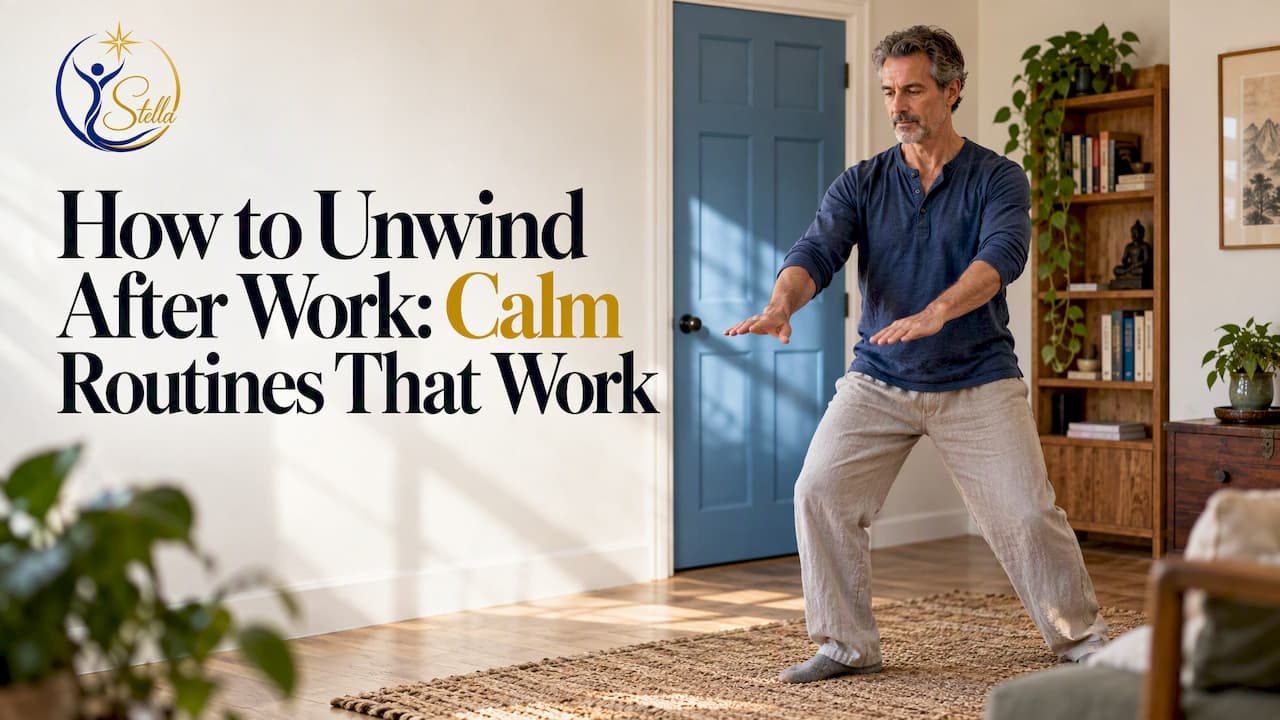
To unwind after work, you need a clear, gentle signal to your body that the working day has ended. Close the laptop, change your surroundings, slow your breathing, move softly and give your mind something ordinary and pleasant to rest on. This guide shows you how, step by step, with simple practices you can do in 5 to 20 minutes, including a few qigong movements that melt away the tension of a long day.
Key takeaways
- Switching off is a skill, not a switch. A deliberate transition between work and home helps your body stop preparing for the next demand.
- Slow breathing, gentle stretching and a short walk are active ways to relax, and they tend to work better than collapsing in front of a screen.
- Small rituals repeated daily beat one big weekend reset. Ten calm minutes at the same time each evening is enough to begin.
- If stress or anxiety keeps following you home and your own efforts are not helping, speak to your GP.
- Qigong combines slow movement, breath and attention in one practice, which makes it a natural fit for the end of the working day.
Table of Contents
- Why it is so hard to switch off after work
- Build a transition ritual first
- Slow breathing: the quickest way to soften
- Release the day from your body
- Why moving relaxation often beats the sofa
- Ordinary pleasures that create distance
- A ten-minute qigong wind-down
- Our perspective: unwinding is something you practise
- Learn to unwind with guidance
- Make it stick: a simple weekly plan
- When stress needs more than a good routine
- FAQ
- Sources
Why it is so hard to switch off after work
You finish at 5.30pm, yet your mind is still answering an email from 3pm. That is very common, and it is not a personal failing.
The European Agency for Safety and Health at Work describes psychological detachment as feeling mentally away from the work situation. When you detach, you replenish the resources your job has used up, and that supports your health, wellbeing and performance. The same overview explains that a transition between your work role and your non-work role helps: once job demands stop, the systems that met them do not need to stay so activated, so strain eases and recovery can begin.
The things that get in the way are familiar:
- Rumination, replaying a difficult conversation or rehearsing tomorrow's tasks.
- Work that follows you home through your phone, messages and notifications.
- Home working, where the desk, the sofa and the kitchen are all within a few steps of each other.
- A body still holding the posture of the day: shoulders lifted, jaw set, breath shallow.
The good news is that you can work with all four. You do not need to change your job to feel the difference. You need a short, repeatable bridge between the two halves of your day.
Build a transition ritual first
Before you try any relaxation technique, mark the end of work. A ritual does the job your commute used to do, even if your commute is now twelve steps from bedroom to spare room.
Try this five-part bridge:
- Close the loop. Write tomorrow's top three tasks on paper. The list holds them so your mind does not have to.
- Silence the work channels. Switch off work email and chat notifications, or move the work apps off your home screen.
- Change the scene. Step outside for a few minutes, or at least move to another room. If you work from home, put the laptop out of sight.
- Change your clothes or your shoes. A small physical change tells the body that a different role is beginning.
- Take three slow breaths. Let the out-breath be longer than the in-breath, and let your shoulders drop as you exhale.
The whole bridge takes under ten minutes. Keep it the same each day: repetition is what turns a set of actions into a cue your nervous system recognises.
Slow breathing: the quickest way to soften
Breath is the one part of your stress response you can reach directly. Several trusted health bodies describe very similar methods, so you can choose the one that feels kindest.
Abdominal breathing for three minutes
University of California, Berkeley's University Health Services suggests abdominal breathing: one hand on your chest, one on your belly, and 6 to 10 deep, slow breaths per minute for three minutes. Your lower hand should rise more than your upper one.
Slow breathing with a soft exhale
Harvard Health Publishing describes a slow, deep, regular breathing pattern that resembles how you breathe when relaxed. Breathe slowly into your abdomen, briefly hold, then exhale slowly while thinking the word "relax". Repeat five to ten times.
Slow rhythmic breathing with muscle release
The U.S. National Institutes of Health describes slow rhythmic breathing at about 9 to 12 breaths per minute, relaxing your muscles as you exhale, for up to 10 minutes. If you are new to this kind of practice, NIH says beginners can start with just 5 to 10 minutes in a quiet, comfortable place.
A few gentle cautions from Health New Zealand are worth knowing. They explain that over-breathing when anxious can cause dizziness, light-headedness, breathlessness, a faster heart rate, or numbness and tingling. So keep your breath soft and unforced, preferably through the nose, and pause briefly after each exhale. If you feel dizzy, return to normal breathing and let it settle.
Release the day from your body
Tension collects in predictable places: the neck, shoulders, jaw, hips and lower back. Two simple methods help you let it go.
Progressive muscle relaxation
Mayo Clinic describes progressive muscle relaxation as slowly tensing and then relaxing each muscle group. One approach tenses a group for about five seconds, relaxes it for 30 seconds, and repeats, working from the toes upward or from the head downward. Lying on your bed or sitting in a supportive chair both work well.

Stretch breaks
Berkeley's health service notes that stretch breaks can increase circulation and reduce tension and discomfort. Keep every stretch comfortable, and stop immediately if anything hurts. You are looking for a pleasant, spreading sensation, never a strain.
If you carry a lot of tightness from desk work or physical labour, hands-on care can also be part of your recovery. Some people find that massage therapy for recovery helps them wind down when tight muscles are part of the picture.
Why moving relaxation often beats the sofa
It is tempting to collapse in front of the television. There is nothing wrong with that now and then, but University of Michigan's PainGuide points out that passive activities such as lying on a couch or watching television may not trigger the relaxation response. Active relaxation, including deep breathing, teaches your body to relax more fully and on command.
The same guide suggests that if sitting still makes you more anxious, moving relaxation is a good alternative. That is helpful if your mind races the moment you stop. Giving your body something slow to do, such as a walk or a flowing movement sequence, often settles the mind more gently than being told to "just relax".
The UK charity Mind recommends gentle physical activity such as walking at your own pace, yoga, Pilates, gentle stretching or seated exercises. Mind adds that even a few minutes of walking may help you relax. You do not need a gym session or a run. A slow ten-minute loop around the block, phone left behind, is a perfectly good start.
Ordinary pleasures that create distance
Not every way to unwind has to be a technique. The research on recovery is encouraging about everyday life. The EU-OSHA overview says non-work time that is protected from work is valuable, and that leisure which is sociable, low-effort or physically active, such as hobbies or time with family or friends, supports recovery.

Mind notes that short breaks from stressful situations can give enough space and distance to feel calmer. Its examples are wonderfully ordinary: reading, watching a film, playing with a pet or trying a new recipe.
Here is a simple way to choose, depending on how you feel when you walk in the door:
| How you feel | What helps | Time |
|---|---|---|
| Wired and buzzing | Slow breathing, then a gentle walk | 10 to 15 minutes |
| Tight and achy | Progressive muscle relaxation or soft stretching | 10 minutes |
| Mentally flooded | Write tomorrow's list, then cook or read | 15 to 20 minutes |
| Flat and lonely | A call or a meal with someone you like | As long as you wish |
| Restless when still | Flowing movement such as qigong | 10 to 20 minutes |
A ten-minute qigong wind-down
Qigong is a gentle Chinese mind-body practice that brings together slow movement, breath and attention. It is a lovely example of the moving relaxation described above, because your mind has a simple, soothing task: follow the breath, follow the movement.
Here is a short sequence you can try after work. Stand with your feet hip-width apart and your knees softly bent. Move slowly, and never push into discomfort.
- Settle (1 minute). Let your arms hang. Close your eyes if that feels comfortable. Breathe in through the nose, and let the out-breath be long and quiet.
- Lifting and lowering the arms (2 minutes). As you inhale, float your hands up in front of you to chest height, palms down. As you exhale, bend your knees slightly and press your palms gently towards the floor. Imagine pressing the day downwards and away.
- Opening the chest (2 minutes). Inhale and draw your arms out to the sides as though opening a large door. Exhale and bring your hands together in front of your heart. Let your shoulders soften each time.
- Gentle waist turns (2 minutes). Let your arms swing loosely as you turn from side to side, like a soft rattle drum. Keep your knees relaxed and your jaw loose.
- Shaking out (1 minute). Shake your hands, arms and legs lightly, as if shaking off water.
- Stand in stillness (2 minutes). Place both hands on your lower belly. Breathe naturally. Notice the warmth under your palms and the quiet after movement.
If you have a joint condition, are pregnant, or have any medical concern, check with your GP or physiotherapist before beginning a new movement practice, and stay within comfortable ranges. You can find more detail in our guides on a daily qigong routine for stress reduction and relaxation techniques without therapy.
Our perspective: unwinding is something you practise
We teach qigong to people who arrive carrying a great deal: long hours, digital overload, a tight stomach, a mind that will not settle. Many of them say the same thing at the start: "I do not know how to relax."
What we have found is that relaxation is not something you force. It is something you invite, a little at a time, by giving the body a slow rhythm to follow. In Chinese medicine, stress and digestion are closely connected, and many people feel the day in their gut before they notice it in their thoughts. That is why our teaching joins gentle movement with breath, rather than treating the mind alone.
Three things matter most in our experience:
- Consistency over intensity. Ten minutes most evenings changes more than one long session a month.
- Comfort first. If a movement hurts or a breath feels strained, make it smaller. Qigong should leave you feeling nurtured, never depleted.
- Support when you need it. A teacher who can see how you move and adjust the practice to you makes the early weeks much easier.
All of our instruction comes from a White Tiger Qigong Level 3 certified instructor who is also accredited by Yoga Alliance, with a background in wellness and digital communications. That mix means we understand the modern, screen-heavy working day as well as the traditional practice.
— Stella
Learn to unwind with guidance
If you would like a structured way to let go of the working day, we offer qigong designed for stress relief and digestive wellness, online and in person.
- Qigong for Stress Relief and Digestive Wellness: a self-paced online course for £116, one-off.
- 30-Min Clarity Session: a focused one-to-one session for £85.
- 60-Min Deep Dive Online Session: a longer personal session for £145.
- 60-Min Face-to-Face Qigong: an in-person session for £165.
- Group Qigong Classes: a shared, supportive way to practise; see the page for details.
You can see everything and choose what suits you on our online qigong classes page. If you are drawn to animal-inspired flowing movement, our Five Animal Qigong course is another gentle place to begin.
Prefer to read first? Our guides on natural remedies for stress without medication and building stress resilience with qigong are good companions.
Make it stick: a simple weekly plan
Habits last when they are small and easy to repeat. Try this for two weeks and adjust:
- Monday to Friday: the five-part transition ritual, followed by three minutes of abdominal breathing.
- Two evenings: the ten-minute qigong wind-down, or a slow walk.
- One evening: something sociable and low-effort, such as a meal with a friend or a call.
- Weekend: one longer pleasure of your choice, such as cooking, gardening, reading or time outdoors.
Notice what changes. Perhaps you fall asleep a little faster, or you stop checking your phone at the table. Keep what helps and drop what does not. There is no perfect routine, only one that you will actually come back to.
When stress needs more than a good routine
Self-care has limits, and it is wise to know them. The NHS advises seeing a GP if you are struggling to cope with anxiety, if the things you are trying yourself are not helping, or if you would prefer a GP referral to an NHS talking therapies service. It also asks you not to self-diagnose, and to speak to a GP if you are worried about how you are feeling.
In practice, that means speaking to someone if:
- You cannot switch off for weeks, even with the steps above.
- Worry, panic or low mood is affecting your sleep, appetite, relationships or work.
- Physical symptoms, such as ongoing digestive trouble, a racing heart or chest tightness, keep returning. These always deserve a medical check rather than assumptions.
If a relaxation technique upsets you, stop it. The University of Michigan PainGuide advises stopping a technique that causes emotional upset and consulting a healthcare provider about the reaction. If you are in crisis or feel unsafe, use the urgent help routes on the NHS page above straight away.
Qigong and the other practices here are supportive tools. They sit alongside medical care, never in place of it.
FAQ
How long should I spend unwinding after work?
Begin with 5 to 10 minutes. NIH says beginners can start mindfulness or meditation with that amount, and a short daily habit is easier to keep than an ambitious one. You can lengthen it to 20 minutes as it becomes part of your evening.
What is the best way to relax after a stressful day?
There is no single best way, but active methods tend to work well: slow breathing, progressive muscle relaxation or a gentle walk. Passive rest on the sofa may not trigger the relaxation response as fully. Choose whatever matches your state, using the table above as a guide.
How do I stop thinking about work in the evening?
Create a clear end to the day. Write tomorrow's priorities on paper, switch off work notifications and change your surroundings. Then give your mind something absorbing but easy, such as cooking, a walk or a conversation. If rumination continues for weeks, mention it to your GP.
Is qigong good for unwinding after work?
Many people find it calming because it gives the mind a gentle focus while the body moves slowly and the breath deepens. It is suitable for beginners and can be practised at home in 10 minutes. If you have a health condition or injury, check with your GP or physiotherapist first, and keep every movement comfortable.
Can I unwind if I work from home?
Yes, but you will need a stronger boundary. Put your laptop out of sight, step outside or change rooms, and use a short ritual to mark the end of work. The physical change of place and clothing helps your body understand that the working role has finished.
Sources
- Detachment and recovery after work: An overview, EU-OSHA OSHwiki
- Relaxation techniques, Health New Zealand
- Mindfulness and Meditation, NIH
- Activity Breaks, UC Berkeley University Health Services
- Exercising to Relax, Harvard Health Publishing
- Relaxation techniques: Try these steps to lower stress, Mayo Clinic
- Relaxation tips and exercises, Mind
- Relaxation, University of Michigan PainGuide
- Get help with anxiety, fear or panic, NHS
- Massage therapy for recovery, Shephard Health