
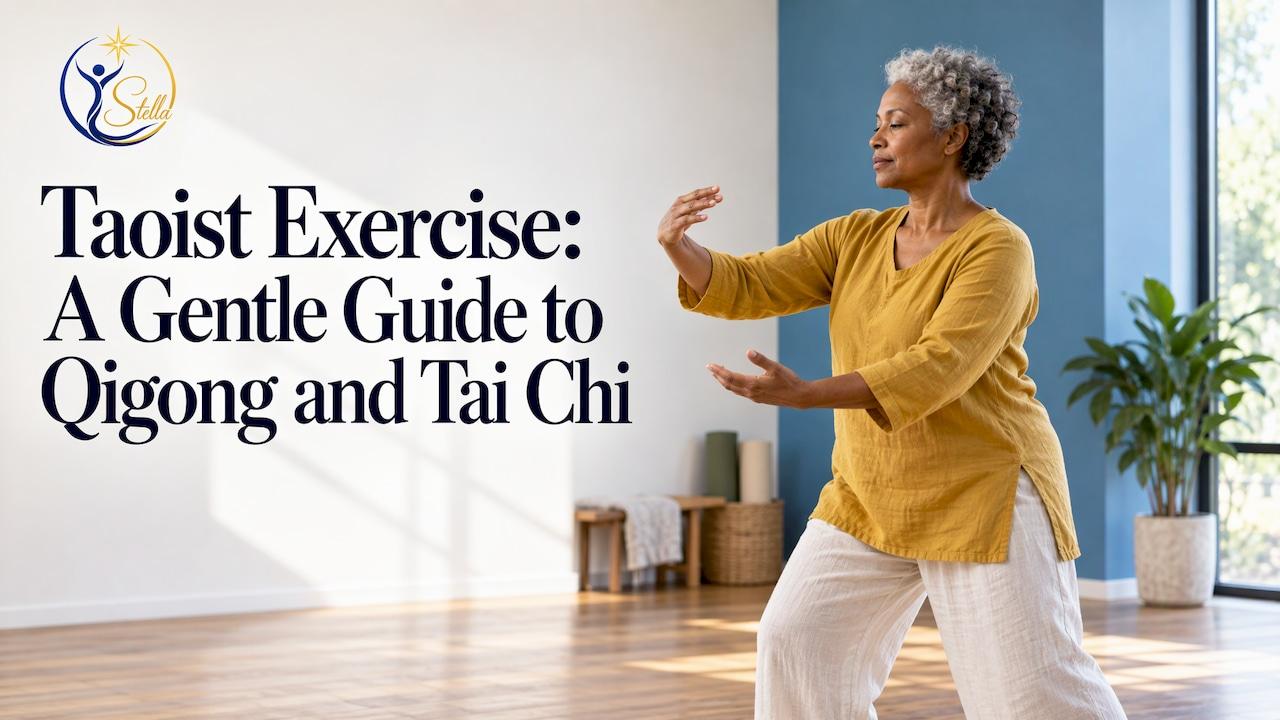
When people search for Taoist exercise, they usually mean qigong and tai chi: slow, flowing movement joined to deep breathing and a quiet, focused mind. Both grow from Taoist ideas about balance and the free flow of energy, and both are gentle enough to begin at any age or fitness level. The best way to learn them is with a qualified teacher who can guide your posture and breathing. That is why we teach qigong live and on demand, with every class led by a White Tiger Qigong Level 3 certified instructor who is also accredited by Yoga Alliance.
Key Takeaways
- Taoist exercise is, in practice, qigong and tai chi: gentle movement, slow breathing and calm attention working together.
- Reviews of the research link these practices with lower depression and anxiety, better sleep, better balance and fewer falls in older adults.
- Start small. Ten to fifteen minutes is enough at first, and the "70% rule" keeps every movement comfortable.
- Both practices have a strong safety record, and a trained teacher helps you get the details right from day one.
- If you have joint, spine or heart problems, are pregnant or have severe osteoporosis, talk with your doctor before you begin.
What Taoist exercise actually means
Taoism is a Chinese philosophy that sees health as harmony: between body and mind, between effort and rest, between you and the natural world. Taoist exercise is the movement side of that idea. You will meet it under several names, but the two most common are qigong (pronounced "chee-gong", roughly "energy work") and tai chi.
The US National Center for Complementary and Integrative Health describes qigong as a combination of slow, deep breathing, gentle smooth movements aimed at relaxation, and mind regulation through focused attention and visualisation. It also notes two broad styles. Dynamic qigong uses whole-body or limb movements. Meditative qigong can be done in any posture you can hold comfortably, with almost no movement at all.
Tai chi is closely related. It strings movements together into longer, flowing sequences, and it began as a martial art. Today it is mostly practised for health. A US Department of Veterans Affairs handout, drawing on work by Dr Peter Wayne of Harvard Medical School, lists eight ingredients of tai chi practice: awareness, intention, structural integration, active relaxation, strengthening and flexibility, natural freer breathing, social support and embodied spirituality. Qigong shares most of them.
If you want the foundations in more depth, our guide to qigong principles of body, breath and mind walks through each in plain language.

The three parts of every practice
Whatever the style, a Taoist exercise session brings together three things. Understanding them helps you feel what you are doing rather than just copy shapes.
Body: soft, rooted movement
Movements are slow, rounded and continuous. Your knees stay soft, your shoulders drop, and your weight shifts smoothly from one leg to the other. Nothing is forced or jerked. This is why people with stiff joints, or who have not exercised for years, often find it welcoming.
Breath: slow and low
Breathing is deep and easy, moving down into the belly rather than lifting the chest. Our guide to the role of breath in qigong explains how to let breath and movement rise and fall together. Many beginners notice their shoulders loosen within a few minutes simply because the breath has slowed.
Mind: quiet, focused attention
You rest your attention on the sensation of movement, the breath or an image such as water flowing. When thoughts wander, you return gently. This is what makes qigong a moving meditation, and if the still side appeals, our page on qigong meditation, moving and still practice shows how the two fit together.
The mind-body part matters. Simple awareness exercises, such as the ones in these simple mindfulness exercises for everyday stress, share the same principle: calm attention changes how the body feels. Qigong adds movement and breath to that attention.
What the research says about stress, mood and sleep
People come to Taoist exercise for many reasons, and calm is the most common. Here is what the published research offers, in plain terms.
Mood and anxiety. A January 2026 systematic review and meta-analysis of 15 studies with 1,351 participants found that mind-body exercise significantly eased depression and anxiety. Qigong stood out as the most effective type for depression, with sessions of 31 to 60 minutes, three times a week, over 9 to 12 weeks. An older review of qigong and tai chi research also reported that anxiety fell significantly in people practising qigong compared with an active exercise group.
Fatigue and sleep. A 2019 review of seven studies including 915 people with cancer, summarised by the NCCIH, found that qigong significantly improved fatigue and sleep quality. Most of the sessions lasted 60 minutes and took place two to three times a week for 6 to 12 weeks. If sleep is your main concern, our page on qigong for sleep offers a short evening routine.
Balance, strength and falls. A 2021 scoping review of 27 meta-analyses found moderate to high-quality evidence that tai chi improves balance, mobility, sleep and strength in older adults and reduces falls. A wider review by Huston and McFarlane, covering more than 500 trials and 120 systematic reviews, rated the evidence as excellent for preventing falls and for osteoarthritis, among other conditions.
These are research findings about groups of people, not promises for any one person. They do show why so many teachers and health services recommend this kind of movement as a steady part of a wellbeing routine.

Digestion, burnout and tight joints
Three groups in particular find their way to Taoist exercise, and each has a natural reason.
Gut comfort
In the Chinese medicine tradition, the belly is a centre of energy, and the slow abdominal breathing of qigong is thought to soothe the whole digestive system. The Huston and McFarlane review notes that many practitioners describe benefits such as improved digestion, alongside warmer hands and feet and feeling younger. Our own courses are built around this link between calm and gut wellbeing. If you live with IBS, our qigong for IBS article explains how the practice is approached.
Burnout and a busy mind
If your days are long and your nervous system feels permanently switched on, the slow rhythm of qigong gives you something rare: a short stretch where nothing is demanded of you. Our guide to relaxation techniques without therapy shows how a few minutes between meetings can help you release tension. For low mood, see our page on qigong for depression.
Joints and gentle rehabilitation
Because movements are low-impact and unhurried, they let stiff joints move through comfortable ranges. The tai chi and osteoporosis discussion is a useful reminder that benefits for falls and balance are clearer than benefits for bone density, so it helps to think of this practice as a way to move with confidence. Older readers can start with our guide to qigong for seniors.
How to start: a gentle first week
You do not need special clothes or equipment. Wear something loose, find a quiet space with fresh air, and give yourself a few minutes.
- Choose your place and time. Practising at the same place and time each day helps you build a routine, which Mayo Clinic links with the greatest stress-reduction benefit.
- Stand or sit comfortably. Feet about shoulder-width apart, knees soft, shoulders relaxed. Sitting is fine, and the seated form is just as valid.
- Breathe low and slow. The NHS beginner guide describes Shibashi qigong, a set of 18 movements, as a moving meditation using abdominal breathing: in through the nose, out through the mouth.
- Learn a few movements at a time. The same guide advises beginners to take it in small pieces, and says most people learn all 18 movements within a week of regular practice, with results appearing after daily practice for three months.
- Follow the 70% rule. Harvard Health tells beginners to stay at about 70% of your effort or range of movement and to back off from anything that causes pain or resistance.
- Finish quietly. Stand still for a minute, hands resting low on the belly, and notice how you feel.
For a ready-made sequence, try our beginner qigong sequence, a 10-minute daily routine, or read how to start qigong gently and well.
Where you practise matters too. The NHS guide suggests a peaceful space with good air circulation, and advises against practising outdoors in thunderstorms, high smog alerts or strong winds. Keep movements smooth and continuous, and tie them to your breath.
How often and for how long
Little and often beats occasional long sessions. Harvard Health recommends beginners start with 10 or 15 minutes and build up gradually, adding that even five minutes on most days is worth doing. For a deeper practice, it suggests 30 to 60 minutes daily, while a few 30-minute sessions a week or 10 minutes a day still bring benefits.
Here is a simple way to build up:
| Stage | Session length | How often |
|---|---|---|
| Weeks 1 to 2 | 10 to 15 minutes | Most days |
| Weeks 3 to 6 | 20 to 30 minutes | 3 to 5 days a week |
| Week 7 onwards | 30 to 60 minutes | As your routine allows |
The 2026 review mentioned above found its best results for depression at 31 to 60 minutes, three times a week, over 9 to 12 weeks, so a plan like the one above is in line with what researchers have tested. There is no strict upper limit for gentle qigong, so listen to your body and rest when you feel tired.
Practising safely
The safety record is strong. The NCCIH says that qigong appears to be a safe form of activity, with many studies showing no negative side effects in people with chronic diseases and older adults. Its tai chi page reports that a 2019 review of 24 studies with 1,794 participants found adverse events were similar to those with other activities or no activity. The VA handout notes that some people may feel minor muscle aches from using muscles they have not used for a while.
To practise safely:
- Talk with your doctor first if you have problems with your joints, spine or heart, are pregnant, have a fracture or have severe osteoporosis. Mayo Clinic gives this advice and notes that injury is possible if movements are not done properly.
- Stay within comfortable range. Never push into pain. Soft knees and slow movement protect your joints.
- Sit if you need to. Seated practice keeps all the benefits of breath and focus.
- Read our guidance on qigong contraindications to see who should modify movements or skip certain ones.
Choosing a teacher
Mayo Clinic points out that tai chi instructors do not have to be licensed and that there are no standard training programmes, so it is worth checking an instructor's training and experience. The VA handout advises a beginner or level 1 class with ten students or fewer, so that you receive personal guidance.
Our instruction is delivered by a White Tiger Qigong Level 3 certified instructor who is also accredited by Yoga Alliance. We offer small-scale, personal sessions as well as group classes, so you can choose the level of attention that suits you.
Begin with guidance
If you want a structured start, our course Qigong for Stress Relief and Digestive Wellness is a one-off £116 and is designed for calm, steadier digestion and a quieter mind. You can learn at your own pace, with beginner-friendly routines you can repeat at home.
If you would prefer to be guided directly, you can book:
- a 30-Min Clarity Session for £85
- a 60-Min Deep Dive Online Session for £145
- a 60-Min Face-to-Face Qigong session for £165
Group Qigong Classes are also available, and details are on the same online qigong classes page. To explore the traditional Taoist lineage of movement, take a look at our Five Animal Qigong course or White Tiger Qigong.
Our perspective
When I began teaching, what struck me most was how quickly people softened. Not their muscles first, but their breath. A person arrives with a held jaw and a racing mind, and after ten quiet minutes the whole body begins to settle.
That is why we focus on gentle movement, breath regulation and mindful attention, rooted in Chinese Medicine. Our courses in White Tiger Qigong and Five Animal Qigong are designed for people dealing with stress, anxiety, burnout and gut-related discomfort, and for anyone who wants a natural, non-invasive practice they can return to every day.
The research on mind-body exercise is encouraging, and I believe the real gift is the routine itself: a small, kind appointment with yourself. Learning with a certified instructor means your posture, breathing and pacing are guided from the start, so you can relax into the practice and enjoy it.
I would love to help you find your own rhythm.
Stella
FAQ
What are some examples of Chinese meditation exercises?
Qigong is the best-known, and it includes moving forms such as Shibashi and the Five Animals, as well as still, seated meditation. Tai chi is another moving meditation. All of them combine slow breathing, gentle movement and focused attention.
What is the 70% rule in tai chi?
It means working at roughly 70% of your effort, intensity or range of movement and never forcing a movement. Harvard Health recommends it for beginners, and it keeps practice comfortable and sustainable.
How many times a day can you do qigong?
Gentle qigong can be practised daily, and some people do short sessions more than once a day. Harvard Health suggests that a little practice often is better than large isolated sessions. If you feel tired or sore, rest.
Does tai chi really work?
Reviews of the research report benefits for balance, fall prevention, sleep, mood and anxiety. Results vary from person to person, and regular practice over weeks and months matters most. Speak to your doctor if you have a medical condition.
Sources
- Qigong: What You Need To Know, NCCIH
- Tai Chi: What You Need To Know, NCCIH
- Introduction to Tai Chi and Qi Gong for Whole Health, US Department of Veterans Affairs
- Tai Chi for beginners, Torbay and South Devon NHS
- An Introduction to Tai Chi, Harvard Health
- Tai Chi: Discover the Many Possible Health Benefits, Mayo Clinic
- Health benefits of tai chi: What is the evidence? PMC
- Systematic review and meta-analysis of mind-body exercise, PMC, 2026
- Effectiveness of Tai Chi for Health Promotion of Older Adults, PMC
- A Comprehensive Review of Health Benefits of Qigong and Tai Chi