
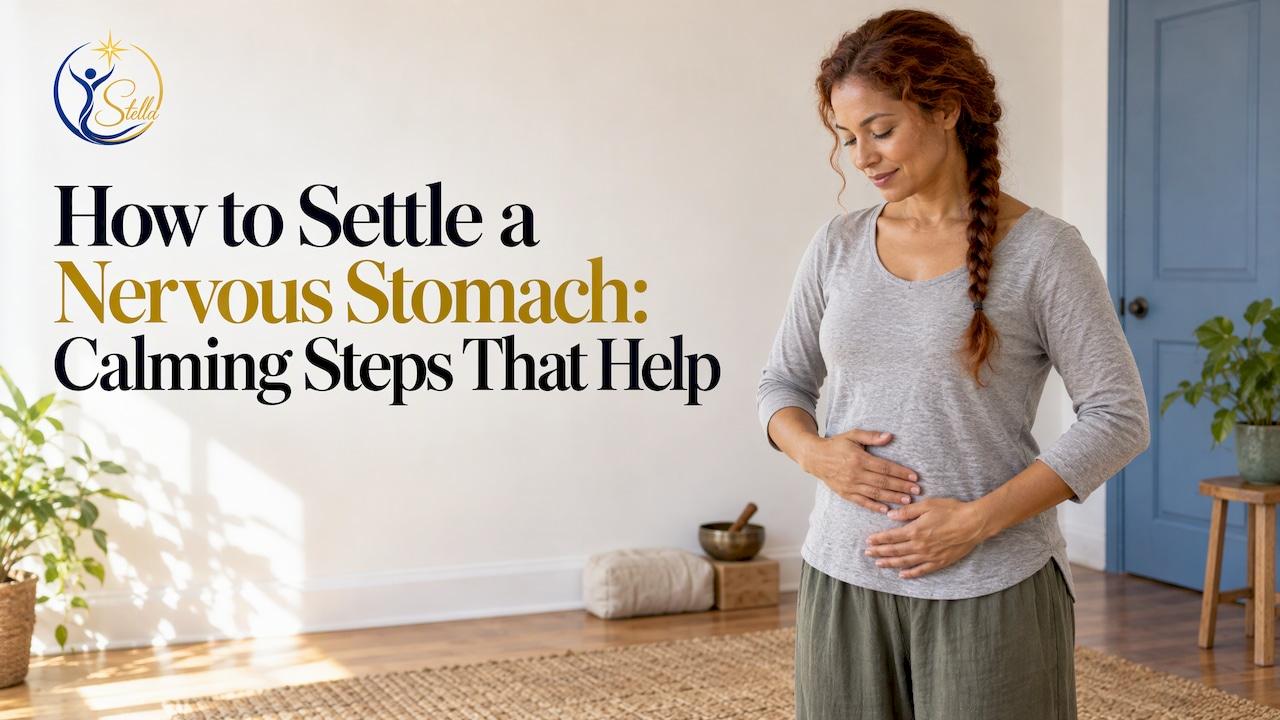
To settle a nervous stomach, you need to tell your body that the threat has passed. Slow your breathing with a long, soft exhale, soften your belly, move gently, and eat and drink simply for a day or two. Most stress-related stomach trouble is temporary, and the steps below can help you feel steadier within minutes. If symptoms keep returning or come with warning signs, speak to your GP.
Key Takeaways
- A nervous stomach is not an official diagnosis. It describes real digestive symptoms that flare when you feel anxious or stressed, through the gut-brain connection.
- A longer exhale, a warm hand on the belly and slow, gentle movement are the quickest ways to calm the system in the moment.
- Simple food, less caffeine and a regular daily rhythm support your gut while it settles.
- Unexplained weight loss, blood in your stool, black tarry stools or symptoms that keep coming back need a medical check, not more self-care.
- A short daily qigong practice can make calming your stomach a habit rather than an emergency measure.
What a nervous stomach feels like
You may know it as butterflies before a presentation, a knot after a difficult email or a churning stomach on a Sunday evening. Healthline notes that a nervous stomach is not an official or diagnosable condition. The common sensations it lists include tightness, churning, cramping, knots, nausea, indigestion, frequent flatulence and an increased need to pass urine or open your bowels.
Verywell Health adds a few more: bloating, a "gut-wrenching" feeling, diarrhoea or constipation, dry heaving, and loss of appetite or hunger cues that feel out of step with the day. The range is wide, and it is also personal. One person loses their appetite before a stressful day. Another feels hungry all the time. Another heads to the toilet three times before leaving the house.
This variety is why so many people feel confused by it. If your symptoms do not match a neat list, that does not mean something is wrong with you. It means your digestive system is responding to your emotional state in its own way.
If some of those symptoms are familiar, an overview of how anxiety symptoms show up and when to get help can also help you recognise the wider picture.
Why stress lands in your stomach
Your gut and your brain are in constant conversation. UCLA Health describes the gut-brain axis as a network of nerves linking the two, with chemical signals travelling in both directions. Emotions can affect you physically, and what happens in the gut can affect how you feel.
When you feel under pressure, the fight-or-flight response switches on. Medical News Today explains that your digestive tract has its own nervous system, and that nerve endings in the stomach respond to stress hormones. Digestion slows down so that more blood can reach the lungs and muscles. Cleveland Clinic points out that there are more serotonin receptors in the intestinal tract than in the brain, and that the resulting contractions create the feeling of butterflies.
The University of Chicago Medicine gastroenterology team says that stress, worry and anxiety can affect gut motility and the balance of gut bacteria. The nervous system can also signal the intestines to push waste through quickly, which is why stress can bring on cramping, bloating or loose stools.
The NHS says in its digestive health advice that managing and reducing stress can help your digestion, and that stress can make conditions such as irritable bowel syndrome and stomach ulcers worse.
It is also worth knowing that this is not imagination. Harvard Health stresses that functional gut symptoms are not "all in your head". Psychology and physical factors combine, and some people feel gut pain more strongly because their brains are more responsive to signals from the digestive tract. Your discomfort is real, and so is your ability to calm it.

Settle it in ten minutes: a gentle sequence
The aim is to move your body from "alert" to "rest and digest". The US Department of Veterans Affairs notes that managing stress can help activate this rest-and-digest response. Try the steps below in order. You can do them sitting at a desk, on the edge of your bed or on a train platform.
- Pause and soften your posture. Sit with both feet on the floor. Let your shoulders drop away from your ears and unclench your jaw. Many of us brace the belly without realising it, so allow it to release.
- Place one hand on your lower belly. Warmth and gentle contact help your attention settle in the area that feels unsettled.
- Breathe in through your nose for a count of four. Let the belly rise softly under your hand, not the chest.
- Breathe out slowly for six to eight. Let the exhale be longer than the inhale, as if you were fogging a mirror. A long exhale is the heart of the practice. Repeat for two to five minutes. Harvard Health advises deep breathing or relaxation exercises, plus a daily walk, to help relieve the tension of anxiety.
- Name what you notice. Silently say "tight", "fluttery" or "hot". Putting a word to a sensation often loosens its grip.
- Shift your attention. Harvard Health also suggests that distraction can help when anxiety is the root of physical symptoms. Look around the room and quietly name five things you can see, or sip warm water slowly.
- Move gently for two minutes. Roll your shoulders, turn your torso slowly from side to side, then take a short walk if you can.
If you want more guided practices for the breathing part, our articles on breathwork for anxiety and slowing your exhale first go step by step. The grounding exercises for anxiety are useful when your mind is racing as fast as your stomach is churning.
A simple heat and hydration ritual
Warmth is a classic comfort for a tense belly. Many people find that a hot water bottle on the tummy or a warm bath helps the muscles let go. Keep sipping water, especially if you have had loose stools. Warm drinks such as ginger or peppermint tea are a soothing choice. UCLA Health notes that ginger and peppermint can ease gut symptoms, and that the scent of lavender and lemon balm can have a calming effect.

Gentle qigong movements for an unsettled stomach
Qigong is a gentle practice from Chinese medicine that pairs slow movement with breath and attention. It suits a nervous stomach because it does three things at once: it lengthens the breath, it moves the abdomen softly, and it gives your mind something steady to follow. Nothing here needs fitness, flexibility or special space.
Belly circles
Stand or sit comfortably. Rest both hands, one over the other, on your lower belly. Breathe out as you make slow, clockwise circles around your navel, using very light pressure. Breathe in as you continue the circle. Keep the pace unhurried for one to two minutes, then rest your hands and notice any warmth.
Opening and closing the chest
Stand with your feet hip-width apart and your knees soft. As you breathe in, let your arms float out and open, as if making space in your ribcage. As you breathe out, draw them in and let your palms settle toward your belly. Repeat six to ten times. The rhythm of opening and releasing is calming in itself, and it reminds you to stop holding your breath.
Gentle twists
With your knees soft, turn your torso slowly from side to side, letting your arms swing loosely so the hands tap the belly and lower back. Think of it as a soft wringing out of tension. Keep the movement easy and stop if anything feels uncomfortable.
Standing like a tree
Stand tall, feet parallel, knees slightly bent. Let your arms hang as if you were holding a large, light ball in front of your belly. Breathe slowly and feel the weight drop into your feet. A minute or two of this stillness often quietens the fluttering feeling.
We have written fuller routines if you want to build this into a habit: qigong for digestion in 5 to 10 minutes a day, qigong for bloating and qigong for IBS. If you would like a wider look at what can sit alongside them, see our list of integrative practices for stress and digestion and our guide to relaxation techniques without therapy.
Food, drink and daily habits that support a calmer gut
When your stomach is already unsettled, kindness is the principle. You do not need a strict plan. A few steady choices are enough.
- Eat simply and slowly. Choose warm, plain meals and chew well. Put your fork down between bites and notice taste and texture. It gives your nervous system time to register that you are safe.
- Favour whole foods. UCLA Health suggests fresh fruit instead of added sugars, and vegetables, leafy greens, whole grains and legumes rather than processed foods.
- Go easy on caffeine. Verywell Mind advises avoiding too much caffeine, because it can make both anxiety and stomach issues worse. A herbal tea is a gentle swap on a tense day.
- Move most days. A walk, a gentle stretch or a short qigong practice keeps energy flowing and helps you release held tension.
- Protect your sleep and your pauses. A regular bedtime and a few unhurried minutes between tasks stop stress from building up unnoticed.
The NHS also lists reducing stress among its core lifestyle tips for a healthy tummy, alongside eating and drinking well. Think of the food side and the calming side as partners.
Our perspective: calm the system, and the stomach follows
We see the same pattern again and again in people who come to us with a restless stomach. They have tried to fix the digestion in isolation, and the digestion keeps answering to the pace of their life.
In the Chinese medicine tradition that shapes our teaching, the belly is a centre of energy and balance. When we are rushing, bracing and holding our breath, that centre tightens. Qigong asks you to do the opposite: slow down, breathe low, soften and let the body settle at its own pace.
That is why we teach short, repeatable practices rather than heroic ones. Five or ten minutes of gentle movement and long exhales, done every day, teaches your body a new default. Over time, the flutter before a meeting or the knot after a hard day has less to hold on to.
Our instruction comes from a White Tiger Qigong Level 3 certified teacher who is also accredited by Yoga Alliance, with a focus on stress, digestive wellbeing and the demands of modern working life. You can begin as a complete beginner, and we adapt the practice to your pace.
Stella
When a nervous stomach needs a medical check
Most stress-related stomach discomfort is short-lived. The University of Chicago Medicine says it is usually temporary and not serious, but chronic stress and anxiety can take a toll on the digestive system. Qigong and breathing are supportive practices and do not replace a diagnosis. Please book a GP appointment if you notice any of the following:
- weight loss you cannot explain
- blood in your stool, or black, tarry stools
- pale, floating stools
- ongoing heartburn or vomiting
- symptoms that keep returning after they stop, or last more than a few days without a clear reason
- symptoms that are getting in the way of your work or social life
These signs come from University of Chicago Medicine, Cleveland Clinic, Verywell Health and Verywell Mind. Harvard Health adds that a physical problem that does not ease with relaxation should be checked by your doctor. It also says that avoiding activities because you are fearful, or being so preoccupied with worry that it affects how you function, can be signs of an anxiety disorder. If that sounds familiar, your GP can talk through support with you.
If you already have a diagnosis such as IBS, tell your teacher about it before you start any new practice, and follow the advice of your own clinician.
Making calm a daily habit with Qigongstar
Quick fixes help in the moment. A steady practice changes how readily your stomach tightens in the first place. At Qigongstar we offer:
- Qigong for Stress Relief and Digestive Wellness, a self-paced online course, £116 one-off
- 30-Min Clarity Session, £85 one-off
- 60-Min Deep Dive Online Session, £145 one-off
- 60-Min Face-to-Face Qigong, £165 one-off
- Group Qigong Classes, for company and rhythm; see the page for details
You can see everything on our online qigong classes page. If you are curious about the traditions behind our teaching, explore White Tiger Qigong or the Five Animal Qigong course.
Whether you are a burnt-out professional, someone whose stomach reacts to every busy week or a complete beginner, you can walk away with a gentle routine that feels like yours. You can find more about us on the Qigongstar home page.
FAQ
Can anxiety really cause stomach problems?
Yes. Verywell Mind says anxiety can cause nausea, diarrhoea and indigestion, and that studies show a link between anxiety, depression and functional gut symptoms. The gut-brain axis carries signals both ways, so stress can reach your stomach and a troubled stomach can affect your mood.
Can stress cause diarrhoea?
Yes. The University of Chicago Medicine explains that the nervous system can signal the gut to move waste through quickly, which can lead to cramping, bloating or loose stools. If it keeps happening, or you notice blood or weight loss, speak to your GP.
What is the fastest way to calm a nervous stomach?
Slow, low breathing with a longer exhale than inhale is the quickest place to begin. Add a warm hand or a hot water bottle on the belly and a few minutes of gentle movement. Many people feel the first softening within a few minutes, though it varies from person to person.
Is qigong safe if my stomach is already sensitive?
Qigong is slow and low-impact, which is why many beginners start with it. Move within a comfortable range, avoid pressing hard on the abdomen and stop if anything hurts. If you have a diagnosed digestive condition, mention it to your teacher and your doctor first.
Should I avoid caffeine and certain foods?
Cutting back on caffeine can help, as it may make anxiety and stomach symptoms worse. Ginger or peppermint tea and simple whole foods are a gentle approach while you settle. If particular foods trigger symptoms repeatedly, ask your GP for guidance.
Sources
- Nervous Stomach: Symptoms, Feeling, Anxiety, Treatment (Healthline)
- Nervous Stomach: Symptoms, Causes, and Treatment (Verywell Health)
- Gut-brain axis could play part in nervous stomach (UCLA Health)
- Nervous stomach: Symptoms, causes, and remedies (Medical News Today)
- How to stop nervous poops (Cleveland Clinic)
- Stress-related stomach pain: When to see a doctor (University of Chicago Medicine)
- 5 lifestyle tips for a healthy tummy (NHS)
- The gut-brain connection (Harvard Health)
- Recognizing and easing the physical symptoms of anxiety (Harvard Health)
- Stress and GI Health (US Department of Veterans Affairs)
- Anxiety and Stomach Issues: Understanding the Connection (Verywell Mind)
- Postpartum Anxiety Symptoms: What to Look For and When to Get Help