
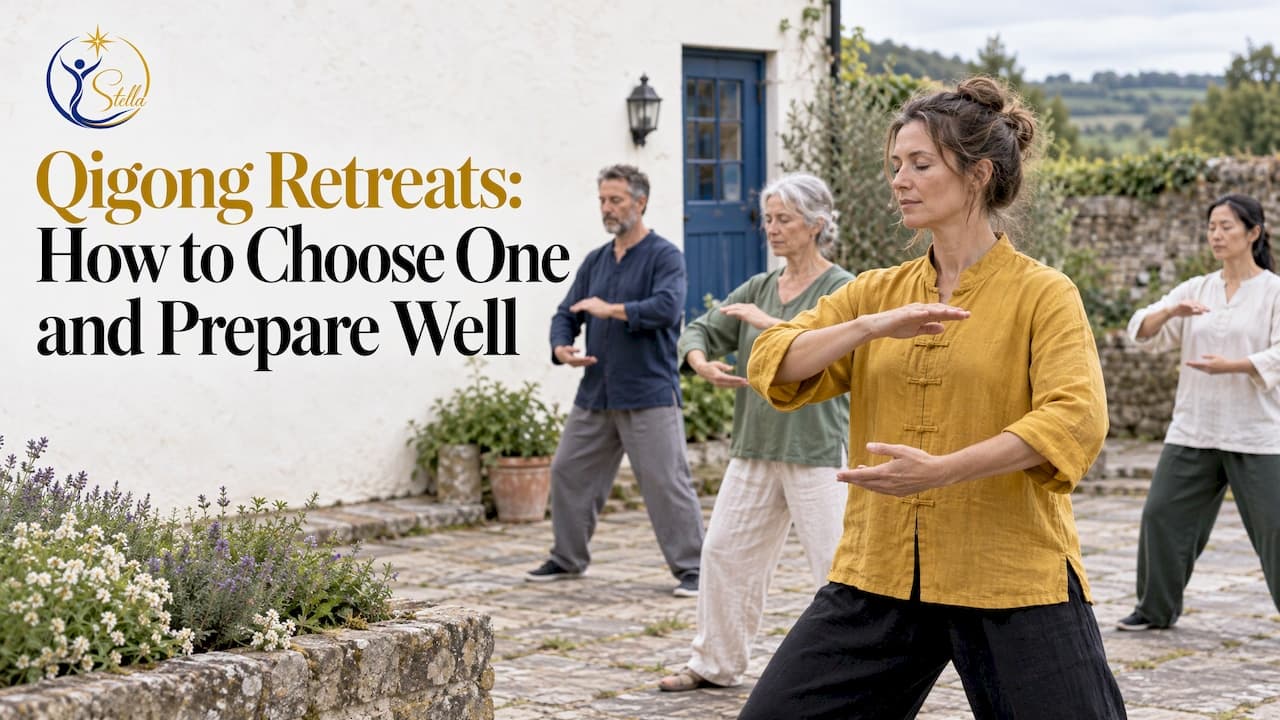
A qigong retreat is a few days or a week set aside for gentle movement, breathwork and stillness, usually away from home and daily demands. The right one leaves you calmer and with a routine you can repeat at home. Choosing well comes down to four things: who leads it, how the days are paced, what the price includes, and whether it suits your body and your reasons for going. This guide walks you through each, and shows how to prepare so you can carry the practice back into ordinary life.
Key Takeaways
- A retreat usually blends daily qigong sessions, meditation, rest and time outdoors. Good ones leave generous free time so the practice can settle.
- Beginners are welcome at many retreats. Choose one that teaches movements step by step in small groups, and that you can repeat on your own afterwards.
- Before booking, check what the fee covers (accommodation, meals, travel), the cancellation terms, accessibility and how the teacher is qualified.
- Research on qigong points to benefits for perceived stress and anxiety, but a retreat is a start. A short daily routine at home is what makes it last.
- If a full retreat feels too much right now, live online sessions give you the same gentle foundations from your own living room.
What a qigong retreat actually involves
The word "retreat" covers a lot of ground, from a quiet weekend in a British retreat house to a week of practice in a sunny Mediterranean village. What they share is a simple rhythm: practise, rest, eat well, practise again.
A typical day has a morning session of qigong movement and breathing, often with a little theory about why the movements work as they do. The middle of the day is left open for lunch, walking, reading or a nap. An evening session tends to be quieter: seated meditation, slow walking or standing stillness. One Greek retreat centre describes exactly this pattern, with a morning block of practice and theory, a long midday break and an evening meditation hour, and the same centre says the week is built so you can repeat the routines independently afterwards.
Many retreats also add:
- Outdoor practice in gardens, woods or by the sea
- Simple stretching and joint-loosening work
- Guided meditation or breath practice
- Shared, often vegetarian, meals
- Optional walks, massage or quiet time in nature
The long breaks are not wasted time. Qigong works through slow, repeated, mindful movement, and your system needs space between sessions to soften and absorb it.
Types of retreat and who they suit
It helps to know the broad types before you start comparing dates and prices.
| Type | Usual length | Best for |
|---|---|---|
| Weekend retreat in the UK | 2 to 3 days | First-timers, tight schedules, low travel costs |
| Residential week | 5 to 7 days | Building a routine you can continue at home |
| Retreat abroad | 6 to 7 days | Combining practice with warm weather and a full change of scene |
| Silent or meditation-led retreat | 3 days to several weeks | Those who want deep stillness alongside movement |
| Intensive training or teacher course | Two weeks or more | Students who already practise regularly |
| Online retreat or intensive | A day to a week | Anyone who cannot travel or prefers their own space |
If you are new, a weekend or a single week is plenty. Going for longer before you know how you respond to the practice is rarely necessary.
Can beginners go?
Yes. Many retreats are designed for complete beginners, and some state plainly that they suit anyone regardless of prior experience, age or fitness level. Qigong is low-impact, and the movements can be adapted: you can practise standing, seated or with smaller ranges of motion. One retreat centre notes that comfortable clothing is all you need.
What matters for beginners is how the teaching is delivered. Look for:
- Small groups, so the teacher can see and correct you
- Movements broken down step by step and built up day by day
- A clear statement that no prior experience is needed
- Time to ask questions without feeling rushed
If you want to arrive with the basics already familiar, our guide to qigong for beginners shows how to start gently and well.
If you are older or have limited mobility
Qigong can be a kind practice for stiff joints and balance, and retreats often welcome older participants. Ask the organiser about stairs, distances between rooms and the practice space, and whether seated options are used. Our page on qigong for seniors explains how to begin safely. For wider background on keeping steady on your feet, balance training for seniors covers safe exercises that help prevent falls.
What the research says about qigong and wellbeing
People go on retreat mostly for stress, poor sleep, tension in the body or a sense of burnout. It is worth knowing what the research reports, and keeping expectations realistic.
A review of qigong for stress prevention reports that practising qigong is associated with lower perceived stress and lower levels of stress hormones such as cortisol. The same review notes that meta-analyses suggest beneficial effects on both state and trait anxiety, and it links the effects to mechanisms such as reduced cortisol and activation of the parasympathetic nervous system, the part of you that supports rest and digestion.
A separate systematic review of qigong as a complementary practice found that some studies of stressed participants reported greater reductions in perceived stress and anxiety in the qigong group than in control groups.
For aches and stiffness, the picture is more mixed. An evidence summary on mind-body exercise and chronic spinal pain found that qigong effects on chronic low back and neck pain were inconsistent, although qigong improved the physical component of quality of life after 12 weeks for chronic neck pain. In plain terms: qigong is a gentle, supportive practice, not a substitute for medical care, and the most reliable gains come from regular practice over weeks rather than a single event.
If you live with a diagnosed condition, such as IBS, a heart condition, chronic pain or a mental health difficulty, speak with your GP or specialist before you book, and tell the retreat organiser about it.
How to choose a retreat you will enjoy
Use these criteria to compare options calmly rather than by the prettiest photo.
The teacher and the lineage
Ask who leads the sessions, how long they have practised and taught, and which style they teach. Qigong includes many traditions, from medical qigong to health qigong and animal forms. A teacher who is open about their training and happy to answer questions is a good sign. Certification, such as recognition by a qigong school or Yoga Alliance, tells you the teacher has trained within a recognised framework.
The programme and pace
Read the daily schedule. You want enough practice to feel progress, but also unhurried time. A programme packed from dawn to night can leave you more tired than when you arrived. Check whether sessions are optional, and whether you can sit one out.
What is included in the price
Retreat pricing varies widely and fees are structured differently, so compare like with like. Some include accommodation and classes but not meals or transport. Others cover everything, and some quote a booking fee with the balance due later. Always check:
- Accommodation type: shared or single room, shared or private bathroom
- Meals: what is provided, and whether dietary needs are catered for
- Travel: airport transfers, parking or train links
- Extras: massage, excursions, tourist taxes, insurance
- Deposit amount and when the balance is due
Accommodation, accessibility and cancellation
Before paying a deposit, read the booking terms in full. Look for the cancellation window, whether the deposit is refundable, and what happens if the organiser cancels or changes the programme. If you need a ground-floor room, step-free access or a single room for health reasons, ask in writing before you book. Good organisers will ask about your health and dietary needs in advance and are glad to talk through your requirements.

For retreats abroad, consider travel insurance that covers cancellation and medical care, and check current entry requirements for your destination on the UK government's travel advice pages.
Group size and atmosphere
Small groups of a dozen or fewer tend to feel more personal. Read reviews for comments about the teaching and the atmosphere, not just the scenery.
How to prepare before you go
A little preparation makes the first day easier.
- Practise for two weeks beforehand. Even ten minutes a day helps your body recognise the movements. Our daily qigong routine for stress reduction is an easy place to start.
- Pack for comfort. Loose, breathable clothing, warm layers for stillness work, flat shoes or soft-soled footwear, and a water bottle.
- Ease your schedule. Clear your calendar for the day before and the day after if you can. Arriving frazzled works against the point.
- Set one intention. Perhaps to sleep better, to feel less wound up, or to learn a routine you will keep.
- Tell the teacher about injuries. Mention anything that affects movement so they can offer adaptations.
Perspective from our teacher
We often hear people say they need a retreat, and we understand why. A few days away can feel like permission to exhale.
What we have found is that the real gift of a retreat is not the setting. It is learning a practice gentle enough to carry home. The people who benefit most are those who leave knowing a few simple movements well, and who return to them on an ordinary Tuesday evening after a long day.
That is why our approach centres on small, repeatable routines for stress, burnout and digestive wellbeing, taught by a White Tiger Qigong Level 3 certified instructor who is also accredited by Yoga Alliance. You learn the movements step by step, with time to ask questions, and you build a rhythm that fits around work and family.
If you are planning a retreat, prepare with regular practice first, and keep going when you return. If a retreat is not possible right now, live online sessions can give you the same calm foundation, from your own home.
Stella
Keeping the benefits after you come home
The days after a retreat are when many people feel most tender and most motivated. Use that window.
- Keep it short. Five to fifteen minutes each day does more than a long session once a week. Our guide on building stress resilience with qigong shows how.
- Anchor it to something you already do. Practise after brushing your teeth, before the kettle boils or before opening your laptop.
- Use qigong in the moment. A few slow breaths and a soft sway can help before a difficult meeting or performance. See our piece on calming anxiety in 1 to 15 minutes.
- Work with the gut. If digestion is a concern, gentle abdominal and breath-led movements can become part of your evening wind-down. We explain more in how qigong movement therapy supports stress and gut health.
- Find a teacher to return to. Ongoing guidance helps you refine the movements as your body changes.
Not ready for a retreat? Learn with us online
Time away, travel costs and a week off work are not always possible. If you want to begin from home, we teach qigong rooted in Chinese medicine for stress relief, digestive wellness and a steadier everyday energy.
Our self-paced course, Qigong for Stress Relief and Digestive Wellness, is £116 as a one-off purchase. If you prefer personal guidance, you can book a 30-Min Clarity Session for £85, a 60-Min Deep Dive Online Session for £145, or a 60-Min Face-to-Face Qigong session for £165. We also run group classes. You can see every option on our online qigong classes page.
Prefer to explore our teaching traditions first? Take a look at White Tiger Qigong or our Five Animal Qigong course.
A simple checklist before you book
Before you pay a deposit, run through this list:
- I know who is teaching and how they trained.
- I have read the daily schedule and it leaves breathing space.
- I understand what the fee includes and what it does not.
- I have read the cancellation and refund terms.
- I have asked about accessibility, diet and any health needs.
- I have checked travel, insurance and transfer arrangements.
- I have spoken to my GP if I have a health condition.
If you can tick every line, you are ready to book with confidence.
FAQ
Do I need experience to go on a qigong retreat?
No. Many retreats are open to complete beginners and teach the movements step by step. Check the description for wording such as "suitable for beginners", and prepare by practising a few minutes daily for a couple of weeks beforehand.
How long should my first retreat be?
A weekend or a single week is plenty for a first experience. It gives you time to learn a routine and to notice how your body responds, without a large commitment of time or money.
What should I wear and bring?
Loose, comfortable clothing, warm layers for stillness and meditation, soft flat shoes and a water bottle. Most retreats need no special equipment. Ask the organiser whether mats or cushions are provided.
Is qigong on retreat safe if I have a health condition?
Qigong is gentle and low-impact, and movements can usually be adapted. Even so, speak with your GP or specialist before booking if you have a medical condition, are pregnant or are recovering from injury, and tell the organiser so the teacher can offer suitable options.
Can I get similar benefits without travelling?
Regular practice at home is what builds lasting benefits, and a retreat is one way to begin. Live online classes, one-to-one sessions and self-paced courses all let you learn the same foundations from home, at a price and pace that suits you.