
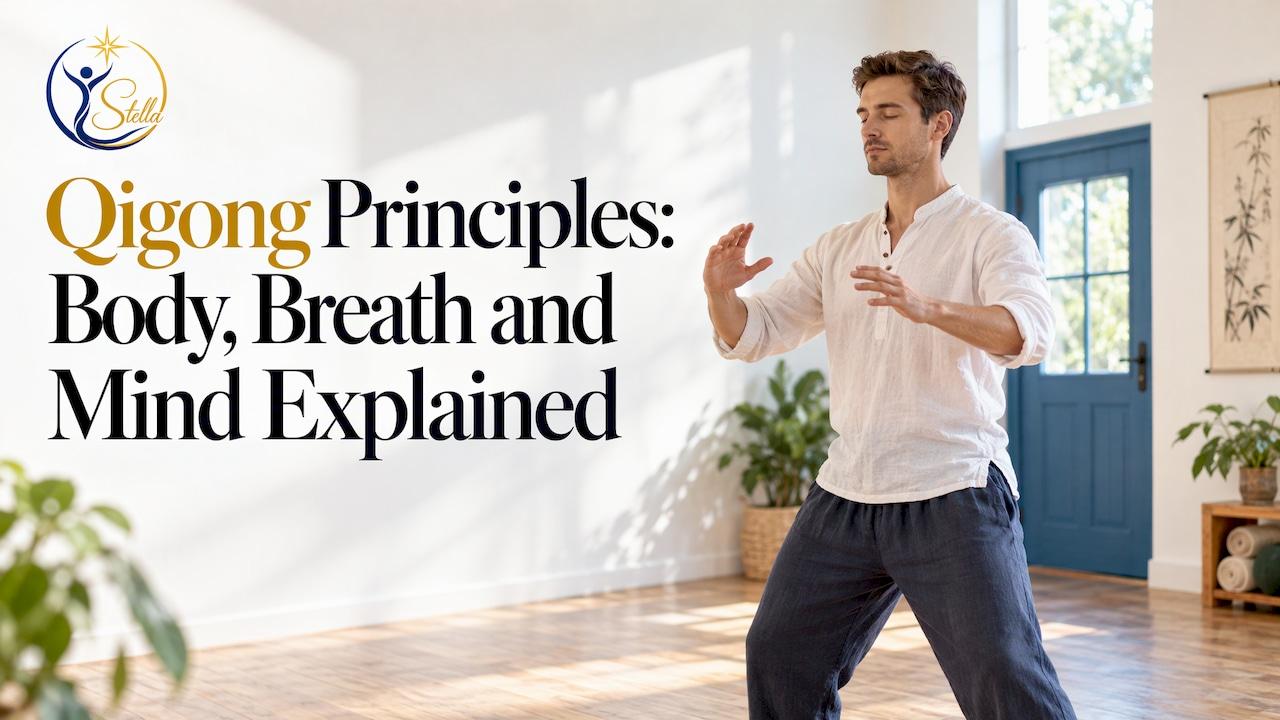
Qigong rests on three principles that work together: a relaxed, well-aligned body, slow and natural breathing, and a calm, focused mind. The US National Center for Complementary and Integrative Health describes qigong as the regulation of mind, breath, and the body's movement and posture. Every form, from flowing animal sequences to quiet standing meditation, is a different way of bringing those three threads together.
This guide explains each principle in plain language, shows how they fit together, and gives you a gentle way to begin applying them today.
Key Takeaways
- Qigong has three working principles: body (posture and gentle movement), breath (slow, deep and smooth) and mind (relaxed, directed attention).
- Relaxation is the thread running through all three. Movements are slow so that the body and nervous system can soften.
- Learn the movements first, add the breath next, and let intention follow. Gradual progress is how qigong is traditionally taught.
- Research suggests qigong may help with stress, though trial quality varies. It is generally regarded as a safe, low-impact practice.
- You do not need experience or flexibility. Standing, seated and moving versions all follow the same principles.
What qigong is, in one sentence
The NCCIH explains that qigong was developed in China as part of traditional Chinese medicine, using exercises intended to optimise energy within the body, mind and spirit to maintain health and wellbeing. The word is often translated as energy work or energy cultivation. Qi means vital energy, and gong means skill built through steady practice.
You do not have to adopt any belief system to benefit from practising. Many people simply notice that after a session their shoulders drop, their breathing slows and their thoughts settle. The principles below are the reason that happens.
The three pillars: body, breath and mind
The National Qigong Association calls body, breath and mind the three pillars of qigong. A comprehensive review of qigong and tai chi research describes the same idea as purposeful regulation of body, breath and mind, working in coordination. In traditional Chinese medicine this is sometimes called the three regulations.
Here is how the three look side by side:
| Principle | What you do | What you may notice |
|---|---|---|
| Body (posture and movement) | Stand or sit with a balanced, aligned frame. Move slowly and smoothly. | Less tension in the neck, shoulders and lower back |
| Breath | Breathe slowly, deeply and without force | A calmer, steadier rhythm |
| Mind (attention and intention) | Rest your attention on a movement, a sensation or an image | Fewer racing thoughts, a sense of presence |
None of these works well alone. Slow movement without attention is just stretching. Breathing without a settled posture can feel forced. Attention without a relaxed body can turn into effort. Qigong is the practice of letting all three meet.
Principle one: the body, posture and gentle movement
In most forms of qigong, the NCCIH notes, movements are gentle and smooth to encourage relaxation. The National Qigong Association also emphasises correct posture and alignment, because a body that is balanced lets energy move freely rather than being held in tension.
A review of health qigong describes it as emphasising slow routines, diaphragmatic breathing, a meditative state of mind and musculoskeletal relaxation, coordinated with symmetrical, balanced postures. In practice, that translates into a few simple habits:
- Soft knees. Keep a slight bend so your legs can absorb weight rather than lock.
- Level shoulders and an open chest. Let the shoulders hang as if the arms were heavy.
- A lengthened spine. Imagine the crown of your head gently suspended from above.
- Even weight. Feel your feet spread evenly on the floor.
If you spend long hours at a desk, these alignment cues are a good place to begin. Our guides to qigong for posture at your desk and standing qigong meditation show how to apply them in a few quiet minutes. If posture and bone strength are a particular concern for you, this daily posture plan for osteoporosis covers safety-first principles for building a short routine.
Dynamic and meditative practice
The NCCIH distinguishes two broad styles. Dynamic, or active, qigong focuses on body movements. Meditative, or passive, qigong is practised in a posture held over time, using breath and mind exercises with almost no movement. Both follow the same principles. Dynamic work is often easier for beginners because the movement gives the mind something to follow. Stillness suits days when you are tired or want to deepen your attention.
If standing is difficult, you can practise seated. The principles of relaxed posture, easy breath and calm attention do not change. Our warm-up with seated options is a kind place to start.
Principle two: the breath
In most qigong, the NCCIH says, breathing is slow, long and deep. The National Qigong Association adds that breath anchors your awareness in the present moment, and that regulating it helps to stimulate and guide energy.
The key word is natural. Qigong breathing is not a contest to take the biggest breath. A useful way to think about it:
- Let the belly soften and expand slightly on the inhale.
- Let the exhale be a little longer, unhurried and quiet.
- Keep the chest and shoulders relaxed, so the diaphragm does the work.
- If you feel strain, return to normal breathing and try again later.
When the breath is gentle, the nervous system tends to follow. That is why so many people reach for qigong when they feel wound up. You can go deeper with our guides on the role of breath in qigong, qigong breathing exercises for beginners and breathwork styles for health.
Principle three: the mind, attention and intention
The third pillar is the quietest. According to the NCCIH, mind regulation includes focusing attention and visualisation. The National Qigong Association describes directed intent, called Yi, as central to qigong's effectiveness: bringing your awareness to where you want the energy to go.
In practice, this can be very simple. You might:
- Follow the slow rise and fall of your hands.
- Feel the weight of your feet as you shift side to side.
- Picture warmth spreading through your abdomen on an exhale.
- Notice when the mind wanders and return, without scolding yourself.
This is the part that makes qigong a moving meditation. The aim is a relaxed awareness rather than hard concentration, so effort should feel light.
How the principles work together: qi and balance
In the traditional view, qi is the vital energy that animates the body, and good health depends on it flowing freely and in balance. The authors of the comprehensive qigong review describe the practice philosophy as cultivating balance and harmony of qi. They add that purposeful coordination of body, breath and mind is thought to activate the body's natural self-regulating and self-healing mechanisms.
You can take this at whatever level feels right to you. Some people work with the image of energy flowing. Others simply value the outcome: a body that feels looser, a breath that feels easier, a mind that feels clearer. Our practical piece on how qigong supports the body explores this further.
How qigong differs from tai chi
The two are close relatives. The same review notes that they share theoretical roots, common operating components and links to the three regulations of traditional Chinese medicine. The difference is mostly in form. A paper on qigong and tai chi for mood contrasts tai chi routines, which are typically more choreographed, lengthy and complicated and often need supervision, with health qigong, which uses slow, formalised routines that are easier to practise independently. For a beginner who wants a short, repeatable practice, that simplicity is a real advantage.
Applying the principles: a gentle order of learning

Traditional teaching does not ask you to do everything at once. Guidance from China's State General Administration of Sport recommends learning and refining each posture first, adding the breathing once the whole sequence is basically familiar, and then bringing in intention, from firm to very light, as the practice matures. It also advises gradual progress, from simple to complex, rather than expecting to master a form in a few days.
Here is a five-minute way to follow that order:
- Settle (1 minute). Stand or sit, feet even, knees soft, shoulders heavy. Let your jaw loosen.
- Move (2 minutes). Slowly raise your arms to chest height as though lifting a light ball of air, then lower them. Repeat, keeping the pace even.
- Add the breath (1 minute). Inhale as the arms rise, exhale as they lower. Keep the breath quiet.
- Add the mind (1 minute). Rest your attention in the palms. Notice warmth, weight or tingling.
- Finish. Rest your hands over your lower abdomen and take three natural breaths.
Practise daily for a week and you will feel the three pillars begin to blend. For a longer pathway, see our guide to starting qigong gently and well.
What research says about stress and wellbeing
People often come to qigong to ease stress, and the research offers encouraging signals alongside honest caveats.
- A 2020 review on stress prevention summarises evidence that qigong is associated with lower perceived stress and changes in stress-related hormones, and suggests that physical training, active relaxation, focused attention and conscious breathing likely all contribute.
- A 2024 systematic review of randomised trials concluded that qigong shows potential for stress management, while noting that trial quality was generally low and methods were not standardised.
- A 2013 meta-analysis found preliminary evidence that qigong may reduce depression and anxiety and improve psychological wellbeing in people with chronic illness, and called for more high-quality studies.
The research is still growing, and qigong is best seen as a supportive daily practice alongside any care your doctor recommends.
Digestion and IBS
Many of our students ask about gut health. A 2019 systematic review of exercise therapy for irritable bowel syndrome included Baduanjin qigong among the exercise approaches and suggested benefit for people with IBS, although the studies were limited by risk of bias. Broader work on mind-body interventions reports reduced symptom severity and improved mental health, sleep and quality of life in IBS, with calls for further high-quality trials. If you live with IBS, keep your GP or dietitian informed and treat gentle qigong as a calming companion to their advice.
Practising safely
The NCCIH describes qigong as appearing to be a safe form of activity, with many studies reporting no negative side effects, including in older adults and people with chronic conditions. In a review of adults with neck pain, side effects occurred in fewer than 10% of people and included muscle soreness and headache.
For your own practice:
- Move within a comfortable range and stop if anything pinches or hurts.
- If you are pregnant or have a medical condition, speak to your GP or midwife first. The NCCIH notes that people in these groups may need to modify or avoid some practices, and that movement-based practices can cause sore muscles and some risk of injury.
- Seek an instructor's guidance on form. In one review, mild knee or shoulder discomfort in a few participants eased after instructor correction.
Our perspective
We teach qigong as a practice you can feel in your body within minutes, not an idea to be studied from a distance. The three principles are the whole map: settle the body, soften the breath, rest the mind. Everything else is detail.
Most people who come to us arrive tense, tired or carrying a gut that never seems to relax. They are often surprised that the answer is not more effort. When you slow down, align gently and let the breath lead, the nervous system begins to soften, and the digestive system tends to follow.
That is why our programmes are built around stress relief and digestive wellness, and why every session is led by a White Tiger Qigong Level 3 certified instructor who is also accredited by Yoga Alliance. Having a guide matters, because small corrections to posture and breath make the practice feel easy rather than awkward.
You do not need to be flexible, fit or experienced. You need a few quiet minutes and a willingness to be kind to yourself. We would love to practise with you.
Stella
Learn the principles with a guide
Reading about qigong is a good start, but the principles settle fastest when someone watches your posture and paces your breath. Our Qigong for Stress Relief and Digestive Wellness course is a self-paced programme at £116 one-off, designed for beginners who want a calm, structured routine.
If you prefer personal attention, you can book a 30-Min Clarity Session at £85, a 60-Min Deep Dive Online Session at £145, or a 60-Min Face-to-Face Qigong session at £165. Group classes are also available. You can explore the full list on our online qigong classes page, or look at our White Tiger Qigong programme if you would like a complete system rooted in Chinese medicine.
FAQ
What are the basic principles of qigong?
There are three: body, breath and mind. You keep a relaxed, aligned posture with gentle movement, breathe slowly and deeply, and rest your attention on the practice. The three are practised together, and relaxation connects them.
Do I need to believe in qi for qigong to work?
No. You can simply follow the posture, breathing and attention instructions and notice how you feel. Qi is the traditional way of describing the vital energy the practice cultivates, and many people value qigong for the calm and ease it brings, whatever their view of the theory.
Which principle should a beginner learn first?
Start with the body. Official guidance on teaching qigong recommends learning the postures first, adding breathing once the sequence is familiar, and bringing in intention last. Progress gradually, from simple to complex.
Is qigong the same as tai chi?
They are close relatives built on the same three regulations of body, breath and mind. Tai chi routines tend to be longer and more choreographed, while health qigong uses shorter, slower routines that are easier to practise on your own.
How long should I practise each day?
Five to ten minutes is plenty to begin with. A short daily session is easier to keep up than an occasional long one, and you can lengthen it as the movements and breath become familiar.
Sources
- Qigong: What You Need To Know, NCCIH
- What Is Qigong?, National Qigong Association
- A Comprehensive Review of Health Benefits of Qigong and Tai Chi
- Qigong and Tai-Chi for Mood Regulation
- 国家体育总局健身气功管理中心
- Individual Stress Prevention through Qigong
- Qigong Therapy for Stress Management: A Systematic Review
- The Effects of Qigong on Anxiety, Depression, and Psychological Well-being
- Exercise therapy of patients with irritable bowel syndrome
- The role of mind body interventions in IBS and fibromyalgia, Frontiers
- Chronic Pain and Complementary Health Approaches: Usefulness and Safety, NCCIH
- Mind-Body Health Benefits of Traditional Chinese Qigong