
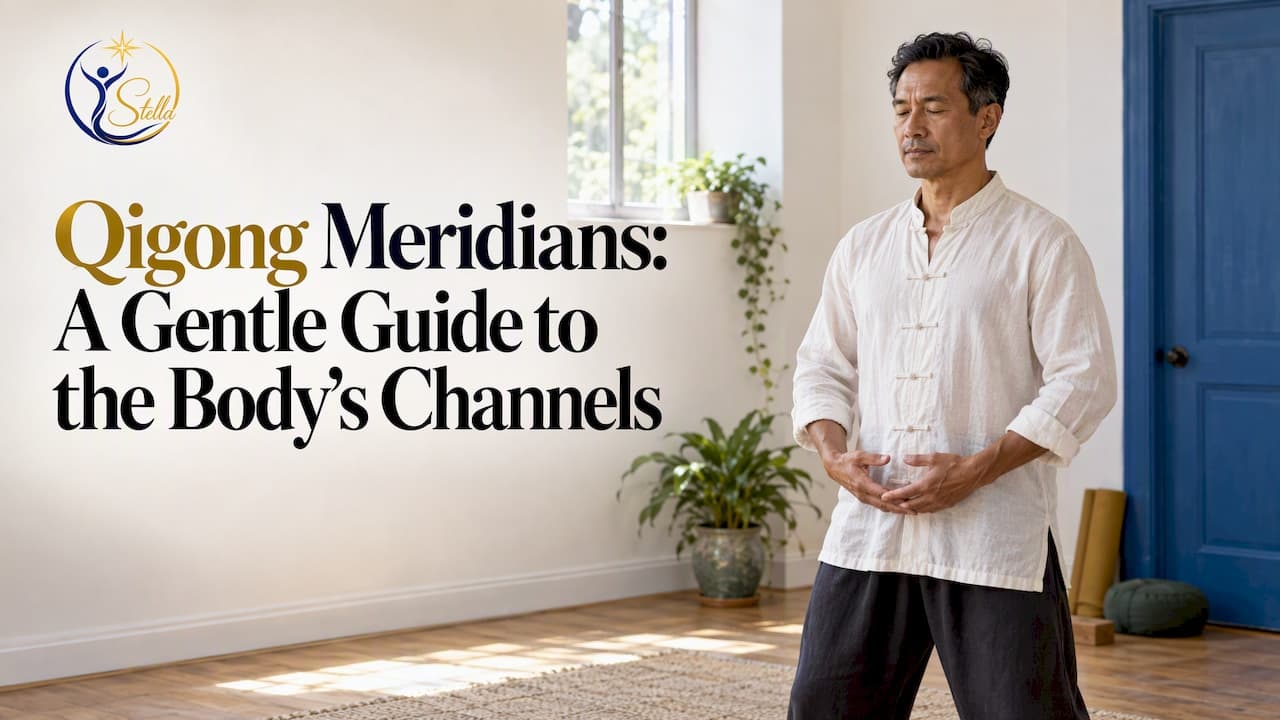
In qigong, meridians are the pathways through which qi, your vital energy, is said to travel around the body. The practice is built on slow movement, soft breathing and quiet attention, all aimed at keeping those pathways open and balanced. You do not need to memorise a map to begin. You need a calm space, a few simple movements and a little patience.
This guide explains what meridians are in traditional Chinese medicine, how qigong works with them, what science can and cannot say, and how to start in a way that feels nurturing rather than overwhelming.
Key Takeaways
- Meridians are the channel network of traditional Chinese medicine, through which qi is believed to circulate and keep the body balanced.
- Qigong uses gentle movement, breath and focus to support that flow. Researchers describe this as a hypothesis, not a settled mechanism.
- Beginners do best with a few smooth movements at a time, paired with relaxed abdominal breathing in a quiet place.
- Qigong appears to be safe for most people, but it should never replace seeing a health professional about a medical problem.
- You do not need to feel anything dramatic. Steady, regular practice matters more than chasing sensations.
What Are Meridians in Traditional Chinese Medicine?
In traditional Chinese medicine (TCM), qi circulates through the body along pathways called meridians, and good health means keeping that circulation balanced and harmonious. Many teachers also call them channels, which is a helpful picture: think of a network of streams and rivers that carry nourishment to every part of a landscape.
In this tradition, the channels are linked with the internal organs, and they run through the limbs, the torso and the head. When the flow is smooth, you feel steady, warm and clear. When it is sluggish or blocked, the tradition describes tension, tiredness, low mood or discomfort. This is the language of TCM, a framework for understanding the body that has been used for a very long time. It is different from the vocabulary of anatomy, and it is worth holding both gently without forcing them to match.
If you have heard of acupuncture, you have already met the meridians. Acupuncture points are places along these channels where the tradition says qi can be influenced. Qigong offers a way to do something similar from the inside, through your own movement and attention.
How Qigong Works With the Meridians
Qigong is a practice that brings together posture, breathing and mindfulness. According to the research literature, it is proposed to maintain the openness of the meridian paths through movement and through self-stimulation of acupuncture points, such as tapping, rubbing or pressing.
There are three ingredients, and each supports the others:
- Gentle movement. Slow stretching, opening and closing, and soft turning of the spine move the tissues along the channel lines.
- Breath. The US National Center for Complementary and Integrative Health notes that qigong typically uses slow, long, deep breathing and gentle, smooth movements for relaxation, along with focused attention or visualisation.
- Attention. Resting your awareness on a part of the body, such as the belly, the palms or the soles of the feet, is how many practitioners "follow" the qi.
A useful way to think about it: movement opens the channels, breath carries the energy through them, and attention guides it. You do not have to force anything. Qigong teachers often say the more you soften, the more the flow can settle.
A Modern Way to Picture the Channels
Researchers have offered several ideas about what meridians might correspond to in the body. One proposal, published in the journal Medical Hypotheses in 2018, suggests the meridian network may be related to the body's interstitial fluid spaces and lymphatic system, which could help explain why mechanical movement affects overall health.
Another line of thought looks at connective tissue. A review by Bai and colleagues in 2011 proposed that the fascia network could provide an anatomical basis for meridian patterns, noting that three-dimensional reconstructions of human fascia line up closely with the traditional distribution of meridian lines.
So is qigong a form of fascia release? It is fair to say that slow, continuous, stretching movements are likely to engage the connective tissues, and some researchers see an overlap with the channel lines. These are ideas under investigation, offered as perspectives rather than proven explanations. For your practice, what matters is simpler: unhurried movement tends to leave the body feeling looser and calmer.
What "Opening the Meridians" Actually Means
A common question is how to open your meridians. In qigong, "opening" is not a dramatic event. It means restoring an easy, unobstructed flow, much like unkinking a garden hose. In practice it looks like this:
- Releasing physical tension. Tight shoulders, a clenched jaw and a held belly all restrict the movement of breath and qi.
- Settling the breath. The breath becomes slower and deeper, and the exhale lengthens.
- Quieting the mind. Thoughts slow down, and the nervous system can move away from alert mode.
- Repeating regularly. The body learns the pattern, and the sense of ease returns more quickly each time.
Some researchers have tried to measure this. One study team generated schematics of the major meridians and their flow directions by recording tiny electrical differences at acupuncture points on the skin. This is an interesting line of work, but it is early, and it is best read as an attempt to give a traditional idea a measurable form.
What You Might Notice
Practitioners often describe warmth, tingling or a feeling of heaviness in the hands, a softer belly, or a general feeling of spaciousness. Some notice nothing in particular in the first weeks, apart from feeling a little calmer afterwards. Both experiences are completely normal. Treat sensations as pleasant side notes, not as a score.
The Channel Systems in a Qigong Practice
Different qigong styles organise the meridians in different ways, and it is helpful to know the main approaches when you read about them online:
| Approach | What it focuses on | Good for |
|---|---|---|
| Organ-channel sequences | Movements that connect each organ with its associated channel, often with a sound or an emotion | Those who enjoy a structured, step-by-step map |
| Whole-body flow sets | Continuous movements that sweep through all the main channels in turn | Beginners who want a simple, rhythmic routine |
| Acupoint self-massage | Tapping, rubbing and pressing along the channel lines | A quick, seated reset at a desk or before bed |
| Animal and nature-inspired forms | Movements modelled on animals, with each one linked to the organs and the seasons | People who prefer imagery and playfulness to anatomy |
Nature-inspired practice has deep roots in the tradition. An academic overview of health cultivation qigong describes how this style of practice conforms to nature and the seasons, which is one reason so many forms borrow images from animals, weather and landscape.
This is also how we teach. White Tiger Qigong and Five Animal Qigong both work with the flow of energy through the body in a gentle, accessible way, and you can learn them without any background in Chinese medicine.
How to Start Practising: A Simple Beginner Routine

You do not need special clothes or equipment. A quiet corner and ten minutes are enough. The NHS guidance for beginners on a closely related practice, Shibashi, suggests you begin with a few movements at a time, keep them smooth and continuous, coordinate them with abdominal breathing and practise somewhere quiet and peaceful. That advice works just as well for any beginner qigong.
Here is a short routine that follows those principles:
- Arrive (1 minute). Stand with your feet hip-width apart, knees soft, shoulders loose. Let your arms hang. Take three slow breaths.
- Warm the channels (2 minutes). Rub your palms together until warm. Gently brush down the outside of each arm and up the inside, then down the front of each leg and up the back. This traces some of the main channel lines.
- Open and close (3 minutes). Slowly draw your hands apart as you inhale, as if opening a ball of light, and bring them together as you exhale. Let the movement come from your waist, not your shoulders.
- Sway and turn (3 minutes). Shift your weight softly from side to side and let your torso rotate, arms swinging loosely. Keep your breathing slow and low in the belly.
- Settle (1 minute). Rest your palms on your lower belly. Feel the breath rise and fall. Let your mind rest there.
If you want to go deeper into the breathing side, our guide to qigong breathing exercises for beginners walks through it step by step. For a wider introduction, see qigong for beginners, or the practical guide for complete beginners.
Tips for Making It Stick
- Practise at the same time each day, so it becomes part of your rhythm.
- Keep the movements slow enough that you could comfortably hold a conversation.
- Stop short of strain. Qigong should feel like a stretch with a smile, never a struggle.
- Finish with stillness. The quiet minute at the end is where many people feel the effect most clearly.
Our Perspective
We teach qigong as a conversation between you and your own body, and the meridians are the best map we know for that conversation. You do not have to believe in qi to feel what happens when you move slowly, breathe low into your belly and let your shoulders drop. Many of the people who come to us are carrying stress, burnout or a sensitive gut, and they tell us the same thing: they have been trying to think their way to calm, and it is a relief to be invited to move their way there instead.
That is why we focus on targeted, beginner-friendly programmes rather than a long list of theory. The gut and the nervous system are closely tied in the Chinese medicine view, and a practice that soothes one often supports the other. Our lessons are led by a White Tiger Qigong Level 3 certified instructor who is also accredited by Yoga Alliance, and they are designed to help you build a routine you can keep, with guidance when you need it.
If meridians feel abstract, start with the movement. The understanding grows from the practice, not the other way round.
Stella
What Does the Research Say?
The honest answer to "does qigong work?" is that the picture is promising but still developing. A 2015 Cochrane review found that the evidence for movement therapies, including qigong, was unclear because the quality of the studies was low or very low. A later 2018 review from the US Agency for Healthcare Research and Quality, reported on the same page, concluded that qigong improved function and/or pain for at least one month.
For fibromyalgia, the NCCIH reports that studies found benefits after 30 to 40 minutes of daily practice for 6 to 8 weeks. That is a useful pointer for anyone planning a routine: consistency over a couple of months is what the studies looked at.
Other gentle mind-body exercise is studied in a similar way. If you are curious how researchers weigh up fall prevention against bone outcomes, a summary of tai chi for osteoporosis shows how the same questions about evidence strength come up across the family of slow-movement practices.
What does this mean for you? Qigong is a low-risk, low-cost way to move, breathe and relax, and many people find it worthwhile for how they feel. It is best viewed as a supportive practice alongside, not instead of, the care your doctor recommends. If you live with a joint problem, our guides to qigong for lower back pain and qigong for knee pain show how to adapt the movements.

Practising Safely
The NCCIH states that qigong appears to be safe, and that many studies have found no negative side effects in people who practise, including people with chronic diseases and older adults. A few points are worth keeping in mind:
- Pregnancy. Pregnant women should check with their health care provider first, and may need to avoid or modify some movements. Our article on qigong in pregnancy covers trimester adaptations.
- Medical problems. Do not use qigong to put off seeing a health care provider about a medical problem. If you have persistent pain, digestive symptoms or low mood, see your GP first and treat qigong as a companion to their advice. Those with inflammatory bowel conditions will find more in our piece on qigong for IBD.
- Expectations and technique. The NCCIH notes there have been reports of qigong-induced mental disorders linked to unrealistic expectations or inappropriate practice. Keep your expectations modest, avoid forcing intense sensations, and learn from a qualified teacher.
- Age and mobility. Qigong can be done seated or holding a chair. See qigong for seniors for a gentle starting point.
If you are unsure whether a movement suits your body, our guide to qigong contraindications explains who should modify or avoid practice.
Learn the Flow With Guidance
Reading about meridians is a good start, but the real understanding comes through your own body, and it is easier with someone to show you the details of posture and breath. Our course, Qigong for Stress Relief and Digestive Wellness, is £116 as a one-off purchase and is designed to help you calm the nervous system and support your digestion through gentle, guided movement.
If you would rather have personal attention, we offer a 30-Minute Clarity Session at £85, a 60-Minute Deep Dive Online Session at £145 and a 60-Minute Face-to-Face Qigong session at £165. Group classes are also available. You can see everything on our online qigong classes page. If you are drawn to the animal forms, explore Five Animal Qigong or White Tiger Qigong.
FAQ
What are meridians in qigong?
Meridians are the channels through which qi is said to flow in traditional Chinese medicine. Qigong uses gentle movement, breath and focused attention to support smooth, balanced flow along them. Different styles emphasise different channels, but the principle is the same.
Does qigong work?
Reviews of the evidence describe benefits for pain and function in some studies, though the quality of the research is often low. Qigong appears safe and many people find it calming. It works best as a regular practice that complements, rather than replaces, medical care.
Is qigong a form of fascia release?
Not exactly, but there may be an overlap. Some researchers propose that the fascia network provides an anatomical basis for the meridian lines, and slow stretching movements engage connective tissue. This remains a hypothesis, so think of it as an interesting perspective rather than a proven fact.
How do I open my meridians?
Start with relaxed posture, slow abdominal breathing and a few smooth, continuous movements, practised regularly in a quiet place. Warming the hands and brushing along the arms and legs is a simple way to bring attention to the channels. Avoid forcing sensations, and build up gradually over weeks.
Sources
- Traditional Chinese Medicine: An Introduction (govinfo.gov)
- Meditative Movement, Energetic, and Physical Analyses (PMC)
- Medical Hypotheses: mindfulness-led breathing and the meridian network
- Review of Evidence Suggesting That the Fascia Network Could Be the Anatomical Basis for Acupoints and Meridians (PMC)
- The Theory and Practice of Health Cultivation Qigong (PubMed)
- Tai Chi for beginners: a basic introduction to the forms (NHS Torbay and South Devon)
- Qigong: What You Need To Know (NCCIH)
- Mind and Body Approaches for Chronic Pain: What the Science Says (NCCIH)
- Anxiety and Complementary Health Approaches (NCCIH)
- Tai Chi for Osteoporosis: Fall Benefits Are Clearer Than Bone Gains