
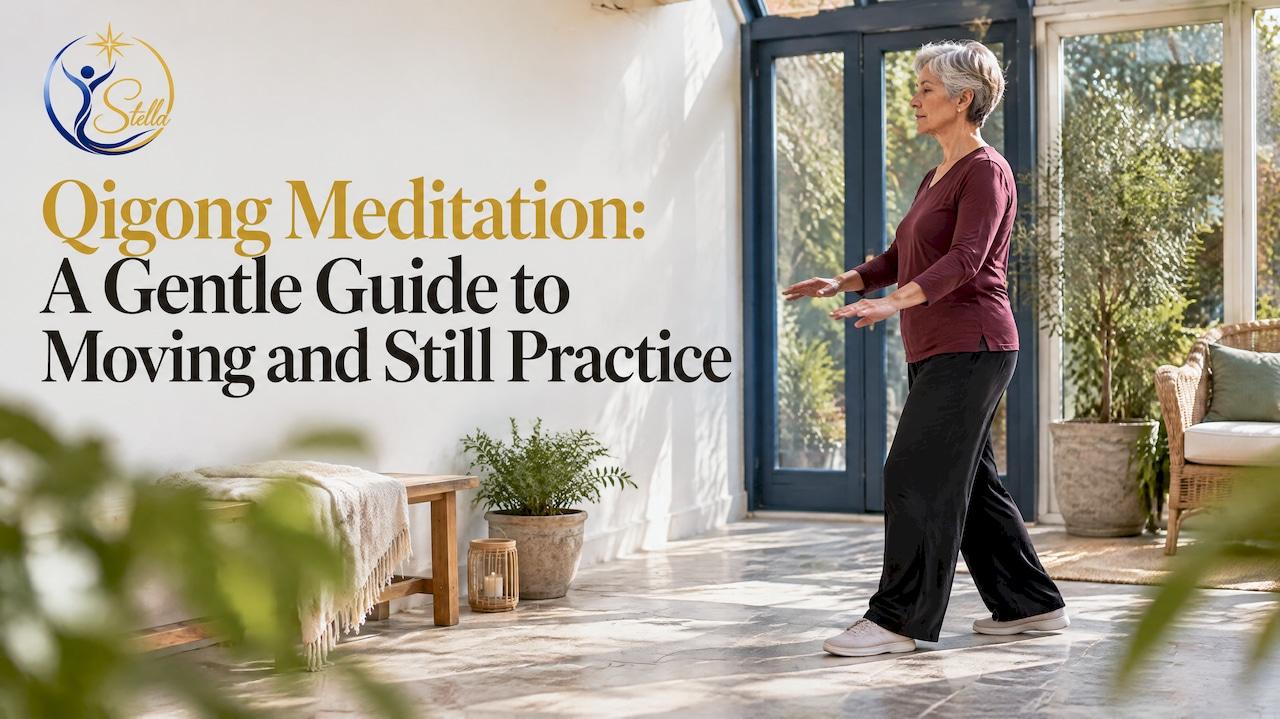
Qigong meditation is a calm practice that joins slow movement or a steady posture with soft breathing and relaxed attention. You can do it standing, seated or in motion, often in 5 to 10 minutes a day, and you need no experience. This guide explains what it is, how to begin, what research does and does not show, and how to choose a mindful movement class that suits you.
Key Takeaways
- Qigong meditation brings together mind, breath, movement and posture. Some forms are flowing, others almost still, and both count as meditation.
- Start small: 5 to 10 minutes, a stable stance, relaxed joints and slow, even breathing.
- Research on stress and anxiety is encouraging, though many trials are small, so it is best seen as a gentle, supportive practice.
- Qigong can be adapted to standing, seated or wheelchair practice, and a guided class helps you settle into it.
- Check with your GP or health professional first if you have a health condition, and stop if you feel pain, breathlessness, chest discomfort or light-headedness.
What qigong meditation actually is
Qigong is a Chinese practice that developed over thousands of years within traditional Chinese medicine. The US National Center for Complementary and Integrative Health describes qigong as a way of regulating the mind, breath, movement and posture to support health and wellbeing.
So "qigong meditation" is not one single technique. It is the meditative side of qigong, and it shows up in two broad ways:
- Dynamic forms use whole-body or limb movement, slow and repeated, with the mind resting on the breath and the sensations of moving.
- Passive or still forms hold a maintainable posture with breath and mind exercises and almost no outward movement, according to NCCIH.
The University of Minnesota's wellbeing programme gives a useful way to picture the two. Traditional teaching often begins with physical movements coordinated with breathing. Once you know the form, your attention moves to the subtle flow of posture, breath and transitions, which is described as moving meditation. The same source links outward, movement-based practice with the term Wai Dan, and sitting meditation with guided imagery with Nei Dan.
In research, this family is sometimes called meditative movement: movement or posture combined with breath focus and a meditative state, aiming at deep relaxation. A 2014 trial report places qigong, tai chi and yoga in that group.
Moving meditation or sitting meditation?
Many people who find sitting still difficult discover that moving meditation is a softer doorway. The body has something to do, so the mind has an anchor. If your thoughts race, or you spend long hours at a desk, flowing movement can feel kinder than a cushion and a timer.
Here is a simple way to compare the styles:
| Flowing qigong | Standing qigong | Seated qigong | |
|---|---|---|---|
| Main focus | Breath linked to slow movement | A held posture, rooted and relaxed | Breath and visualisation |
| Movement | Continuous, gentle | Almost none | Little or none |
| Good if you | Feel restless or stiff | Want calm and steadiness | Prefer a chair or have limited mobility |
| Typical beginner length | 5 to 10 minutes | 3 to 10 minutes | 5 to 10 minutes |
None of these is better than the others. Many practitioners combine them: a few minutes of loosening and flowing movement, then a standing or seated pause to let everything settle.
Breath is the thread running through all three. NCCIH notes that qigong commonly uses slow, long and deep breathing, gentle smooth movements, focused attention and visualisation. If you would like to explore breathing more widely before you begin, these breathing improvement techniques are one place to start.
How to begin: a simple 10-minute practice
You do not need a special room or clothing. Wear something loose, find a floor you can stand on comfortably, and let your shoulders drop. NCCIH's guidance for beginners is to keep sessions short, even 5 to 10 minutes, move slowly and with attention, avoid forced positions, and stop if pain or discomfort appears.
Try this sequence:
- Arrive (1 minute). Stand with feet about hip-width apart, knees soft, arms hanging. Let your eyes rest on a point ahead or close them gently. Notice your breathing without changing it.
- Soften (2 minutes). Slowly rock your weight from one foot to the other. Let your shoulders, jaw and hands loosen. Imagine tension melting down through your legs into the floor.
- Flow (4 minutes). Breathing in, raise your arms slowly to shoulder height, palms down. Breathing out, lower them as if pressing down on a cushion of air. Repeat at the pace of your breath. If your mind wanders, return to the feeling of your hands.
- Stand still (2 minutes). Pause with arms by your sides, or with hands resting low on your belly. Feel your feet and the steady rhythm of your breathing.
- Close (1 minute). Rub your palms together until warm, rest them over your lower belly or your eyes, and take one slow breath before moving on.
If standing is not comfortable, do all of it seated. The US Department of Veterans Affairs notes that qigong movements can be done standing, seated, with a walker or in a wheelchair.
For more ideas on easing in, our guides to qigong for beginners and a short qigong warm-up with seated options walk you through the first steps. If you prefer holding a posture, read about standing qigong meditation for stress relief and posture.

Making it a habit
Consistency matters more than length. Pair your practice with something you already do: after brushing your teeth, before your first coffee, or when you finish work for the day. Five calm minutes daily will nurture more than one long session a month. If you want a ready-made structure, a daily qigong routine for stress reduction gives you a pattern to follow.
What about "developing qi"?
Readers often ask how to develop qi. In traditional practice, qi is understood as the vital energy of the body. NCCIH says qigong exercises aim to optimise energy within the body, mind and spirit through regulating the mind, breath, movement and posture.
In practical terms, you do not "make" qi through effort. You make room for it. That means:
- loosening habitual tension in the neck, shoulders and belly
- breathing slowly, and lengthening the exhale
- keeping attention soft, noticing warmth, weight, tingling or ease in the hands and feet
- practising often and gently rather than forcing sensations
The roots of these ideas are old and varied. A 2026 history article traces qigong's antecedents to guiding and pulling practices, Buddhist quiet sitting, Daoist visualisation and later Neo-Confucian self-cultivation. That mix is why modern qigong can feel part exercise, part meditation and part gentle breathwork.
What the research says about stress, anxiety and digestion
Qigong meditation is calming for many people, and researchers have begun to measure it. The honest picture is promising but still developing.
Stress. A 2024 systematic review of nine randomised trials found that qigong lowered perceived stress compared with no treatment in a two-trial analysis. It did not significantly outperform other active approaches in three further studies. Only one of the nine trials was rated high quality, so the authors felt firm conclusions were still hard to draw.
Anxiety. A 2026 meta-analysis of exercise interventions reported a moderate anxiety-reducing effect for tai chi and qigong across seven studies and 231 participants, although the programmes and populations varied.
Quality of life. A 2023 umbrella review reported improvements in overall quality of life, cancer-related fatigue and cognitive impairment. Findings for sleep and gastrointestinal problems varied between programmes, and longer practice may be needed.
Digestion. A 2019 systematic review of 14 trials with 683 people with irritable bowel syndrome suggested that exercise approaches, including Baduanjin qigong, may help IBS, though the methods of the studies meant no firm conclusion about the true effect.

What does this mean for you? Think of qigong meditation as a supportive daily practice that sits alongside the care you already receive, not a replacement for medical advice. Many people value it simply because it gives them a regular, peaceful pause. If stress and gut comfort are your main interests, our article on how qigong movement therapy supports stress and gut health goes deeper, and building stress resilience with qigong shows how to weave it into a busy week.
Who should take care, and how to practise safely
NCCIH describes qigong as generally safe in the studies available, including studies of older adults and people with chronic disease. In a review of adults with neck pain, side effects were comparable with other exercise groups, occurred in fewer than 10% of people and included muscle pain, soreness and headache.
To keep your practice gentle:
- Talk to your GP, physiotherapist or specialist before starting if you have a heart or lung condition, balance problems, an injury, are pregnant, or are recovering from surgery. The VA's advice is to ask your health care provider whether qigong is right for you.
- Keep knees soft and never lock your joints or force a posture.
- Stop if you notice pain, shortness of breath, chest discomfort or light-headedness, and seek medical advice if it persists.
- Use a chair or a wall for balance whenever you want to.
If you are exploring gentle movement for joints or nerve-related discomfort, see our UK six-week plan for qigong with sciatica. For low mood, our guide to qigong for depression offers routines to use alongside support from your GP or therapist.
Mindful movement and moving meditation classes: what to expect
Many people searching for mindful movement classes or moving meditation classes are really looking for one thing: a guided, unhurried space where they can learn to relax in the body. Qigong fits that description well.
According to the VA, a session may include instructor-guided movements, breathing exercises, meditation and simple repeated motions such as bending, stretching and shifting weight. The 2014 trial report adds that qigong and tai chi classes are generally low-impact with low-to-moderate aerobic exertion, though this varies by the practice and the session. It also notes that qigong typically uses simple, repeated movements, whereas traditional tai chi is usually a longer, more complex sequence. For a beginner, repetition is a gift: you can stop worrying about getting the steps right and start feeling the practice.
When choosing a class, look for:
- Clear, slow teaching with options for standing and seated practice
- A named lineage and recognised qualifications, so you know what you are learning
- A realistic rhythm, such as one short session each week plus a few minutes at home
- A format that suits your life: live online, in person or on demand
The class in one trial was 60 minutes, with participants also asked to practise at home on most days. You do not need to match a research protocol, but it shows how a steady rhythm is usually built. If you want a gentle overview of the options, see our guide to the easiest meditative movement types for beginners.
Our perspective
After years of teaching, we have found that the biggest obstacle to meditation is the belief that you must empty your mind. Qigong offers a kinder route. You give your attention to something real, the slow lift of your arms, the weight in your feet, the length of your out-breath, and calm follows. The mind has a place to rest.
That is why we teach qigong as a gentle movement practice rooted in Chinese medicine, with particular care for stress and digestive comfort. Many of the people who come to us are busy professionals, people feeling burnt out, or those whose stomachs tighten when life speeds up. They do not need another demanding programme. They need a routine that is simple enough to keep.
All of our instruction comes from a White Tiger Qigong Level 3 certified teacher who is also accredited by Yoga Alliance. We combine that training with a background in wellness and digital communication, so that online lessons feel personal, clear and easy to follow. Our aim is that you walk away with an empowering routine you can use on your own, whether you have five minutes or fifty.
Stella
Learn qigong meditation with guidance
If you would like a teacher alongside you, our online programme, Qigong for Stress Relief and Digestive Wellness, is a one-off purchase at £116 and is designed to help you ease stress and nurture your digestion through gentle movement and breath.
For personal guidance, we also offer a 30-minute Clarity Session at £85, a 60-minute Deep Dive Online Session at £145 and a 60-minute face-to-face qigong session at £165. Group classes are available too. You can see everything on our online qigong classes page. If you are drawn to a particular tradition, you can also explore White Tiger Qigong or Five Animal Qigong.
FAQ
What is the difference between qigong and qigong meditation?
Qigong is the whole practice of coordinating breath, posture, movement and attention. Qigong meditation is the meditative quality within it, whether you are moving slowly or holding a still posture. In practice the two overlap, and most sessions include both.
Can qigong help with anxiety?
Some research is encouraging. A 2026 meta-analysis found a moderate anxiety-reducing effect for tai chi and qigong, though the studies varied. Qigong works best as a gentle, supportive habit. If anxiety is affecting daily life, please speak to your GP as well.
Who should not do qigong?
Qigong is generally considered safe, but you should check with a health professional first if you have a medical condition, an injury or balance concerns. Stop if you feel pain, breathlessness, chest discomfort or light-headedness. Seated or supported versions are available.
How long should I practise each day?
Begin with 5 to 10 minutes. A short, calm session you repeat daily is more useful than a long one you dread. As it becomes familiar you can add time, or combine movement and standing stillness.
Sources
- Qigong: What You Need To Know, NCCIH
- Qigong, Taking Charge of Your Wellbeing, University of Minnesota
- Randomized Controlled Trial of Qigong/Tai Chi Easy, PMC
- Qigong Therapy for Stress Management: A Systematic Review, PMC
- Evidence for Choosing Qigong as an Integrated Intervention, PMC
- Exercise therapy of patients with irritable bowel syndrome, Wiley
- Comparative Efficacy of Exercise Interventions, Dovepress
- Tai Chi and Qigong, Whole Health, US Department of Veterans Affairs
- Tracing the origins of Qigong fever, Medical History, Cambridge
- Breathing Improvement Techniques: Your 2026 Practical Guide