
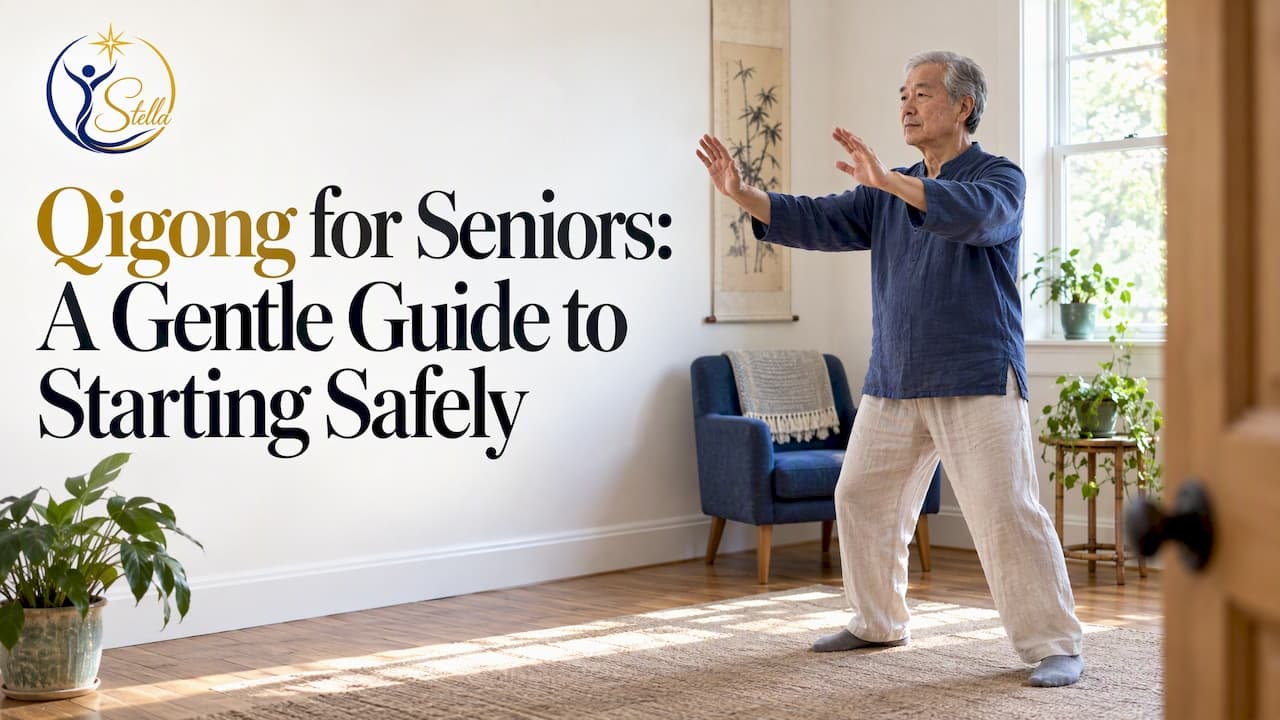
Qigong is one of the kindest forms of movement you can begin later in life. It uses slow, flowing movements, soft breathing and quiet attention, so you can practise standing or seated, at your own pace, with no special fitness. Research in older adults points to better balance, mood and quality of life. This guide explains what qigong is, what the evidence says, how to adapt it to your body, and how to begin with confidence, whether you are 55 or 85.
Key takeaways
- Qigong is slow, low-impact and easily adapted, including fully seated versions, so it suits most older beginners.
- Studies in older adults link regular practice with better balance, walking ability, mood and quality of life, though it is not a cure for any condition.
- Three sessions a week, under an hour each, kept up for around 12 weeks, is a sensible target based on current research.
- Speak to your GP or physiotherapist before starting if you have a medical condition, pain or balance problems, and choose a teacher who adapts movements to you.
- Gentle consistency matters far more than doing a lot at once.
Table of Contents
- What qigong is, and why it suits later life
- What research says about qigong for older adults
- Is gentle qigong safe for seniors?
- Seated or standing: choosing what feels right
- Three gentle movements to try today
- How often and how long to practise
- Qigong or tai chi: which is better for older adults?
- Starting at 50 or beyond: what to expect
- Our perspective: learning gently, with a teacher who adapts
- Learning with us
- FAQ
- Sources
What qigong is, and why it suits later life
Qigong (sometimes written qi gong or chi kung) is a Chinese practice that brings together meditation, breathwork, postural awareness and energy awareness in one practice. The movements are slow and repeated. You soften your shoulders, let the breath deepen, and move as if through warm water.
That makes it a natural fit as we age. There is no jumping, no heavy lifting and no need to get down on the floor. The movements can be small or large, and the pace is yours. If you have ever felt that exercise classes were not made for you, qigong is often the practice that feels different.
Many people searching for "senior qigong" are really asking three things: is it safe, will it help, and can I do it if I am stiff, tired or unsteady? The sections below take each in turn.
What research says about qigong for older adults
It is worth being honest here. Qigong has a growing body of research behind it, but trials differ in quality, style and length, so we describe the findings as encouraging rather than conclusive.
- Balance, walking and mood. A 2026 meta-analysis in Frontiers in Public Health found that Health Qigong significantly improved balance, 6-minute walk distance, quality of life and depressive symptoms in older adults. The same analysis noted that its benefits are comparable to conventional exercise, with a possible edge in overall quality of life.
- Physical and thinking skills. A 2023 meta-analysis of 17 randomised controlled trials, with a mean age of 70.3, found that tai chi and qigong had significant positive effects on both physical and cognitive function. The authors suggest qigong may help thinking both directly and by improving physical capability.
- Physical ability. A 2019 systematic review found that qigong exercise improved physical ability in older adults compared with usual care.
- Heart health. A review of traditional Chinese exercises suggested that forms such as Ba Duan Jin, Yi Jin Jing and Wu Qin Xi are promising for cardiovascular health, including lowering blood pressure.
What does this mean for you? Qigong is a credible, evidence-informed way to stay active and steady, and to support your mood. It is not a replacement for medical treatment, medication or physiotherapy. If you are interested in how far it can reasonably take you, our piece on what qigong can and can't do for longevity goes into this in more detail.
A note on falls and bones
Balance is often the reason people over 60 come to qigong. Related research on its close cousin tai chi suggests that fall-related benefits are clearer than bone-density gains, which is a helpful reminder: movement like this builds steadiness and confidence, and if you have osteoporosis or osteopenia, your clinician should guide any wider bone-health plan.
Is gentle qigong safe for seniors?
For most people, yes. The US National Center for Complementary and Integrative Health reports that qigong is generally considered safe, with studies showing no negative side effects in older adults or those with chronic conditions, although muscle soreness can occur. That is a US source, but the finding reflects trial evidence rather than local rules.
Some sensible precautions, applied where they matter:
- If you have a long-term condition, dizziness, heart problems or recent surgery, speak to your GP or physiotherapist before you begin. The Cleveland Clinic likewise advises consulting a healthcare provider before starting.
- If you live with chronic pain, depression or trauma, the National Qigong Association suggests practising slowly and with guidance, rather than pushing through on your own.
- If you have movement difficulties such as Parkinson's, Parkinson's UK explains that qigong's precise, repetitive movements and mindfulness can be adapted by instructors to suit individual needs.
- If you feel unsteady, practise seated, or standing beside a sturdy chair or worktop you can hold.
- If something hurts, stop. Mild muscle tiredness the next day is normal. Sharp or joint pain is not.
One more point: in the United States, qigong instructors do not have to be licensed and there is no national standard for certification. The same is true of the UK in practice, so ask any teacher about their training, their lineage and how they adapt movements for older students.
Seated or standing: choosing what feels right
You do not need to stand to benefit. An NHS Torbay and South Devon leaflet on Shibashi qigong illustrates both standing and seated versions and invites you to choose the position that will help you most.
Here is how we tend to think about it:
| Your situation | A good starting point |
|---|---|
| Steady on your feet, a little stiff | Standing, feet hip-width, knees soft |
| Occasionally unsteady or easily tired | Standing beside a chair, or alternate standing and seated |
| Dizzy, recovering, or using a frame | Fully seated, feet flat, back tall but relaxed |
| Low energy or in pain today | Seated, small movements, mostly breathing |
Parkinson's UK notes that instructors can make movements small and subtle, or large and expansive, depending on the student's physical condition. You can do the same at home: shrink a movement when you are tired, and let it grow when you feel strong.
If you would like a ready-made seated practice, try our 7-minute seated qigong routine. For a short opener, our 5 to 10 minute qigong warm-up with seated options is informed by NHS guidance.
Three gentle movements to try today
These are simple, general movements, not a prescribed programme. Do them seated or standing, slowly, and stop if anything feels wrong.
1. Lifting the sky
Sit tall with your hands resting in your lap. Breathe in and let your palms float up in front of you, turning them to face the ceiling as they rise. Breathe out and let them sink back down. Repeat six to eight times, letting the shoulders melt away from the ears.
2. Opening the chest
With elbows soft, draw your hands apart like opening a gentle curtain as you inhale, then bring them back towards each other as you exhale. Keep the movement small if your shoulders are stiff. Six to eight rounds is plenty.
3. Slow belly breathing
Rest one hand on your lower belly. Breathe in through the nose and feel the belly rise softly; breathe out slowly and feel it settle. Do this for two to three minutes. It is the quietest of the three, and often the most calming.
When you are ready for more shape, our beginner qigong sequence builds a 10-minute daily routine, and walking qigong is a lovely outdoor option.
How often and how long to practise
You do not need long sessions. The National Qigong Association says consistency matters more than the length of any one session, with general health maintenance often involving 30 to 60 minutes, three to five times a week.

The 2026 meta-analysis suggests that at least three sessions a week, for at least 12 weeks, with sessions under 60 minutes may maximise benefits for depression and quality of life. The NHS Torbay and South Devon leaflet adds that Shibashi practised daily can cultivate deep relaxation and calm, and that results can often be noticed within three months.
A realistic first month might look like this:
- Week 1: five to ten minutes, three days. Mostly breathing and two or three movements.
- Week 2: ten minutes, three or four days. Add a second movement or two.
- Week 3: 15 minutes, four days. Notice where you feel looser.
- Week 4: 15 to 20 minutes, three to five days, with a little standing practice if it feels right.
The same leaflet suggests learning a few movements at a time. If you are new to all of this, our guide to starting qigong practice at home and qigong for complete beginners walk you through the first steps.
Qigong or tai chi: which is better for older adults?
Both are slow, gentle and well studied together. Parkinson's UK describes qigong as often preferred for general health and ease of learning, because it relies on precise, repeatable movements. Tai chi tends to string movements into longer, more complex sequences that take more time to learn.

If you want something simple you can repeat daily, even from a chair, qigong is a very good place to begin. If you later want a longer choreographed form, tai chi will still be there.
Starting at 50 or beyond: what to expect
If you are over 50 and new to this, you might wonder if you have left it too late. You have not. The studies above include participants with an average age above 70, and qigong is designed to be adapted rather than mastered.
Realistic expectations help:
- In the first weeks, you will probably notice calmer breathing and a little more ease in the shoulders and back.
- Over a few months, many people feel steadier and more relaxed. Research suggests balance and mood can improve, but results vary from person to person.
- Qigong will not replace medication, physiotherapy or a falls-prevention programme your GP recommends. It can sit comfortably beside them.
If dizziness is part of your picture, see our article on qigong for dizziness for UK adults, and for stability work in general, five qigong moves to track for balance.
Our perspective: learning gently, with a teacher who adapts
We teach qigong because we have seen how it changes the way people carry stress in the body. Our instruction comes from a White Tiger Qigong Level 3 certified teacher who is also accredited by Yoga Alliance, and who brings experience in professional wellness.
What we have learned is simple. Older students rarely need more effort. They need permission to go slowly, to sit when they wish, and to be told that a smaller movement is still a real one. Free videos can be a lovely way to begin, and a class is helpful rather than essential, as one Cleveland Clinic physician puts it. Where a teacher makes a real difference is in the details: how to protect a sore knee, how to soften a rounded back, how to stay with the breath when the mind is busy.
So our advice is to start small, keep it kind, and let the practice grow at the speed of your body. Nothing about qigong asks you to prove anything.
— Stella
Learning with us
If you would like guidance rather than going it alone, we offer online and in-person qigong with a certified instructor. The Qigong for Stress Relief and Digestive Wellness course is £116 one-off and can be followed at your own pace. For personal attention, you can book a 30-minute Clarity Session at £85, a 60-minute Deep Dive Online Session at £145, or a 60-minute face-to-face session at £165, where movements can be adapted to your joints, balance and energy. We also run group classes; see the classes page for details. Not sure where to begin? Start from our home page and explore.
FAQ
Is qigong good for seniors with poor balance?
It can be, when adapted. Research in older adults has found improvements in balance after Health Qigong, and you can start seated or beside a sturdy support. If you have been told you are at risk of falls, check with your GP or physiotherapist first.
Can I do qigong if I have never exercised before?
Yes. Qigong is built from slow, repeatable movements that do not need fitness or flexibility. Start with five to ten minutes, three days a week, and add time gradually.
How long before I notice a difference?
You may feel calmer after a single session. Longer-term changes take more patience: the NHS leaflet notes that results from daily Shibashi practice can often be seen within three months, and the 2026 meta-analysis points to at least 12 weeks.
Do I need a teacher?
Not strictly. Free videos are a reasonable way to begin, but a teacher can adapt movements to your body and spot habits you cannot see yourself. This matters most if you have pain, a medical condition or balance concerns.
Sources
- What Is Qigong? National Qigong Association
- Effects of Health Qigong on quality of life, Frontiers in Public Health (2026)
- Effects of Tai Chi and Qigong on cognitive and physical function (2023)
- Physical and Psychological Health Outcomes of Qigong (2019)
- Health benefits of traditional Chinese sports and physical activity (2016)
- Qigong: What You Need To Know, NCCIH
- Tai chi and qigong for Parkinson's, Parkinson's UK
- Tai Chi for beginners, NHS Torbay and South Devon
- Your Guide to Qigong, Cleveland Clinic
- Tai Chi for Osteoporosis: Fall Benefits Are Clearer Than Bone Gains