
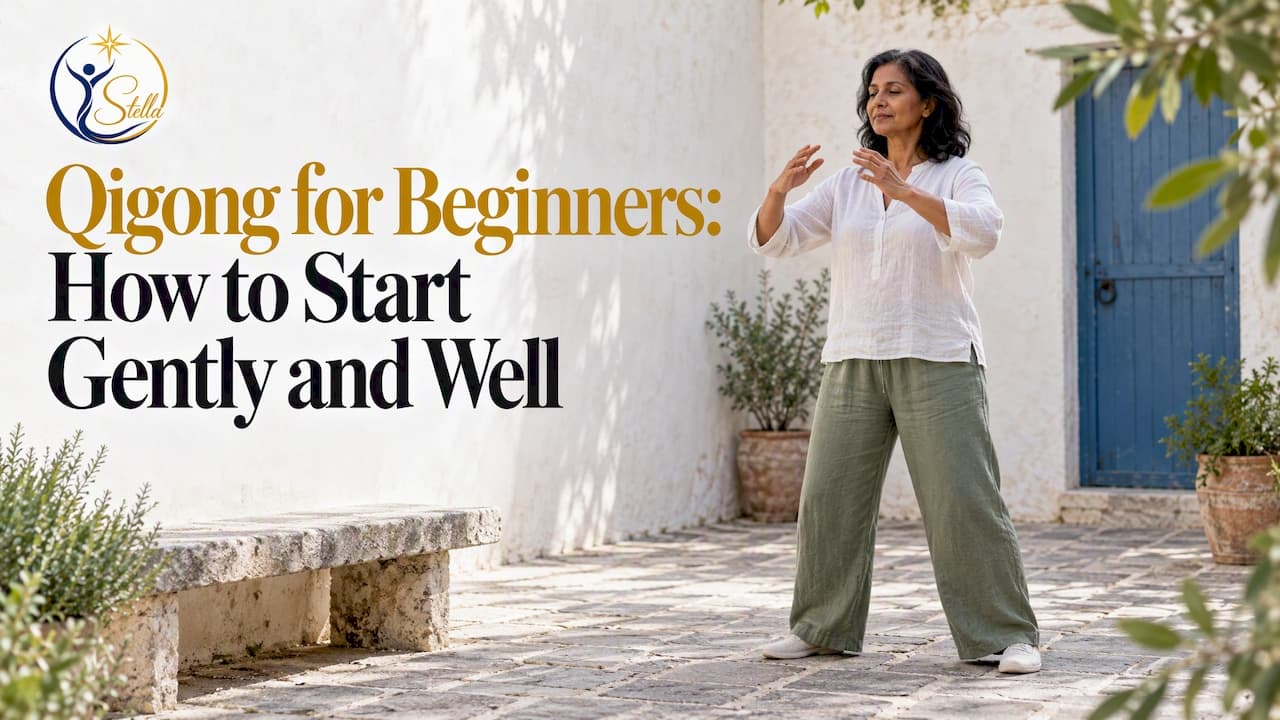
If you are new to qigong, the simplest way to begin is this: stand or sit comfortably, soften your shoulders, breathe slowly, and move with unhurried, flowing motions for about ten minutes a day. You need no equipment, no flexibility and no experience. Qigong (pronounced "chee-gung") is a gentle Chinese practice that joins movement, breath and focused attention, and it welcomes people of nearly every age and ability. This guide shows you what to expect, which first exercises to try, how to stay safe, and how to choose between free videos, classes and one-to-one teaching.
Key Takeaways
- Qigong combines slow movement, deep breathing and calm attention, and it can be done standing, seated or lying down.
- Ten minutes a day is a sound place to begin. Regular short sessions matter more than long, occasional ones.
- Start with a loose standing posture, soft knees, a relaxed jaw and easy breathing before you add any sequence.
- Qigong appears to be a safe activity, but it should never replace care for a medical problem, and some situations call for a chat with your GP first.
- You can learn online. Good form, clear explanation and a teacher who can adapt movements for you make the difference.
What qigong is, and what a first session feels like
Qigong developed in China thousands of years ago. According to the US National Center for Complementary and Integrative Health, it brings together mind, breath and body postures with the aim of supporting health and well-being. The practice generally involves gentle, smooth movements, slow, long, deep breathing and focused attention.
The National Qigong Association describes qigong as a blend of meditation, breathwork, postural correction and energy awareness in one practice. It also notes that qigong is widely accessible, and can be performed standing, seated or lying down. That is why it suits so many beginners, including people who feel put off by faster, more demanding exercise.
In practice, a first session is quieter than most people expect. You will probably:
- stand with your feet about hip-width apart and let your arms hang
- notice where you are holding tension, often the shoulders, jaw and lower back
- move your arms slowly, as if gliding through water
- match each movement to an unhurried in-breath or out-breath
- finish by standing still for a minute and noticing how your body feels
In the Chinese medicine tradition that qigong comes from, "qi" is the vital energy that moves through the body. You do not need to believe in any particular theory to begin. Many beginners simply describe feeling calmer, warmer in the hands and more grounded after a few minutes. Treat it as a mindful, movement-based pause in your day, and let your own experience guide you.
If you would like a deeper look at the tradition, our guide to Daoist qigong for beginners explains the ancient roots and how to practise in ten minutes.
Setting up: where, when and what to wear
Qigong asks very little of your surroundings. A few small choices, though, help you settle faster and stay with it.
Choose a quiet corner. You need roughly the space to stretch your arms out to the sides. A rug or a bare floor is fine. If standing is difficult, a stable chair works well.
Wear loose clothing. Anything that lets your waist, shoulders and knees move freely is ideal. Many people practise in socks or bare feet, which makes it easier to feel the floor beneath you.
Pick a regular time. Morning practice can awaken your energy before the day begins. Evening practice can help you melt away the tension of a busy day. Choose the slot you are most likely to keep. If you would like a step-by-step approach to building a habit, see our guide on how to start qigong practice at home.
Warm up gently. A few minutes of shoulder rolls, soft knee bends and easy side-to-side turns prepare the joints. Our qigong warm-up for beginners takes five to ten minutes and includes seated options.
The foundations: posture, breath and attention
Before any named exercise, three simple skills carry almost everything else.
Posture: rooted and relaxed
Stand with your feet roughly hip-width apart and your toes pointing forward. Let your knees be slightly soft, never locked. Imagine a thread lifting the crown of your head, so your spine lengthens without stiffness. Let your shoulders drop, your chest soften and your tongue rest lightly behind your upper teeth. Your weight should feel evenly spread across both feet.
This is often called the standing, or "wuji", posture. It looks like doing nothing, and it is the best way to start, because it teaches you to notice tension and release it.
Breath: slow and easy
Breathe in through your nose, letting your lower belly gently expand. Breathe out slowly, softly, through the nose or the lightly parted lips. Do not force the breath or hold it. If you feel dizzy or strained, return to your natural breathing rhythm. The point is smoothness, not depth at any cost.
Our qigong breathing guide for beginners walks through this without rushing. If you like a very short, focused practice to try during a working day, this breathing routine for focus takes only a few minutes and pairs well with the slow breathing you will learn here.
Attention: follow the movement
Let your mind rest on the feeling of the movement: the weight of your arms, the air at your nostrils, the floor under your feet. When your thoughts wander, which they will, bring them back kindly. There is no failing here. Returning your attention is the practice.
Simple qigong exercises to try first
These five movements are traditional in spirit and gentle by design. Treat them as a starting menu, not a rigid sequence. Move at a pace that feels soothing, and stop any movement that causes pain.
1. Standing still (wuji posture)
Stand as described above and close your eyes or soften your gaze. Breathe slowly for one to two minutes. Scan from the top of your head to your feet, releasing tension as you go. This is your reset point between other movements.
2. Loosening and shaking
With soft knees, begin to bounce very gently, letting your arms and shoulders swing loose. Keep it small and easy. After about a minute, stop and stand still, noticing the tingling or warmth that often follows. It is a lovely way to release deep-held tension.
3. Lifting and lowering the qi
Start with your palms facing down at hip height. As you breathe in, slowly float your hands up to chest height while your knees rise slightly. As you breathe out, press your palms softly down while your knees bend a little. Repeat eight to twelve times. Let the breath lead the movement, never the other way round.
4. Opening and closing
Hold your hands as if cradling a soft ball in front of your chest. Breathe in as your hands move apart, and out as they come back together. Imagine feeling a gentle resistance between your palms. This movement is popular with beginners because it makes the sensation of qi easier to notice.
5. Gentle waist turns
Let your arms hang loose and rotate your torso slowly from side to side, so your arms swing lightly and tap your belly and lower back. Your feet stay planted and your head follows the movement naturally. This eases the spine and is particularly soothing after sitting for long periods.
For a more detailed walkthrough, read our first six qigong moves explained. When you are ready to link movements together, our 10-minute beginner qigong sequence shows how.
If you prefer to sit
Every movement above can be adapted to a chair. Sit towards the front edge of the seat with your feet flat and your spine tall. Keep the arm movements, the breathing and the waist turns, and let your legs rest. Our seated qigong routine takes seven minutes and is a calm choice for office days or low-energy days.

How often should you practise?
Ten minutes a day is enough to begin. Dr. Lin, quoted by the Cleveland Clinic, says that ten minutes a day is enough to practise qigong. That is encouraging news if your schedule is full.
A realistic plan for your first month might look like this:
| Week | Focus | Time per day |
|---|---|---|
| 1 | Standing posture and slow breathing | 5 to 10 minutes |
| 2 | Add loosening and lifting and lowering | 10 minutes |
| 3 | Add opening and closing, and waist turns | 10 to 15 minutes |
| 4 | Link the movements into a short flow | 10 to 20 minutes |
If you miss a day, simply start again the next. Qigong rewards gentle consistency, not perfection. Pairing practice with something you already do, such as your morning kettle or the end of your working day, makes it much easier to stay with.
What research says about qigong and well-being
Many beginners come to qigong for stress, low mood, tension or digestive discomfort. It helps to know where the science stands, so your expectations stay realistic and kind to yourself.
The US Department of Veterans Affairs notes that tai chi and qigong may support general well-being and the management of pain, arthritis, breathing issues, balance challenges and mood issues, while adding that more rigorous research is needed. On anxiety specifically, the NCCIH reports that systematic reviews suggest potential benefits of qigong and tai chi for reducing anxiety and depression symptoms, particularly in adolescents, although results across studies are inconsistent.
In plain terms: qigong is a promising, low-risk way to support how you feel, and research is still developing. It works best as part of a caring approach to your wellbeing, alongside any support from your GP or other health professionals.
If balance and steadiness are your main interest, this article on tai chi, osteoporosis and falls looks at a closely related gentle practice.

Staying safe as a beginner
The NCCIH says that qigong appears to be a safe activity. It also gives two clear cautions. Pregnant women should talk with their health care provider before starting, and qigong should not be used to postpone care for a medical problem. If you have symptoms that worry you, such as persistent digestive changes, chest pain or ongoing low mood, see your GP first and treat qigong as a companion to their advice.
A few practical habits keep your practice comfortable:
- Move within comfort. Qigong should never hurt. Reduce the range of any movement that pulls at a joint.
- Keep your knees soft. Locked knees and deep squats are common beginner strains.
- Sit if you feel unsteady. A chair is a perfectly valid way to practise.
- Avoid chasing sensations. The NCCIH notes rare reports of mental disorders linked to qigong, often associated with unrealistic expectations or inappropriate practice. Gentle practice, sensible expectations and a qualified teacher are the best protection.
- Talk to a professional if you have a specific condition. If you live with high blood pressure, recent surgery, a joint replacement or a serious mental health condition, speak to your GP or specialist before you start, and share what they say with your teacher.
Our guide to qigong contraindications explains who should modify or avoid certain movements, and how.
Learning online: what to look for
You can absolutely learn qigong online. The Cleveland Clinic notes that many people learn from free online videos, and that taking a class is helpful but not necessary. Its advice is to focus on proper form and modify movements if needed.
Free videos are a lovely way to sample different styles. Where they fall short is feedback: a video cannot see that your shoulders are creeping up, or that you are holding your breath. Here is what to look for in any online course or class:
- A clear teaching lineage. Ask who trained the teacher and in which tradition.
- Beginner-friendly pacing. Movements should be broken down, repeated and offered with seated alternatives.
- Attention to safety. A good teacher asks about injuries and health conditions, and says when to check with your doctor.
- A format that suits you. Some people thrive on live classes with a group. Others prefer on-demand lessons they can repeat at their own pace.
- Opportunities to ask questions. Even occasional one-to-one time makes a big difference to your form.
We go through this in more detail in our guide, 3 steps to choose a qigong teacher in the UK.
Our perspective
Most beginners we meet arrive tired, tense or unsettled in their stomach, and they are worried they will do qigong "wrong". We always say the same thing: you cannot do it wrong if you do it gently. The aim is not to master a complicated routine. It is to teach your body that it is safe to slow down.
This is why we teach from the Chinese medicine tradition, with a focus on stress relief and digestive wellness. When you breathe slowly and move softly, your whole system has a chance to settle, and many of our students tell us that is when their digestion and sleep begin to feel calmer too. We offer this as our own experience of the practice, not as a cure.
Our teaching is led by a White Tiger Qigong Level 3 certified instructor who is also accredited by Yoga Alliance. That matters to us because a beginner deserves clear guidance, honest pacing and someone who can adapt each movement to your body. Whether you are a burnt-out professional, someone with a sensitive gut, or simply curious, you can start where you are today.
Stella
Your next step with Qigong Star
If you would like guidance beyond videos, our online qigong programme is designed for people who want a calm, structured start. Qigong for Stress Relief and Digestive Wellness is available for a one-off £116 and teaches gentle movement and breathwork for stress and gut comfort at your own pace.
Prefer personal attention? You can book a 30-minute Clarity Session for £85 or a 60-minute Deep Dive online session for £145. A 60-minute face-to-face session is £165, and we also run group classes. Prices are as published on our site, and you can see every option on our online qigong classes page. If you are curious about the traditions we teach, you can also explore White Tiger Qigong.
Building a practice you will keep
The beginners who stay with qigong are rarely the most flexible or the most disciplined. They are the ones who make it easy and pleasant.
- Keep it short. Ten calm minutes beat an hour you dread.
- Anchor it. Link practice to a daily cue, like before breakfast or after you close your laptop.
- Notice small shifts. A looser jaw, a slower breath, a quieter mind: these are real progress.
- Be patient. Subtle practices work over weeks, not days.
- Enjoy it. Let the movements feel nurturing, not like another task.
If stress is your main reason for starting, our guide to relaxation techniques without therapy shows how qigong can fit into a wider, gentle toolkit.
FAQ
Is qigong suitable for complete beginners?
Yes. Qigong uses slow, simple movements and can be done standing, seated or lying down, so people of many ages and abilities can begin. Start with the standing posture and slow breathing, and add movements gradually. If you have a health condition, check with your GP first.
How long does it take to feel the benefits?
Many people notice a calmer mood or looser shoulders within the first few sessions, but experiences vary. Research on qigong is still developing, so it is best to approach it with patience and curiosity. Practising for ten minutes most days is a good way to give it a fair try.
Do I need a teacher, or can I learn from videos?
You can learn from free videos, and many people do. A teacher adds personal feedback on posture, breathing and safe adaptations, which is especially helpful if you have injuries, anxiety or digestive concerns. A mix of both often works well.
Can I do qigong if I have a health condition?
Often yes, with adaptations, but speak to your GP or specialist first. Qigong should never be used to delay care for a medical problem, and pregnant women should talk with their health care provider before starting. A qualified teacher can then modify the movements for you.
What is the difference between qigong and tai chi?
Both are gentle Chinese mind-body practices that combine movement, breath and attention. Qigong tends to use simpler, repeated movements that are quicker to learn, while tai chi usually follows longer, more complex forms. Many beginners find qigong an easier first step.