
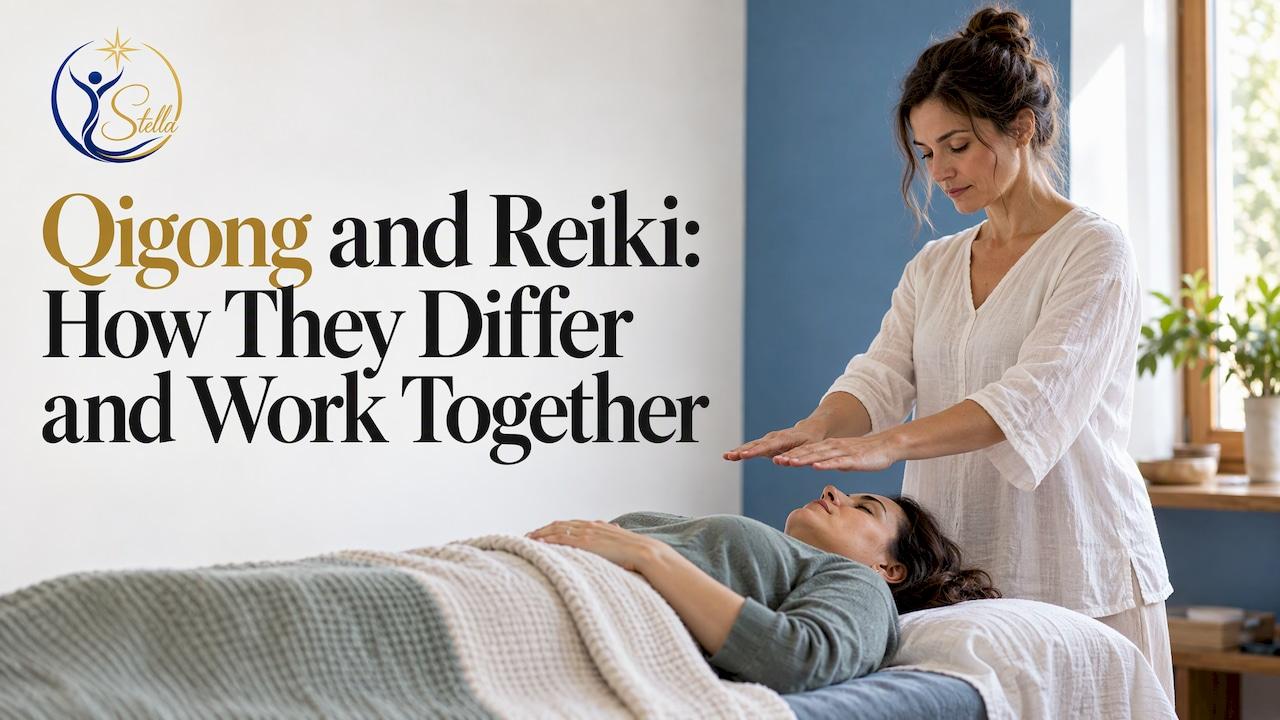
Qigong and Reiki are both gentle, energy-based practices, but they work in opposite directions. Qigong is something you do: slow movement, steady breathing and focused attention. Reiki is something you receive: a practitioner places their hands lightly on or just above your body. Many people enjoy both, and they sit comfortably side by side as part of a calm self-care routine.
This guide explains what each practice involves, where they overlap, what the research says, how to stay safe, and how to decide where to begin.
Key Takeaways
- Qigong is an active practice you learn and repeat yourself. Reiki is a hands-on or hands-near session given to you by a practitioner.
- Both aim to support the body's own balance and healing response, and both are generally regarded as gentle and low risk.
- Research on qigong for stress, sleep and pain is encouraging but mixed in quality. Reiki research is described by US health authorities as inconsistent.
- Neither practice replaces medical care. Tell your GP or specialist what you are doing, especially if you are pregnant or managing a health condition.
- If you want a skill you can use every day, qigong gives you a routine that stays with you.
What qigong and Reiki each involve
Qigong: movement, breath and intention
Qigong developed in China thousands of years ago as part of traditional Chinese medicine. According to the US National Center for Complementary and Integrative Health (NCCIH), it uses exercises to optimise energy within the body, mind and spirit, with the aim of improving and maintaining health and wellbeing.
In most forms, the same source explains, the breath is slow, long and deep, the movements are gentle and smooth for relaxation, and the mind focuses attention, sometimes with visualisation. The National Qigong Association describes it as cultivating energy through movement, breath and intention, and says it suits people of all ages and abilities, with movements that can be adapted.
The word qi is usually translated as life energy, and the practice is about helping that energy move freely. If you would like to understand the breathing side in depth, our guide to the role of breath in qigong walks through it step by step.
Reiki: gentle touch and focused intention
Reiki comes from Japan. Cleveland Clinic explains the name through two Japanese words, "Rei" (higher power) and "Ki" (life force energy), and describes practitioners placing their hands lightly on, or hovering over, the body.
NCCIH describes it as a complementary approach in which practitioners aim to direct energy to help facilitate a person's own healing response. You normally rest on a treatment table, fully clothed, while the practitioner works in quiet. There is no movement to learn and nothing to perform.
Qigong and Reiki side by side
Cleveland Clinic places both practices under the heading of energy healing: Reiki channels energy through the practitioner's hands, while qigong uses movement and breath to improve the flow of qi. Dana-Farber Cancer Institute draws the same line in its comparison for patients: in Reiki the practitioner places hands on or above a seated or lying person, while qigong combines meditation with body movement and breathing, often in gentle group sessions.
| Qigong | Reiki | |
|---|---|---|
| Your role | Active: you move, breathe and focus | Receptive: you rest while the practitioner works |
| Origin | China, within traditional Chinese medicine | Japan |
| Typical format | Classes, courses, daily home practice | One-to-one sessions, sometimes at a distance |
| What you take home | A routine you can repeat anywhere | A restful experience; some people later train to practise it themselves |
| Physical demand | Low intensity, adaptable to most abilities | None |
| Best for | Building a daily habit for stress, tension and vitality | Deep, passive rest when you want to be looked after |
The similarities matter as much as the differences. Both ask you to slow down, soften the breath and turn attention inwards. Both are rooted in the idea of an underlying life energy. Both are usually experienced as deeply relaxing.
For a wider view of how these and other approaches relate, see our comparison of mind-body healing modalities and our overview of TCM energy healing techniques.
Can you practise qigong and Reiki together?
Yes. Nothing about the two practices conflicts, and they are often combined in a single wellbeing routine. A common pattern is to use qigong as your daily practice and Reiki as an occasional treat: a session when life is demanding and you want to simply lie down and be supported.
Some therapists also offer both in one session, for example a short gentle movement sequence followed by a period of rest. Anyone who teaches both will tell you the movement settles the body first, so the rest afterwards comes more easily. You can also do this at home: a ten-minute qigong sequence to release tension, then a few minutes lying still with a hand resting on the belly.
If you have a Reiki session booked, there is no need to pause your qigong. Mention it to your practitioner, and mention both to your doctor if you are receiving medical treatment. NCCAM guidance advises people to tell all their health care providers about complementary practices so that care stays coordinated and safe.
What the research says about stress, anxiety and pain
Both practices are popular because people report feeling calmer afterwards. Research is still developing, and it is worth knowing where it stands.
Qigong
A systematic review of stress prevention through qigong reported that after a nine-week programme of two one-hour sessions a week, participants slept better, took less time to fall asleep and felt less fatigued, with effects still noticeable after three months.
Another systematic review of qigong as an integrative practice found studies reporting benefits across several conditions, including stress, depression and different kinds of pain, while noting a high risk of bias around blinding, which is hard to arrange in movement studies.
For pain, NCCIH describes the picture as mixed: reviews from 2018 and 2019 suggested qigong may reduce pain in certain groups, while a 2020 review found conflicting results for low-back and neck pain. In cancer care, an umbrella review found no evidence of risk and reported improvements in overall quality of life, cancer-related fatigue and cognitive impairment.
If low mood is part of your picture, our article on qigong for depression sets out routines of 45 to 60 minutes.
Reiki
A 2026 meta-analysis of biofield therapies found statistically significant effects on pain and on symptoms associated with mental disorders, with consistent small-to-moderate effects for anxiety and depression and a less stable estimate for stress. A randomised study in older adults reported differences in pain, depression and anxiety between a Reiki group and a wait-list group.
In the UK, a pilot trial of distance Reiki for frontline healthcare workers during COVID-19 involved 40 participants. After four consecutive days, they showed statistically significant decreases in stress, anxiety and pain, and increases in wellbeing and sleep quality. It was a small pilot without a control group, so it points to a direction rather than a conclusion.
NCCIH is cautious: it states that Reiki has not been clearly shown to be effective for any health purpose, because studies have been of mixed quality and results inconsistent. A review of biofield therapy trials likewise noted that the small pilot nature of most studies limits firm conclusions. The sensible reading is that many people find these sessions soothing, and that the formal evidence is still being built.
The experience of relaxation itself is real and valuable. Other restful, hands-on approaches are studied in similar ways: for example, this piece on massage for stress looks at what a single session can and cannot do within a wider plan.

Safety and sensible precautions
Both practices are widely regarded as gentle, but a few points keep your practice safe and supportive.
- Qigong appears to be a safe form of activity. NCCIH reports that many studies found no negative side effects. Where side effects were reported in a neck-pain review, they occurred in under 10% of people and included muscle pain, soreness and headache. Go gently, stop if something hurts, and build up gradually.
- Pregnancy. NCCIH notes there is no research on the safety of qigong during pregnancy and extremely limited research on practising it while pregnant. Speak with your midwife or doctor, who may suggest avoiding or modifying certain movements. The National Qigong Association also advises checking with a healthcare provider if you are pregnant or have existing health conditions. Our guide to qigong contraindications explains who should modify or avoid practice.
- Balance and bone health. If you are concerned about falls or osteoporosis, ask your doctor which movements suit you. This overview of tai chi and fall prevention shows how gentle movement is assessed in that context.
- Keep medical care in place. NCCAM guidance says not to use Reiki to replace proven conventional care or to delay seeing a health care provider about a medical problem. Cleveland Clinic similarly advises using energy healing alongside traditional medicine and working with your primary care provider. If you have persistent symptoms, see your GP.
- Choosing a Reiki practitioner. The same NCCAM guidance notes that training and certification for Reiki practitioners are not formally regulated, so ask about their training and experience before you book.
- Reiki and medical treatment. The University of Minnesota's Taking Charge of Your Wellbeing page reports no known adverse effects or contraindications and says Reiki can be used alongside conventional care. It also stresses that Reiki is not for diagnosis, and that in an emergency you should call emergency services (999 in the UK).
Which should you start with?
A simple way to decide is to ask what you need most right now.
- You want something you can do yourself, every day. Start with qigong. Short sessions of 10 to 20 minutes build a habit, and the National Qigong Association notes that many people practising for general health do 30 to 60 minutes, three to five times a week.
- You are exhausted and want to be looked after. A Reiki session offers passive rest, with nothing to learn or remember.
- You want both. Make qigong your foundation and add Reiki when you want extra support. Pairing movement with sound is another soothing option, explored in our guide to sound healing combined with qigong.
- You are new to both. Choose the one whose format you will actually keep up. A gentle class with a clear teacher is often the easiest way in, and our guide to relaxation techniques without therapy offers more starting points.
What a first qigong class feels like
Expect to stand or sit comfortably, with soft knees and relaxed shoulders. You will be guided through slow, flowing movements, each linked to an unhurried breath. You do not need flexibility, fitness or any background. Most people notice a steadier breath and a quieter mind within the first few minutes, and some feel pleasantly warm or tingly. Afterwards, drink some water and give yourself a moment before returning to your day.

What a first Reiki session feels like
You lie down fully clothed. The practitioner places their hands lightly on, or just above, different areas of the body, usually in near silence or with soft music. Many people describe warmth, heaviness or deep relaxation, and some simply drift off.
Our perspective on qigong and Reiki
I have seen again and again that people arrive tired, tense and a little sceptical, and what moves them is not a theory about energy but the experience of slowing down. Whether that comes through a hands-on treatment or a movement practice, the body is relieved to be allowed to rest.
What qigong adds is that the calm becomes yours. You learn how to settle your breath, soften your shoulders and soothe your digestion without needing anyone else in the room. That is why we teach it the way we do: gently, step by step, rooted in Chinese medicine and designed to support stress relief and digestive wellness.
All of our instruction comes from a White Tiger Qigong Level 3 certified teacher who is also accredited by Yoga Alliance, bringing professional wellness experience together with a practical understanding of how demanding modern working life can be. If you already enjoy Reiki, qigong will sit beautifully alongside it. If you are new to both, begin with the practice that gives you a tool for every day.
Stella
Begin your own qigong practice
If you would like a guided, beginner-friendly start, our course Qigong for Stress Relief and Digestive Wellness is available as a one-off purchase at £116. It is built around gentle movement and breath regulation, so you can practise at your own pace and return to it whenever you need to calm your system.
Prefer personal guidance? You can book a 30-Min Clarity Session at £85, a 60-Min Deep Dive Online Session at £145, or a 60-Min Face-to-Face Qigong session at £165. Group qigong classes are also available. See every option on our online qigong classes page, or explore the traditions we teach: White Tiger Qigong and Five Animal Qigong.
FAQ
Is qigong the same as Reiki?
No. Qigong is an active practice of movement, breath and focused attention that you carry out yourself. Reiki is a session in which a practitioner places their hands on or just above you while you rest. Both are described as energy-based approaches, but they are practised very differently.
Can I do qigong if I have a health condition?
Qigong is adaptable and generally regarded as safe, but check with your GP or specialist first if you have a health condition or are pregnant. Movements can usually be modified, and a teacher can adjust the practice to suit you. Our guide to who should modify practice gives more detail.
Which is better for stress, qigong or Reiki?
Both are used for relaxation, and studies on each report benefits for stress, though the evidence is mixed in quality. Qigong has the advantage of becoming a daily skill you can use anywhere. Reiki offers deeply restful time with a practitioner. Many people use the two together.
How often should I practise qigong?
The National Qigong Association says many people practising for general health do 30 to 60 minutes, three to five times a week. As a beginner, start with shorter sessions and build up as it feels comfortable.
Sources
- Qigong: What You Need To Know, NCCIH
- Reiki, NCCIH
- What Is Qigong? National Qigong Association
- Energy Healing, Cleveland Clinic
- Reiki and Qigong: How They Can Help Cancer Patients, Dana-Farber
- Reiki: An Introduction, NCCAM
- Individual Stress Prevention through Qigong
- Benefits of Qigong as an integrative and complementary practice
- Evidence for Choosing Qigong as an Integrated Intervention
- Efficacy of biofield therapies, OBM Integrative and Complementary Medicine
- Effects of Reiki on Anxiety, Depression, Pain
- Evaluation of a Distance Reiki Program for Frontline Healthcare Workers
- Nontouch Biofield Therapy: A Systematic Review
- Are There Any Safety Concerns for Using Reiki? Taking Charge of Your Wellbeing
- Massage for Stress: What One Session Can Do
- Tai Chi for Osteoporosis: Fall Benefits