
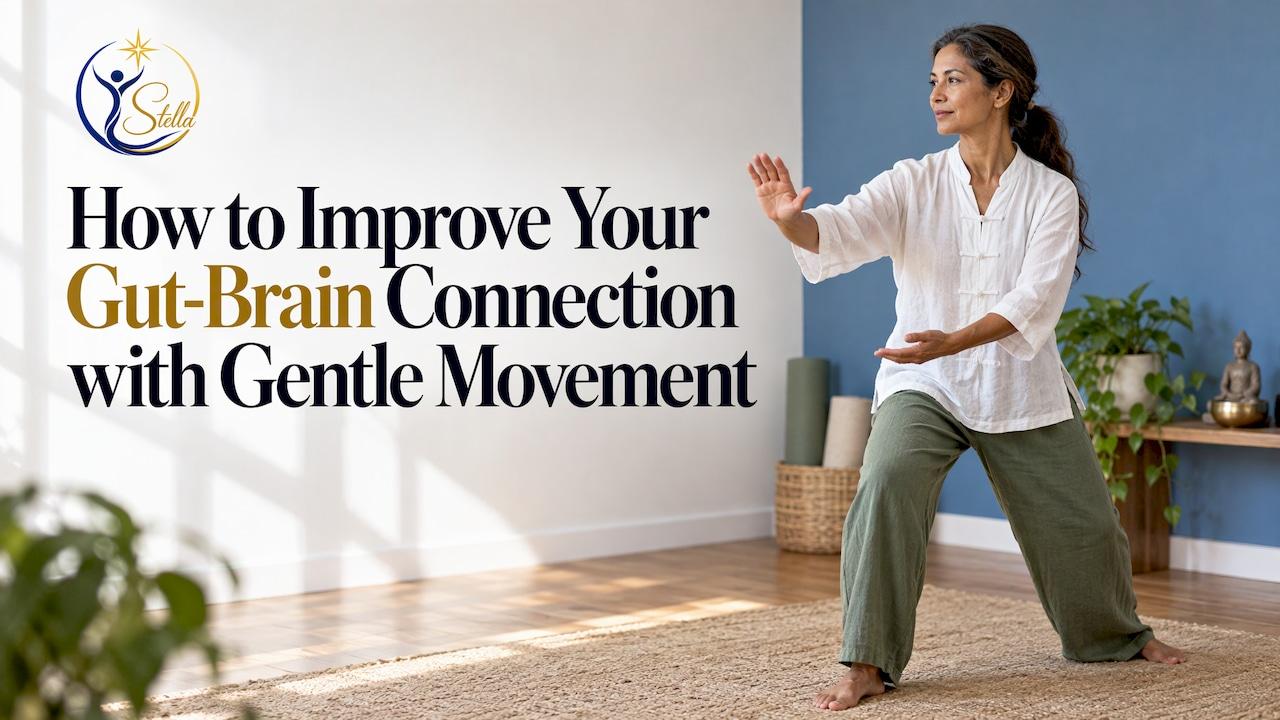
You can nurture your gut-brain connection by calming the stress signals that travel between your mind and your digestive system. Slow movement, steady breathing and a short daily routine are a gentle place to begin. Your gut and brain talk to each other all day, so when your mind is tense your digestion often feels it, and when your belly settles your mind often follows. Qigong, a Chinese Medicine movement practice built on soft flowing posture and breath, gives you a way to work on both sides of that conversation at once. We teach it online for exactly this purpose: Qigong for Stress Relief and Digestive Wellness is our course for people whose stress lands in their stomach.
Key Takeaways
- Your gut and brain communicate in both directions, through nerves, hormones and immune signals, so stress can change digestion and digestion can colour mood.
- Research on stress and irritable bowel syndrome (IBS) shows that mental stress can increase IBS symptoms and alter how the gut moves, which makes daily stress relief a practical part of gut care.
- Mild, slow movement may help gas move through and ease bloating, and yoga and tai chi were found safe in studies of people with IBS.
- Short, regular sessions that you can pace to your own energy matter more than long, demanding ones.
- Persistent or changing digestive symptoms belong with your GP, whatever else you practise.
What the gut-brain connection actually is
The gut-brain connection is a two-way communication line between your digestive system and your central nervous system. Cleveland Clinic describes it as involving the enteric nervous system (the network of nerves lining your digestive tract), the vagus nerve (the long nerve linking brain and gut) and the community of microbes in your gut.
It is more than a single wire. A 2021 review by Margolis, Cryan and Mayer explains that gut-brain communication also runs through hormonal and immune pathways, and that scientists are still working out the precise mechanisms in humans.
You already know this from experience. Butterflies before a presentation, a knotted stomach during a difficult week, a settled belly after a good walk: these are the connection speaking in everyday language.
How stress reaches your digestion
When you feel under pressure, your body shifts into a protective state. Digestion is not a priority in that state, and over weeks and months the effect can show up as bloating, urgency, cramping or a stomach that never quite relaxes.
The research on IBS is a useful window into this. A 2022 systematic review of 37 case-control studies found that mental stress increased IBS-specific symptoms and changed gastrointestinal motility, the muscular movement that carries food along. A review by Lin Chang links chronic stress with IBS symptom flare-ups and with changes in motility, gut sensitivity and the body's stress-hormone response. A 2019 review by Qin and colleagues describes stress affecting gut sensitivity, motility, secretion and permeability through nerve, hormone, immune and microbial pathways.
What this means for you: if your days are long, your inbox is relentless or you are running on burnout, calming your nervous system is a genuine part of caring for your gut, not an optional extra.
Why slow movement suits the gut-brain connection
Movement helps in two ways at the same time. It acts on the body, and it acts on the stress that sits behind the symptoms.
The U.S. Department of Veterans Affairs Whole Health Library notes that mild physical exercise may increase gas clearance and reduce bloating, and that stress relief and bowel motility may help explain movement's effects on IBS.
Mind-body forms of movement have their own research. A 2026 clinical discussion in Gastroenterology & Hepatology reports that a 2016 review of six randomised trials with 273 people with IBS found yoga beneficial for gastrointestinal symptoms, IBS severity and anxiety. The same discussion says yoga and tai chi were safe and feasible in the studies it cites, with few adverse events, all musculoskeletal.
Qigong belongs to the same family of meditative movement: slow, rhythmic, breath-led and kind to joints. If you are a beginner, or you are coming back to movement after illness, burnout or joint trouble, that gentleness is the point.
The three ingredients of a gut-calming practice
Whatever form you choose, three ingredients do most of the work.
1. Breath that reaches your belly
Deep abdominal breathing is the simplest way to tell your nervous system it can stand down. An NHS Lothian booklet on coping with stress when you have IBS teaches it like this: rest a hand on your tummy, breathe in slowly and feel it rise, breathe out slowly and feel it fall, without forcing the breath, and repeat 10 to 20 times.

Some people find this harder than it sounds. The same Gastroenterology & Hepatology discussion notes that tight muscles between the ribs can limit chest expansion, so diaphragmatic breathing may take time. If that is you, let the breath be small and easy, and let it deepen over weeks rather than minutes.
2. Soft, flowing movement
Gentle, low-intensity movement is the common thread in the guidance for people with digestive symptoms. A 2023 review by Radziszewska and colleagues describes slow, low-intensity options such as walking, yoga, cycling, swimming and aerobics, and notes that more research is needed to identify which activity helps most. That is encouraging for you: the best practice is the one you will actually return to.
Qigong movements are designed to be slow and continuous, with attention on how the body feels rather than how it performs. That makes them suitable if you are tired, anxious or stiff.
3. A quiet, attentive mind
The third ingredient is attention. Following your breath through a movement sequence gives a busy mind something kind to do. Cleveland Clinic's patient guide to IBS and the brain-gut connection lists relaxation therapy and guided imagery among the behavioural approaches for the brain-gut link, which is the territory a mindful, breath-led practice naturally sits in.
If you would like to widen your toolkit for stress, this overview of types of stress management techniques shows how different approaches fit together.
A simple 10-minute routine to begin with
You do not need special equipment, only a quiet corner and comfortable clothes. Here is a gentle sequence for the first week.
- Arrive (2 minutes). Stand with your feet hip-width apart and knees soft. Let your shoulders drop and rest a hand on your lower belly. Notice your breathing without changing it.
- Belly breathing (3 minutes). Breathe in slowly through your nose and feel your belly rise under your hand. Breathe out slowly and feel it settle. Aim for roughly 10 to 20 breaths, as in the NHS Lothian booklet.
- Slow weight shifts (3 minutes). Shift your weight gently from one foot to the other, letting your arms float with the movement. Keep the pace unhurried and the breath easy.
- Soft belly circles (1 minute). With your hands resting on your abdomen, turn your upper body in slow, small circles, as if stirring warm water.
- Rest (1 minute). Stand still, hands on belly, and notice any warmth, softness or quiet.
Do this once a day at a time you can protect, perhaps before breakfast or as a pause between work and evening. Regular, small sessions help your nervous system learn the pattern of calm.
A study-based "perfect dose" does not exist yet. A 2025 systematic review of yoga for IBS notes that the studies used varied programmes and do not establish an optimal amount of practice. The VA guidance adds that people with IBS are not advised to follow different exercise recommendations from the general population. So you can choose a length and frequency that fits your life and let it grow.

Pacing your practice
Gentle does not mean careless. The 2026 Gastroenterology & Hepatology discussion advises pacing, because vigorous activity can flare symptoms, and suggests considering your personal functional limits and building tolerance gradually.
In practice:
- Start with five to ten minutes and add time only when it feels easy.
- Move within a comfortable range. If a posture strains a knee, hip or shoulder, make it smaller or practise it seated.
- Practise on an empty or comfortably light stomach rather than straight after a large meal.
- Stop and rest if you feel pain, dizziness or a flare of symptoms.
If you have joint pain or are rehabilitating after injury, mention it to a qualified instructor before you start so the movements can be adapted. In our one-to-one sessions we shape the practice around you.
When to speak to your GP
Breathing and movement support everyday wellbeing, and they sit alongside medical care rather than replacing it. See your GP if you notice blood in your stool, black or tarry stools, unexplained weight loss, severe or worsening abdominal pain, or a lasting change in your bowel habits. If you already have a diagnosis such as IBS or inflammatory bowel disease, check with your GP or specialist about how a new practice fits with your treatment. Call 999 or go to A&E for heavy bleeding.
Building the rest of your gut-brain routine
Movement works best as part of a calm daily rhythm. Alongside your practice, you can support the connection in everyday ways:
- Eat regularly and unhurriedly. Sitting down, chewing well and pausing between mouthfuls gives your digestion a softer start.
- Protect your sleep. A consistent bedtime gives both gut and mind time to reset.
- Take breath breaks at work. Three slow belly breaths before a meeting or a meal is a small, repeatable cue for calm.
- Go outdoors. A slow walk is one of the gentle options named in the research above and sits well alongside qigong.
If you are exploring nutritional support as well, this look at glutamine and gut health explains where the evidence stands. Our own guides on qigong for IBS and on how movement therapy supports stress and gut health go deeper on the practice side.
Learn it with a guide
A routine is easier to keep when someone shows you the movements, watches how you breathe and adapts the practice as you change. All our instruction is delivered by a White Tiger Qigong Level 3 certified instructor who is also accredited by Yoga Alliance, and our programmes are built for stress, digestive health and the pace of a modern working life.
Our course, Qigong for Stress Relief and Digestive Wellness, is £116 one-off and is designed for beginners. If you would like personal guidance, we also offer a 30-Min Clarity Session at £85, a 60-Min Deep Dive Online Session at £145 and a 60-Min Face-to-Face Qigong session at £165, along with group classes. You can see everything on our online qigong classes page.
If you are drawn to the traditional roots of the practice, you can also explore White Tiger Qigong or the Five Animal Qigong course.
Our perspective
When someone comes to us with an unsettled stomach, we rarely meet only a stomach. We meet a person who has been holding on for a long time: long days, constant alertness, a body that has forgotten how to soften.
That is why we teach gut care through the whole person. In Chinese Medicine, digestion and the calm of the mind are woven together, and qigong gives you a way to feel that for yourself: slow movement, a deepening breath and a quiet inner focus.
What we love most about this practice is how accessible it is. You do not need to be flexible, fit or experienced. You need a few unhurried minutes and a willingness to listen to your body. Our programmes are designed around that, with live classes and on-demand courses so you can begin where you are and keep going at your own pace.
Be patient and kind with yourself. A little each day teaches your system that it is safe to relax, and that is where the gentle change begins.
Stella
FAQ
Can movement really improve digestion?
Gentle movement may help in two ways. The VA Whole Health Library notes that mild exercise may increase gas clearance and reduce bloating, and that stress relief and bowel motility may explain its effects. Slow, breath-led practices also calm the stress response, which is closely tied to how your gut behaves.
How long should I practise each day?
Start with five to ten minutes once a day and extend as it feels comfortable. Research has not set an ideal amount of practice, so regularity and ease matter more than length. Increase gradually and rest when you need to.
Is qigong suitable if I am a complete beginner or have joint problems?
Yes, the movements are slow, low-impact and can be made smaller or done seated. Tell your instructor about any joint pain or injury so the practice can be adapted. If you are recovering from surgery or an injury, check with your GP or physiotherapist first.
Does the gut-brain connection only matter if I have IBS?
No. Everyone has this two-way link, which is why nerves can upset your stomach and a settled gut can lift your mood. IBS research simply shows it clearly, because stress is known to affect symptoms in many people with the condition.
Sources
- The Gut-Brain Connection, Cleveland Clinic
- The Microbiota-Gut-Brain Axis: From Motility to Mood, 2021
- Emotional stress responsivity of patients with IBS, 2022 systematic review
- The Role of Stress on Physiological Responses and Clinical Symptoms in IBS, 2011
- Impact of psychological stress on irritable bowel syndrome, 2019
- Irritable Bowel Syndrome, VA Whole Health Library
- Meditative Movement Approaches for Irritable Bowel Syndrome, Gastroenterology & Hepatology, 2026
- IBS Booklet 3: Ways to cope with stress, NHS Lothian
- Nutrition, Physical Activity and Supplementation in IBS, 2023
- IBS: What Your Brain Has to Do with It, Cleveland Clinic
- The Effectiveness of Yoga for Irritable Bowel Syndrome, 2025
- Types of stress management techniques
- Glutamine for gut health