
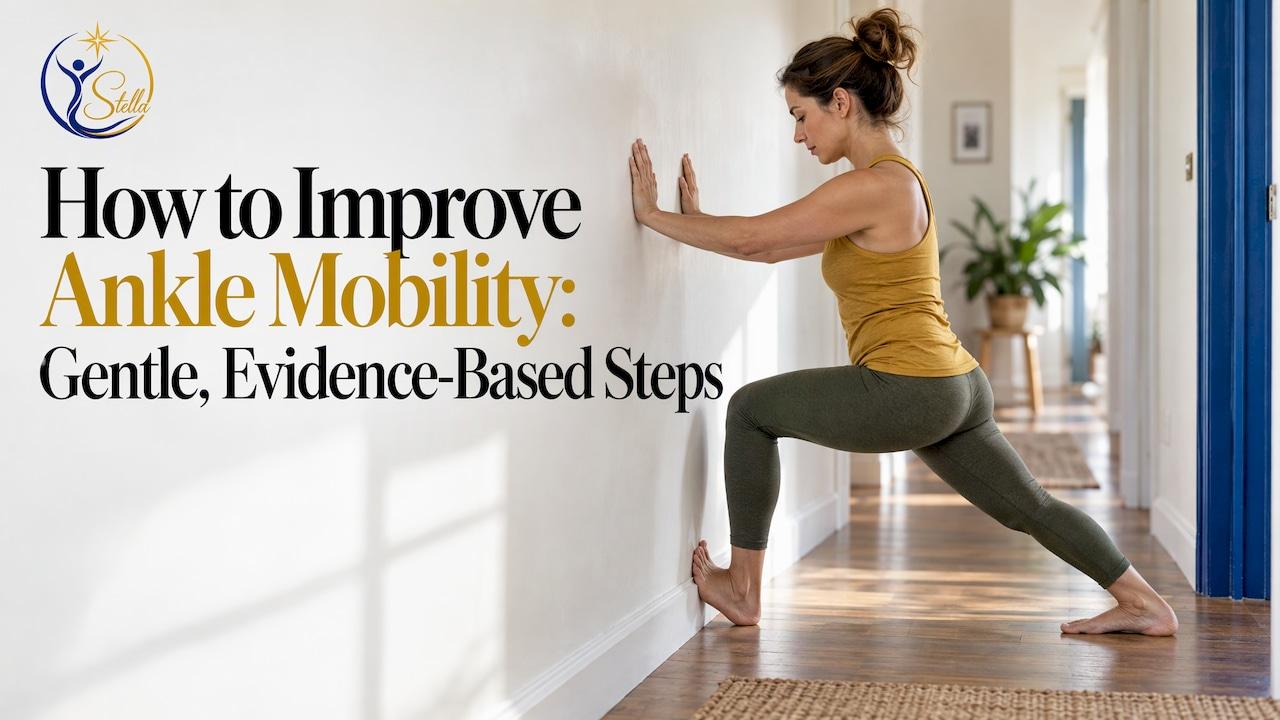
Yes, ankle mobility can be improved, and for most healthy adults the route is calm and unglamorous: test where you are, stretch the calf in a weight-bearing position, add slow heel raises and gentle circles, and repeat several times a week for weeks, not days. Research on healthy people supports exactly this. The hard part is rarely the exercises. It is staying consistent and moving at a pace your body welcomes. That is where guided, gentle practice such as our online Qigong classes helps, because the routine is taught to you step by step and you are not left to improvise.
Key Takeaways
- Ankle mobility responds to practice: a systematic review of 23 studies supports static stretching, heel raises and warming up for ankle dorsiflexion in healthy people.
- Check your starting point with the wall (weight-bearing lunge) test, and compare both sides.
- Aim for little and often: three to five sessions a week, and expect several weeks before the change feels real.
- Pain after a fall, visible deformity, or sudden hot swelling needs urgent medical advice, not stretching.
- Slow, mindful movement makes the habit easier to keep, which is what actually changes range of motion.
What ankle mobility really means
When people say they want to improve ankle mobility, they usually mean dorsiflexion: the ability to bring your shin forward over your foot while your heel stays down. You need it to squat comfortably, climb stairs, walk downhill and crouch to pick something up. Physical therapist Grayson Wickham explains that good ankle mobility means the muscles, ligaments, tendons and fascia around the joint are not tight and can move through their full range, and that you need to work both dorsiflexion (toes towards shin) and plantarflexion (toes pointing away).
Common signs of limited mobility include:
- Your heels lift when you squat, or you tip forwards to stay balanced.
- Your knees collapse inwards when you lower down.
- A pinching feeling at the front of the ankle when you bend deeply.
- Stiff, heavy-feeling ankles first thing in the morning or after long sitting.
- One ankle clearly stiffer than the other, often after an old sprain.
These are signs, not a diagnosis. They simply tell you where to begin.
Why ankles feel stiff
Most stiff ankles come down to two broad causes. Either the soft tissue, mainly the calf muscles and their tendon, is limiting the movement, or the joint itself is restricted. The PhysioTutors guide to the weight-bearing lunge test describes the difference: a pinching feeling at the front of the ankle during the lunge suggests the restriction lies in the joint, while a stretch felt in the calf suggests soft tissue, which responds to stretching or foam rolling.
Life adds to it. Long hours at a desk, supportive shoes all day, and a past sprain that was never fully rehabilitated all leave the ankle moving less than it could. Wickham makes the point that it took years for ankles to become less mobile, so one stretch will not restore them. That is reassuring: it means gentle, repeated effort is the right tool.
Step 1: Test your ankle mobility at home
The wall test is simple and gives you a number to improve on.
- Stand facing a wall, one foot forward, toes pointing straight ahead.
- Keeping the front heel flat on the floor, bend the knee forwards towards the wall, aiming to touch it.
- If you can touch it, slide the foot back a little and repeat. Stop when your heel is about to lift.
- Measure from the wall to your big toe. Do both sides.
PhysioTutors gives a distance of at least 5 inches (12.5 cm) as normal for this test, and notes that a change of 1.9 cm is needed before it counts as more than measurement error. A 2025 paper in Frontiers in Sports and Active Living reports normal values above 9 to 10 cm toe-to-wall distance and treats an asymmetry greater than 1.5 cm between sides as clinically relevant. The two sources use slightly different thresholds, so treat the result as a guide and a personal baseline, not a pass or fail.
To keep your readings consistent, the same authors suggest keeping your weight on the tested leg, raising the back heel, keeping the knee lined up over the toes rather than letting it drift inwards, and stopping at the very first sign of the heel lifting. Mark the floor with tape so you can repeat the test each week.
A clinician would normally measure the angle with a goniometer, and normal values there run from 30° to 50° according to a 2009 journal article, which also found the lunge method reliable. At home, the wall and a tape measure are plenty.
Step 2: Warm the ankle first
Warming up is itself supported by evidence: the 2013 review found a warm-up improved dorsiflexion range (SMD 0.87). You do not need anything elaborate. Two or three minutes is enough:
- Ankle pumps: sitting or lying, pull your toes up towards you, then point them away, slowly, ten times. This is the same early movement described in an NHS physiotherapy ankle exercise leaflet, which says exercises should begin as early as possible after injury to prevent stiffness.
- Ankle circles: slowly draw a circle with your big toe, ten times each way, making the circle a little larger as it feels comfortable.
- Gentle rocking: standing, shift your weight from heel to toe and back, like a soft wave.
Breathe slowly through the nose and let the shoulders drop. This is also the part where mindful movement earns its place: when you move at the pace of your breath, you notice stiffness without forcing through it. Our Qigong warm-up with seated options follows the same idea if you would like a longer sequence.
Step 3: Stretch the calf in a weight-bearing position
Static stretching has the strongest support for gains in dorsiflexion. The 2013 review found effects for static stretching alone ranging from SMD 0.70 to 1.69. An earlier 2006 meta-analysis found calf stretching gave a small but statistically significant increase: a weighted mean difference of 2.07° after 15 minutes of total stretching, and 3.03° for 15 to 30 minutes.
How to do it:
- Stand facing a wall in a split stance, front knee bent, back heel down.
- Lean forwards until you feel a firm but comfortable stretch in the back calf.
- Hold, breathing slowly. Then bend the back knee slightly to reach the deeper soleus muscle lower down the calf.
- Swap sides.
For dose, the 2025 Frontiers authors suggest more than 200 seconds per session, for example three sets of 75 seconds with 30 seconds' rest, five to seven sessions per week, adding up to more than 1,200 seconds weekly. They describe working from the point of discomfort to the onset of pain. In plain terms for a gentle routine: stay at a strong but tolerable stretch, never a sharp one. If you are new to this, begin with less and build up.
Step 4: Add heel raises
Heel raises also have supporting evidence, with effects of SMD 0.70 to 0.77 in the 2013 review. Stand with feet hip-width apart, hold a wall or chair for balance, and rise slowly as high as you can, pause, then lower over three to four seconds. Slowing the lowering is the useful part: it works the calf and keeps the ankle moving through its range.

The NHS DynamicHealth service suggests 3 to 5 sets of 5 repetitions, three times a week with rest days between. Once an exercise feels easy after a week, they suggest progressing by adding resistance, increasing depth of movement, slowing the return phase or adding a hold of a few seconds at the end.
Step 5: Practise balance and weight shifting
Ankles do not just need range, they need control. After a sprain, the muscles around the joint can weaken, and balance retraining is part of standard rehabilitation advice. Try standing on one leg beside a wall for 20 to 30 seconds, then close to a soft knee and shift your weight slowly. If balance is a concern for you or an older relative, this guide to balance training for seniors covers safe exercises to prevent falls.
Slow weight-shifting is also a natural part of Qigong. Our Qigong for seniors guide and Qigong for knee pain guide show how a gentle stance and soft knees take pressure off the lower limbs.
A simple weekly plan
| Day | Practice | Time |
|---|---|---|
| Mon | Warm-up, wall stretch, heel raises | 10 to 12 min |
| Tue | Warm-up, circles, one-leg balance | 8 to 10 min |
| Wed | Rest or an easy walk | |
| Thu | Warm-up, wall stretch, heel raises | 10 to 12 min |
| Fri | Warm-up, circles, one-leg balance | 8 to 10 min |
| Sat | Wall stretch and gentle flowing movement | 10 min |
| Sun | Rest, repeat the wall test | 2 min |
The American Academy of Orthopaedic Surgeons' foot and ankle conditioning programme advises continuing for 4 to 6 weeks unless a doctor or physical therapist says otherwise, and notes that three to five days a week helps maintain strength and range of motion. The plan above sits within that.
How long does it take?
The honest answer depends on why the ankle is stiff. For general stiffness, Wickham says daily ankle mobility exercises should show results in 2 to 4 weeks. After an injury, the pace is slower: NHS DynamicHealth says it is normal for it to take 6 to 12 weeks to see a good improvement in pain, movement and strength, while the Leicestershire Partnership NHS Trust says most new foot and ankle pain improves within 6 to 8 weeks with self-help measures including gentle movement and a gradual return to normal activities.

Repeat the wall test every week or two and write the number down. Seeing it creep forward by a centimetre is a far better motivator than how a single session felt.
When to get your ankle checked
Gentle mobility work is for stiffness, not for an unexplained or injured ankle. The Leicestershire Partnership NHS Trust advises seeking urgent medical advice for foot or ankle pain after a fall or injury, a visible deformity, significant loss of movement with difficulty walking, or sudden swelling, redness and warmth with a fever. It also advises contacting your GP urgently for new unexplained pain if you have a history of cancer, HIV, TB or inflammatory arthritis, or pain with fever, unexplained weight loss or night sweats.
The same page suggests physiotherapy may help if pain has not improved after a few weeks of self-help, affects work, sleep or daily activities, limits walking or exercise, or if you keep spraining the ankle. If any of these apply, see your GP or an NHS physiotherapist first, then return to gentle movement with their agreement.
Why guided practice helps you stay the course
The studies agree on one thing: results come from repetition across weeks. The Frontiers authors note that higher total doses produce greater gains in range. A routine you actually look forward to is the one you will repeat. That is why many people find it easier to follow a guided session than a list of exercises on a screen.
Our view: slow movement is how stiffness lets go
When someone arrives with stiff ankles, hips or shoulders, the instinct is to push harder. In our teaching we do the opposite. We ask you to slow down, soften the knees, breathe, and let each shift of weight travel through the foot and ankle. Stiffness often holds more tension than we realise, and attention to the breath helps it release.
The movements are gentle and beginner-friendly, so you can practise little and often, which is exactly the pattern the research on ankle range of motion rewards. We teach through live classes and on-demand courses, with each session led by a White Tiger Qigong Level 3 certified instructor who is also accredited by Yoga Alliance.
If you want to walk away with a calm routine you can repeat at home, start with a few minutes a day and let the practice build. Our guides on Qigong for flexibility and low impact exercise for recovery are good places to begin.
Stella
Learn a gentle routine with us
If you would like someone to guide you through slow, mindful movement, our course Qigong for Stress Relief and Digestive Wellness is available as a one-off purchase of £116. You can also book a 30-Min Clarity Session for £85, a 60-Min Deep Dive Online Session for £145, or a 60-Min Face-to-Face Qigong session for £165. We also run group Qigong classes. Everything is taught with a beginner-friendly approach.
See the options on our online Qigong classes page and choose the format that suits your week.
FAQ
Can ankle mobility be improved?
Yes. A systematic review of 23 studies in healthy people found evidence supporting static stretching, heel raises and warm-up for improving ankle dorsiflexion. Change is gradual and depends on regular practice.
What are signs of poor ankle mobility?
Heels lifting in a squat, knees falling inwards, a pinch at the front of the ankle, or one side clearly stiffer than the other. The wall test gives you a measurable check: under about 12.5 cm toe-to-wall is below the usual guide, and a gap of more than 1.5 cm between sides is worth noting.
Why are my ankles so inflexible?
The calf muscles may be tight, the joint itself may be restricted, or both. Long periods sitting, past sprains and years of limited ankle movement all contribute. A calf stretch felt in the muscle suggests soft tissue, while a pinch at the front of the ankle suggests the joint.
How long does it take to get good ankle mobility?
Daily mobility work can show results in 2 to 4 weeks according to physical therapist Grayson Wickham. After an injury, NHS DynamicHealth says 6 to 12 weeks is normal for a good improvement. Keep going for at least four to six weeks before judging the result.
Sources
- Interventions for increasing ankle joint dorsiflexion: a systematic review and meta-analysis
- Does stretching increase ankle dorsiflexion range of motion? A systematic review
- Restoring ankle dorsiflexion range of motion, Frontiers in Sports and Active Living (2025)
- Assessment of Ankle Dorsiflexion Range of Motion, Athletic Training & Sports Health Care (2009)
- Weight Bearing Lunge Test, PhysioTutors
- Why Good Ankle Mobility Is Key to Preventing Injury, Greatist
- Foot or ankle pain, NHS DynamicHealth
- Foot and Ankle Pain, Leicestershire Partnership NHS Trust
- Ankle exercises, Leicestershire Partnership NHS Trust (leaflet)
- Foot and Ankle Conditioning Program, AAOS OrthoInfo (2025)