
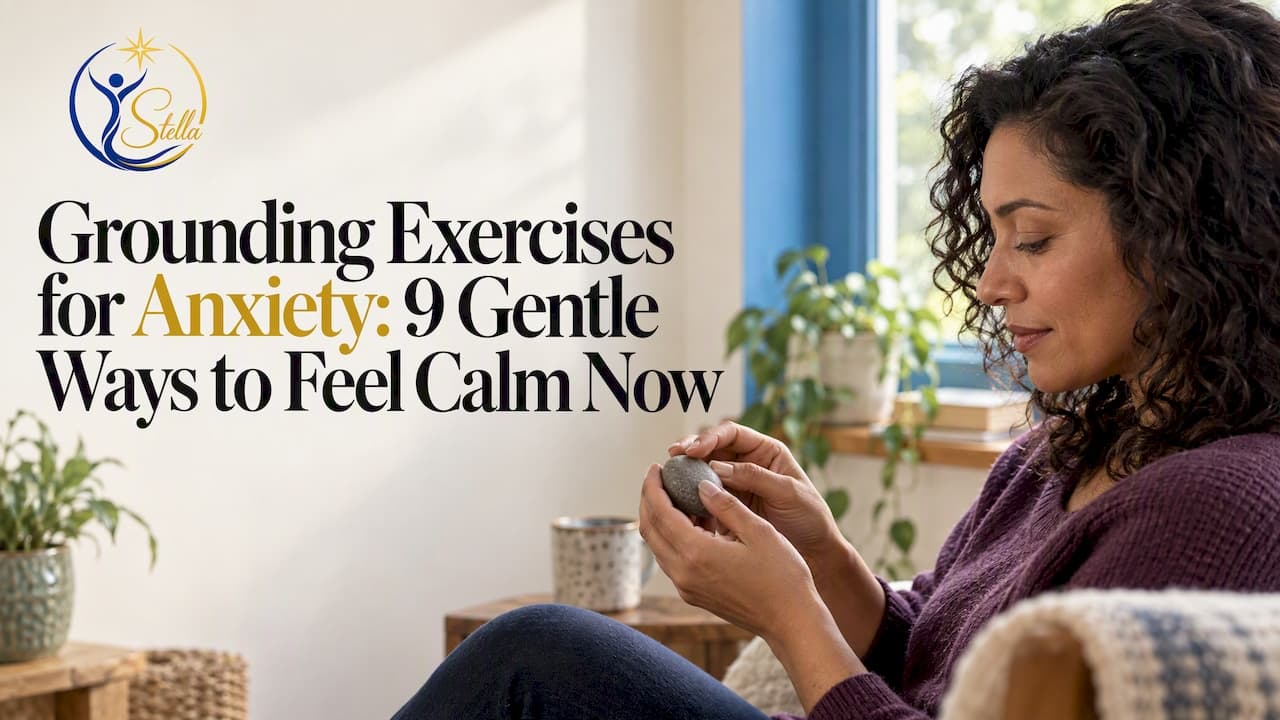
Grounding exercises bring your attention back to the present moment, using your senses, your breath or your body, so that anxious thoughts lose some of their pull. You can do them anywhere, they cost nothing, and most take under five minutes. Below you will find nine you can try today, how to choose between them, what the research does and does not show, and how slow, mindful movement such as qigong can turn a one-off tool into a daily habit.
Key takeaways
- Grounding works by moving your attention from worry about the past or future to what you can see, hear, feel and touch right now.
- Start with the simplest tools: 5-4-3-2-1, feet on the floor and a slow, steady breath. Practise them when you feel calm, so they are easy to reach for when you do not.
- Research on brief calming techniques is encouraging for in-the-moment relief, but evidence for mind-body methods as a stand-alone treatment is limited.
- If anxiety is hard to manage or affects your daily life, speak to your GP or a mental health professional. Grounding is a support, not a replacement.
- Gentle, regular movement can help you carry that sense of steadiness through the day, not only during a difficult moment.
Table of Contents
- What grounding exercises are and why they can help
- Five senses and mental grounding
- Physical grounding
- Breathing exercises to calm anxiety
- Mindful movement for anxiety
- Which exercise should you try first?
- Does grounding really help? An honest look at the evidence
- Our perspective: from grounding to a daily practice
- Learn grounding through gentle qigong
- FAQ
- Sources
What grounding exercises are and why they can help
Anxiety pulls you into "what if" thinking about the future or into replaying the past. Grounding is the opposite movement. It is a set of mental, physical and soothing activities that redirect attention to what is happening now, which may help you feel safer, interrupt spiralling thoughts and cope with panic or overwhelming feelings.
The NHS describes the aim simply: to take your mind off uncomfortable symptoms or thoughts. One NHS hospital trust's guide sums up the principle in a phrase worth remembering: be where your feet are.
A US clinician at Cleveland Clinic explains that sensory exercises work by shifting attention from worry to immediate sensory information. The counting structure gives your mind a simple frame to hold on to. It is not a test, so you cannot do it wrong.
Five senses and mental grounding
These are the quietest exercises. Nobody around you needs to know you are doing them, which makes them ideal at a desk, on a train or in a waiting room.
1. The 5-4-3-2-1 method
Sit comfortably and take a slow breath. Then notice five things you can see, four you can feel, three you can hear, two you can smell and one you can taste. This is the exercise NHS inform lists first. Cleveland Clinic notes that it can be practised almost anywhere and works best when you first notice anxiety or another strong emotion rising.
A few tips:
- Be specific. "The grain of the wooden desk" holds your attention better than "a desk".
- If you cannot find a smell or taste, recall a favourite one, or simply note the taste in your mouth.
- Slow down. The point is the noticing, not finishing quickly.
2. Describe your surroundings
Silently, or out loud if you are alone, describe the room in plain detail: the colour of the wall, the shape of the window, the sound of traffic. Orienting yourself to the current time and place is exactly what the NHS trust guide recommends for reconnecting with the present.
3. Mental anchors: facts, categories and a safe place
When your thoughts are racing, give them a simple job. Cleveland Clinic's examples include imagining a safe or happy place, reciting familiar facts or counting, and sorting nearby objects into categories. Try naming every town you know that starts with the same letter, or sort the items on your desk by colour. The task is deliberately easy, because its purpose is to occupy the anxious part of your mind.
Physical grounding
When anxiety is mostly in the body, with a tight chest, restless legs or a buzzing feeling, start with the body.
4. Feet into the floor
Press both feet firmly into the floor. Notice the pressure through your heels and toes, the chair beneath you and the weight of your clothes on your shoulders. Physical orientation like this is recommended in NHS guidance. Stay with it for a minute or two, and let your shoulders drop as you exhale.
5. Hold something with texture
Pick up a smooth stone, a mug, a keyring or the fabric of your sleeve. Describe it to yourself: cool or warm, rough or smooth, heavy or light. Holding or describing a textured object is one of the five practical options Lifeline suggests. Running your hands under cool water works in the same way.
6. Tense and release
Clench your fists for a few seconds, then let them open. Work up through your arms, shoulders and face. A 2024 systematic review in Frontiers in Psychology found that progressive muscle relaxation and deep-relaxation training were consistently effective at reducing state anxiety in the brief-intervention studies it included. If you have an injury or joint pain, tense gently, or simply imagine each area softening.
Breathing exercises to calm anxiety
Breathing is the one body function you can change on purpose, which is why it sits alongside grounding in most guidance. The key for anxious breathers is to keep it gentle. Forcing deep breaths can make you feel more breathless, so aim for slow and smooth rather than big.
7. Box breathing
Breathe in for a count of four, hold for four, breathe out for four, then hold for four. Repeat for a minute or two. Lifeline says this can calm your thoughts and help you regain a sense of control, and that beginners can start with counts of three. If holding your breath feels uncomfortable, skip the holds and simply breathe in and out to the same count.

8. The balloon breath
This is NHS inform's gentle version. Imagine an empty balloon in your stomach. Breathe in through your nose for a count of three to inflate it, then slowly breathe out through your mouth to deflate it. Repeat a few times until you feel calmer. If panic is the main issue, our guide to slowing your exhale first goes deeper, and breathwork styles for health explains how different approaches compare.
Mindful movement for anxiety
9. A slow mindful walk
Walk more slowly than usual and notice the sights, sounds and smells around you, and the feeling of each foot meeting the ground. Lifeline includes mindful walking in its list of mindfulness exercises alongside a five-senses check-in, mindful eating, cloud watching and exploring textures. Even a walk to the end of the road counts.
This is where grounding naturally meets qigong. Qigong is a family of slow, flowing movements coordinated with the breath, and its core instructions will sound familiar: soften your knees, feel your feet, let your breath settle, and notice what is happening in your body. In other words, you rehearse grounding with your whole body, at a pace your joints and nervous system can enjoy. Our pieces on how qigong movement therapy eases stress and what holistic movement therapy involves explain the approach in more detail.
Which exercise should you try first?
The best exercise is the one you can do in the moment you need it. Use this as a starting point.
| Situation | Try this | Time |
|---|---|---|
| Racing thoughts at your desk | 5-4-3-2-1 or mental categories | 2 to 3 minutes |
| Tight chest or fast breathing | Balloon breath or box breathing | 1 to 2 minutes |
| Restless, buzzing body | Feet into the floor, tense and release | 2 to 5 minutes |
| Feeling overwhelmed outdoors | Mindful walk, holding a textured object | 5 minutes |
| A low, worried evening | A slow qigong sequence | 10 to 15 minutes |
Two habits make all of these work better. First, practise when you are already calm, even for a minute a day, so the exercise feels familiar when your mind is loud. Second, try it for a few minutes before judging it. If one does not suit you, move to another without any sense of failure.
Does grounding really help? An honest look at the evidence
Grounding is widely recommended by health services, and the research gives it a cautious thumbs up for short-term relief. The 2024 Frontiers review found that brief interventions involving cognition, body-state changes or breathing can reduce state anxiety, while noting that not every breathing exercise has acute evidence behind it. The authors also suggest that passively paying attention to thoughts, body and breath may be more reliably helpful in the moment than demanding that yourself change.
The limits matter too. A peer-reviewed review of mind-body approaches for anxiety disorders concluded that evidence for most of them is limited and inconsistent, with the strongest support among those reviewed for applied relaxation, yoga and mindfulness-based interventions. It found there is not enough data to recommend them as a primary treatment, though they may be considered as part of a larger treatment plan.
Qigong specifically deserves the same honesty. A 2013 meta-analysis of randomised trials found a beneficial effect on depressive symptoms in some comparisons, but available evidence did not suggest a beneficial effect on anxiety symptoms and called for better-designed trials. So we describe qigong as a gentle, supportive practice that many people find calming, not as a cure.

When to ask for professional help
See your GP or a mental health professional if your anxiety is difficult to manage, keeps coming back or interferes with work, sleep, relationships or daily life. Cleveland Clinic advises that grounding works best as part of an overall mental health approach. If you feel unsafe, or are in crisis, contact emergency services or a crisis line straight away. Grounding sits alongside treatment such as talking therapies or medication when those are right for you. It does not replace them.
Our perspective: from grounding to a daily practice
We often meet people who have learned a handful of grounding tricks and still feel that anxiety arrives faster than the tools do. That is understandable. A technique used only in a crisis is a fire extinguisher. What many people want is a calmer baseline, so that there is less to put out.
That is why we teach grounding through movement and breath. In White Tiger Qigong and Five Animal Qigong, you stand with soft knees, feel the floor, breathe slowly and move with attention. It is the same skill as 5-4-3-2-1, practised for ten or fifteen minutes a day until it becomes familiar and easy to reach. Because qigong is gentle and low-impact, it also suits beginners, busy professionals and people who need to be kind to their joints.
We also see how tightly stress, the gut and the nervous system are linked, which is why our programmes pay attention to digestion as well as the mind. If you want a place to start, our daily qigong routine for stress reduction is short, and building stress resilience with qigong explains how the practice grows over weeks. You do not need to be flexible, fit or calm to begin. You only need a few quiet minutes and a willingness to notice.
— Stella
Learn grounding through gentle qigong
If you would like guidance rather than working it out alone, our online programme Qigong for Stress Relief and Digestive Wellness is £116 as a one-off purchase. It is designed for beginners, and you move at your own pace. Every lesson is taught by a White Tiger Qigong Level 3 certified instructor who is also accredited by Yoga Alliance.
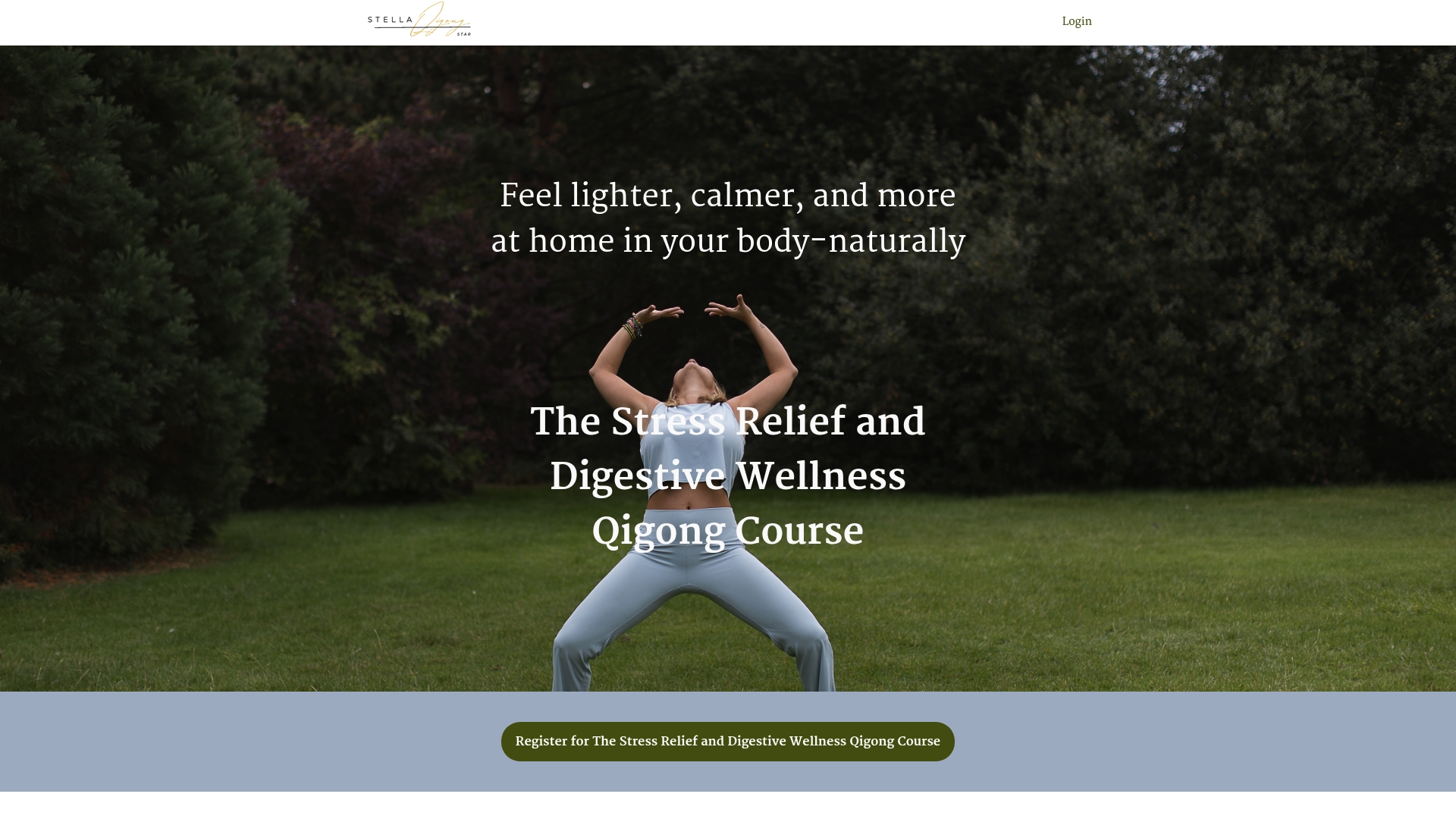
Prefer personal attention? You can book a 30-Min Clarity Session for £85, a 60-Min Deep Dive Online Session for £145, or a 60-Min Face-to-Face Qigong session for £165. Group classes are also available. See everything on our online qigong classes and courses page and choose what feels right for you.
FAQ
What are the 5 grounding techniques for anxiety?
Five reliable ones are 5-4-3-2-1 sensory noticing, box breathing, pressing your feet into the floor, holding or describing a textured object, and a slow mindful walk. Between them they cover your senses, your breath and your body, so you can pick whichever fits where you are. Lifeline lists all five among its grounding techniques.
Does grounding really help with anxiety?
For many people it helps take the edge off in the moment, and brief calming techniques have some research support for reducing state anxiety. It is not a stand-alone treatment for anxiety disorders. If anxiety is frequent or hard to manage, speak to your GP.
What is the 3-3-3 rule for anxiety?
It is a quick variation of the same idea: name three things you can see, three sounds you can hear, and move three parts of your body, such as your fingers, ankles and shoulders. It works for the same reason as 5-4-3-2-1, by pulling your attention to the present. The NHS version is the 5-4-3-2-1 method.
Can gentle movement help with anxiety?
Slow, mindful movement can help you notice your body and breath, which is the same skill grounding trains. Evidence for qigong on anxiety specifically is still mixed, so treat it as a supportive practice. Go gently, and check with your GP first if you have an injury or a health condition.
Sources
- Finding relief through grounding techniques, Lifeline
- Grounding exercises, NHS inform
- Grounding exercises guide, Sherwood Forest Hospitals NHS Foundation Trust
- 5-4-3-2-1 grounding technique, Cleveland Clinic
- 13 grounding techniques to help calm anxiety, Cleveland Clinic
- A systematic review of brief respiratory, embodiment, cognitive, and mindfulness interventions, Frontiers in Psychology, 2024
- Mind-body interventions for anxiety disorders: a review, 2021
- The effect of qigong on depressive and anxiety symptoms, PubMed, 2013