
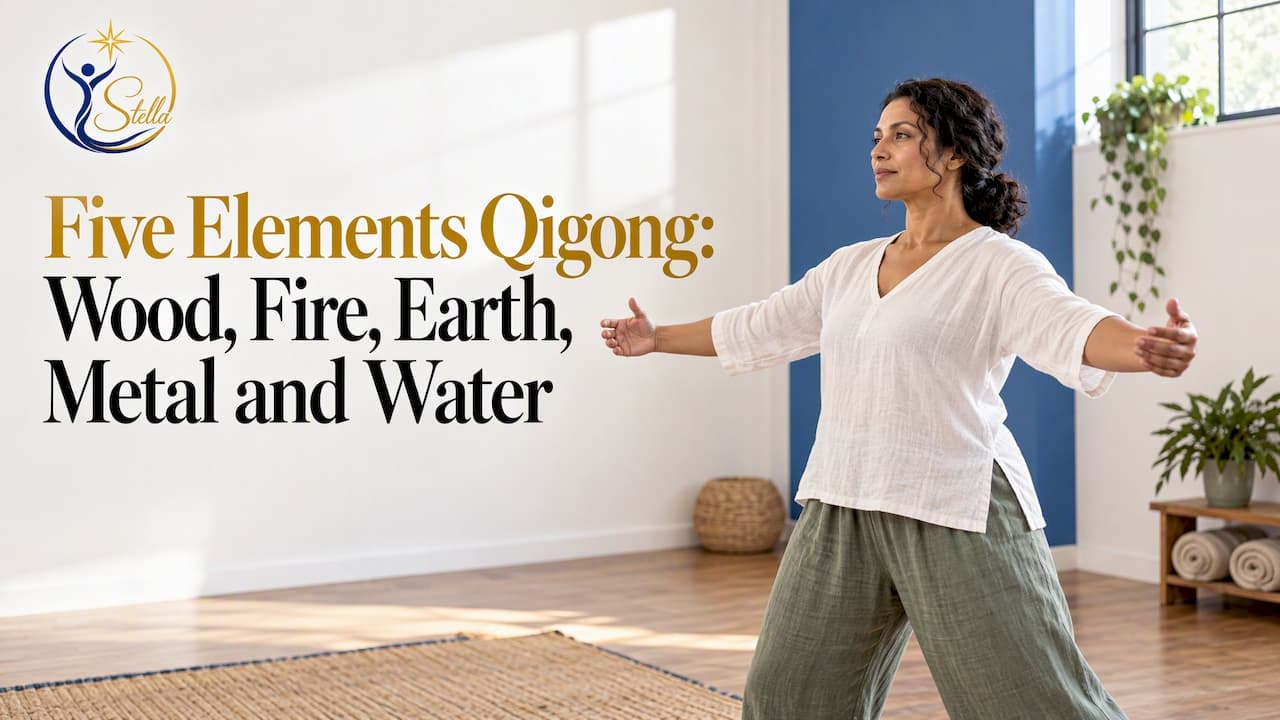
Five Elements Qigong is a way of moving, breathing and focusing your attention that follows the five phases of change in Chinese medicine: Wood, Fire, Earth, Metal and Water. Each phase is linked to a season, a pair of organs and an emotional tone, and each has its own movement and stance. You practise them one at a time or as a flowing sequence, so that your body learns to rise, warm, settle, release and rest in turn. Below you will find what each element means, how we teach it in White Tiger Qigong, and how to start gently at home.
Key takeaways
- The five elements (Wu Xing) are better understood as five phases of change than as five physical substances. Each one describes a quality of energy that you can feel in your own body.
- In the White Tiger Qigong approach we teach, each element is matched to an organ system, an emotion and a specific animal form with its own stance.
- Wood and Earth are the best starting point if you feel tense or your digestion is unsettled. Metal and Water help when you feel depleted or unable to let go.
- Beginners can practise 5 to 10 minutes a day, adapting every movement to what feels comfortable. Seated versions are always available.
- If you have a health condition, warm up slowly, move within comfort and speak to your GP or specialist before you begin.
Table of Contents
- What Five Elements Qigong actually is
- The two cycles that hold the elements together
- The five elements at a glance
- Wood element qigong: release and rise
- Fire element qigong: open the heart
- Earth element qigong: centre and digest
- Metal element qigong: let go
- Water element qigong: restore and store
- Practising the five elements as a sequence
- Practising safely with a health condition
- Our perspective: why we teach the elements through the body
- Learn the elements with guidance
- FAQ
- Sources
What Five Elements Qigong actually is
The Chinese term is Wu Xing, which literally means five movements or five phases. Western writing usually says "elements", which can mislead, because Wood is not simply timber and Water is not simply a liquid. Wu Xing describes how qualities such as growth, warmth, nourishment, contraction and storage follow one another and balance one another in nature and in the body.
Qigong takes that map and turns it into practice. Instead of reading about the Liver or the Lungs, you move in a way that invites that region to open, soften or settle. Classic sequences such as Hua Tuo's Five Animal Frolics draw on Yin-Yang, Wu Xing, organ and meridian theory together, as this academic review of Wu Qin Xi describes. It also notes that the animal order in that sequence does not follow the standard generating cycle, so different schools arrange their forms differently.
That is worth knowing if you have tried a few videos and found they disagree. Lineages vary. Here we follow the White Tiger Qigong five element theory, in which the elements are carried by Five Animal forms and by the stances beneath them.
The two cycles that hold the elements together
Before the individual elements, two relationships are worth learning, because they explain why a sequence is ordered as it is.
The generating cycle (sheng) describes how each element nourishes the next: Wood feeds Fire, Fire creates Earth (ash), Earth bears Metal, Metal gathers Water, and Water nourishes Wood. In practice this is the order you move through when you want to build energy gradually.
The controlling cycle (ke) describes how each element keeps another in check: Wood steadies Earth, Earth contains Water, Water cools Fire, Fire shapes Metal, and Metal trims Wood. When one element is excessive, its neighbour in this cycle often helps to rebalance it.

You do not need to memorise either cycle. Many students simply notice that after a tense, irritable day, slowing down with Metal or Water movements feels like exactly what the body wanted.
The five elements at a glance
Traditional correspondences are consistent across most Chinese medicine texts. This overview of Five Element correspondences sets out the organs, seasons and emotions in the same way as the table below. The animal forms and stances are those we use in White Tiger Qigong.
| Element | Yin organ | Yang organ | Season | Emotional tone | White Tiger Five Animal form |
|---|---|---|---|---|---|
| Wood | Liver | Gallbladder | Spring | Anger, frustration | Monkey Picks the Fruit |
| Fire | Heart | Small Intestine | Summer | Joy, agitation | Crane Spreads its Wings |
| Earth | Spleen | Stomach | Late summer | Worry, over-thinking | Bear form |
| Metal | Lung | Large Intestine | Autumn | Sadness, grief | Tiger Climbs the Mountain |
| Water | Kidney | Urinary Bladder | Winter | Fear, depletion | Long Distance Running Deer |
The sections below take each element in turn, in the generating order.
Wood element qigong: release and rise
Wood is spring: upward, expansive, a little impatient. Its organ is the Liver, with the Gallbladder as its partner, and in Chinese medicine it governs the smooth flow of qi through the body. When Wood is blocked, the classic picture is irritability, tight shoulders, tension headaches and a feeling of being stuck.
In our Five Animal Qigong, the Wood form is Monkey Picks the Fruit. The movement reaches and gathers, with a light, springy quality in the legs and an open chest. The reaching action lengthens the sides of the body, which is where Liver and Gallbladder meridians travel. We teach it as a way to melt away frustration, not by forcing anything but by letting the arms and ribs open on each exhale.
Try this: stand with feet hip-width apart and soften the knees. Inhale and reach one hand up and forward as though picking fruit from a branch. Exhale and draw it down to your belly. Alternate sides for one to two minutes. Sit if standing is tiring.
Fire element qigong: open the heart
Fire is summer: bright, sociable, warm. Its organ is the Heart, partnered with the Small Intestine. A balanced Fire brings joy and clear thinking, while an excess shows up as restlessness, racing thoughts, poor sleep or a restless pull towards more stimulation.
The White Tiger Fire form is the Crane Spreads its Wings. The arms open wide and lift, the chest broadens and the breath becomes slow and light. In our teaching it is practised to balance excess desire and bring a settled sense of contentment. The stance stays light and upright, so the heart region can open without strain.
Try this: stand or sit tall. Breathe in as the arms float outwards and upwards like wings. Breathe out as they lower with the palms facing the floor. Keep the shoulders soft and the breath quiet.
Earth element qigong: centre and digest
Earth is late summer, the pause between seasons. Its organs are the Spleen and the Stomach, the centre of digestion in Chinese medicine. This is the element we turn to most with students who carry worry, over-thinking, bloating or an unsettled gut, which is why it sits at the heart of our work on stress and digestive wellness.
Earth practice is about grounding. Stances are wider and lower, weight sinks into the legs, and the hands often rest on or circle around the abdomen. In White Tiger Qigong the bear form completes the Five Animal set for this element, with its heavy, rooted, rolling quality. If you are new, keep the stance shallow and let the movement come from the waist and belly rather than from deep knee bends.
Try this: sit or stand with your hands on your lower abdomen. Breathe slowly into the belly and make a gentle clockwise circle with your palms, following the direction of digestion. Two minutes after a meal, once you feel settled, is plenty.

If digestion is your main concern, you may also like our guide to qigong for IBS and gut health.
Metal element qigong: let go
Metal is autumn: clarity, boundaries and release. Its organs are the Lungs and the Large Intestine. Traditionally, grief and sadness are held in the Lungs, and the ability to let go, in the breath and in the bowel, belongs to Metal.
The White Tiger form for Metal is Tiger Climbs the Mountain. It is strong and deliberate, with a firm stance and an expansive chest, and we use it to help release stagnation, stuck thoughts and held emotions. Think of it as a clean exhale that you let travel through the whole body.
Try this: stand in a stable, slightly wide stance. Inhale and draw the hands up the front of the body, as if climbing. Exhale slowly through the nose or mouth, pressing the palms forward and letting the shoulders drop. Repeat five times.
Water element qigong: restore and store
Water is winter: stillness, reserves and depth. Its organs are the Kidneys and the Urinary Bladder. Chinese medicine links this element to the lower back, the knees, willpower and fear. When Water is low, people describe fatigue, a weak or aching lower back, and a sense of running on empty.
Our Water form is Long Distance Running Deer, a soft, flowing and graceful movement that students often find helps with lower back discomfort. The stance is gentle and the pace slow, so the spine can lengthen and the kidney area can warm. It is one of the kinder forms for burnt-out professionals who need replenishment rather than effort.
Try this: stand with feet hip-width apart and place the backs of your hands on your lower back. Breathe slowly and make small, unhurried rocking movements in the pelvis. Finish by resting your hands on your belly for three breaths.
Practising the five elements as a sequence
Once each element feels familiar, you can link them in generating order: Wood, Fire, Earth, Metal, Water. A short daily version looks like this:
- Arrive (1 minute): feet grounded, hands on the belly, three slow breaths.
- Wood (1 to 2 minutes): reaching and gathering.
- Fire (1 to 2 minutes): wings opening and lowering.
- Earth (1 to 2 minutes): belly circles and a low, steady stance.
- Metal (1 to 2 minutes): climbing and releasing breath.
- Water (1 to 2 minutes): lower back and soft rocking.
- Close (1 minute): stand still, hands on the belly.
That is around 10 minutes. Many people also match the emphasis to the season: more Wood in spring, Metal in autumn, Water in winter. If you are new to qigong altogether, our beginner qigong sequence and the guide to qigong for complete beginners are good places to build confidence first. For a gentler start, try the seated qigong routine.
How often should you practise?
Short and regular is kinder than long and occasional. Five to ten minutes most days is a realistic rhythm for a beginner. The UK Chief Medical Officers' guidance says that the risk of serious adverse events from physical activity is very low and its benefits outweigh the risks. The same guidance asks adults to break up long periods of sitting with at least light activity, and a few minutes of qigong fits that comfortably.
Practising safely with a health condition
Qigong is gentle, but gentle does not mean it suits every body in every state. Before you start, make sure the space is safe, keep a sturdy surface such as a kitchen worktop within reach if your balance is uncertain, and wear comfortable clothes and supportive footwear, as NHS balance exercise guidance advises.
Some situations call for specific care:
- Flares of inflammatory back conditions. NHS Tayside advises that people with axial spondyloarthropathy or ankylosing spondylitis adapt rather than stop exercise during a flare, using gentle stretches in small amounts, regularly. Keep the Wood and Water movements small and slow.
- Pulmonary hypertension. The Royal Brompton and Harefield specialists say that people exercising at home should warm up before and cool down after each session so heart rate and blood pressure adjust gradually, and should listen to their body, since energy varies from day to day. Ask your specialist team before adding any new routine, and consider reading about simple home exercises for recovery to pace your return to movement.
- Pregnancy, recent surgery, high blood pressure, dizziness. Talk to your GP or midwife first. Our guide to qigong contraindications explains who should modify or avoid practice, and our warm-up routine offers seated options.
Stop if you feel pain, dizziness or breathlessness, and seek medical advice if it persists.
Our perspective: why we teach the elements through the body
We do not see the five elements as a theory to memorise. We see them as a language your body already speaks. Tightness in the ribs after a difficult meeting is Wood. A mind that loops through worry at the dinner table is Earth. The shallow breath of a long screen day is Metal asking to be released.
Our teaching is built on White Tiger Qigong, in which each element has its animal and its stance, so that you are never guessing what to do with an idea. Our instruction comes from a White Tiger Qigong Level 3 certified instructor who is also accredited by Yoga Alliance, and who has spent years working with people carrying stress, burnout and gut troubles. What we have found is that the most helpful sessions are rarely the most vigorous. They are the ones where you feel safe enough to slow down, breathe and notice.
— Stella
Learn the elements with guidance
It is easier to feel the difference between Wood and Earth when someone watches your stance and adjusts your breath. We offer several ways to learn:
- Qigong for Stress Relief and Digestive Wellness: a self-paced online course, £116 one-off.
- 30-Min Clarity Session online: £85.
- 60-Min Deep Dive Online Session: £145.
- 60-Min Face-to-Face Qigong: £165.
- Group classes: see the same page for details.
If you are drawn to the animal forms, our Five Animal Qigong course goes deeper into the movements, and you can read about the White Tiger Qigong lineage behind them. Beginners are welcome at every level.
FAQ
Is Five Element Qigong the same as Wu Xing Qigong?
Yes. Wu Xing is the Chinese name for the five elements or phases, so Wu Xing Qigong and Five Element Qigong describe the same idea. The exact movements vary between schools, but each links Wood, Fire, Earth, Metal and Water with organs, seasons and emotions.
Which element should a beginner start with?
Many beginners begin with Earth, because its grounded stance and belly breathing are calming and easy to learn. If you feel tense and irritable, Wood is a natural second step. Once all five feel familiar, link them in generating order.
Can I practise the five elements sitting down?
Yes. Every element can be adapted to a chair by keeping the feet planted and letting the arms, torso and breath carry the movement. Seated practice is a good choice if you have limited mobility, balance concerns or a flare of a long-term condition.
How long until I notice a difference?
Most people notice a calmer breath and looser shoulders within a few sessions, though experiences vary and qigong is a complement to medical care, not a replacement for it. Regular short practice, rather than occasional long sessions, tends to build the steadiest sense of ease.
Sources
- Hua Tuo's Wu Qin Xi (Five Animal Frolics): movements and theory
- 5 Elements (Wu Xing) correspondences in TCM
- UK Chief Medical Officers' physical activity guidelines
- Strength and Balance Retraining Exercises (NHS)
- Exercises for axial spondyloarthropathy and ankylosing spondylitis (NHS Tayside)
- Exercise advice for people with pulmonary hypertension (Royal Brompton)