
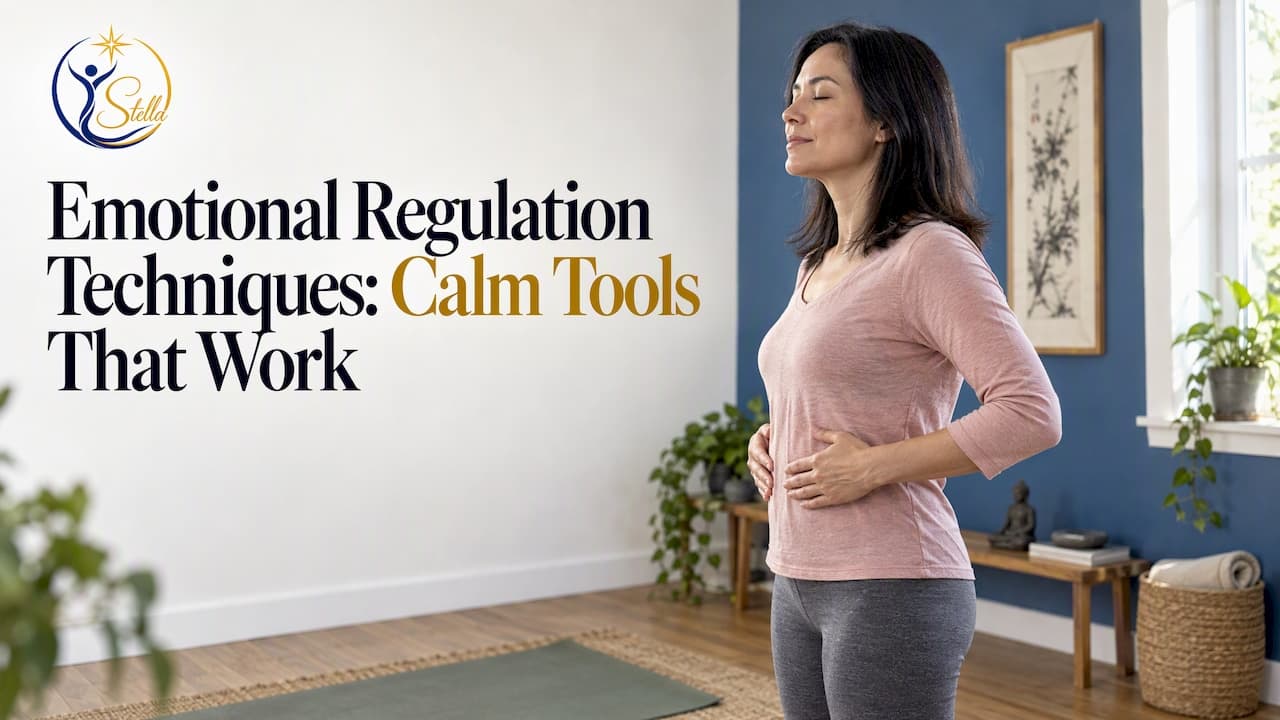
Emotional regulation is the skill of noticing what you feel, understanding it and choosing how to respond, rather than being swept along by it. It does not mean pushing feelings down or staying calm all the time. This guide gives you techniques you can use in the heat of a moment, habits that make big feelings easier to meet, and the gentle movement we teach at Qigongstar, so you can find what suits your body and your day.
Key Takeaways
- Regulation means responding to emotions in ways that fit the situation, not suppressing them or forcing positivity.
- Match the tool to the moment: solve the problem when the feeling fits the facts, and calm or ground yourself when it is too big.
- Slow breathing, naming the feeling and a short pause are the quickest techniques to learn, and daily practice makes them easier to reach for.
- Gentle, rhythmic movement such as walking or qigong gives your breath and attention something steady to follow.
- If distress is affecting daily life, speak to your GP. Self-help tools support professional care and do not replace it.
Table of Contents
- What emotional regulation actually means
- Why it can feel so hard
- Choose the technique to fit the moment
- Techniques for the moment you are overwhelmed
- Techniques that build the skill over time
- Using gentle movement for emotional regulation
- Build a routine you will actually keep
- Our perspective: regulation is something you practise, not something you pass
- Learn it with guidance
- When self-help is not enough
- FAQ
- Sources
What emotional regulation actually means
The American Psychiatric Association describes emotional regulation as noticing, understanding and responding to emotions in ways that fit the situation and support your wellbeing. It stresses that this is a choice in how you respond, not suppression and not forced positivity.
The NHS child and adolescent mental health service in Manchester puts it practically: regulation is using helpful strategies so that emotions support your goals rather than take over. That includes turning down feelings that are too intense, turning up feelings that are too low, matching the intensity of a feeling to the facts, and acting effectively even while you are distressed.
In other words, a regulated person still feels anger, grief and fear. They simply have more room between the feeling and the reaction.
Why it can feel so hard
If you struggle, it is rarely a character flaw. The APA notes that biology, life experiences, chronic stress, sleep, substance use and your environment can all contribute to dysregulation. The NHS guide adds trauma, invalidation, unmet needs, unpredictable surroundings, tiredness, hunger, sensory overload, missing skills or support, and unhelpful thinking traps to the list of contributors.
Some of those are fixable today: eat, rest, step away from noise. Others take time and support. Either way, the first kindness is to stop treating a big reaction as a failure and start treating it as information.
Choose the technique to fit the moment
There is no single best strategy. A 2024 review by Berking notes that effectiveness depends on the state and the situation, and that observing an emotion and letting it run its course can sometimes serve you better than trying to change it.
The NHS guidance frames the choice simply: if the problem is real, solve it; if the emotional response is too strong or does not fit the facts, calm and ground yourself first. Here is a quick map.
| Situation | What helps first | Example |
|---|---|---|
| Feeling flooded, heart racing | Slow the body | Slow breathing, a longer exhale |
| Mind spinning in the past or future | Come back to the present | Grounding through the senses |
| Unsure what you feel | Name it and check the facts | Writing a few lines in a journal |
| Tight shoulders, clenched jaw | Release tension | Progressive muscle relaxation |
| Urge to react or snap | Create a gap | Pause, count to 10, walk away |
| Problem is real and solvable | Act | Make the call, set the boundary |
Techniques for the moment you are overwhelmed
Slow your breathing
Breathing is the most portable tool you own. Beyond Blue explains that slow, deep breathing signals relaxation to the body, reduces fight-or-flight activation and supports emotional regulation, whereas fast, shallow breathing can increase anxious feelings. If you enjoy reading about how different breathing approaches are used for stress, these oxygen breathing exercises for stress relief are another angle on the same idea.
The NHS breathing exercise for stress is a good place to begin:
- Sit or lie in a position that is comfortable for you.
- Let your breath flow down into your belly without forcing it.
- Breathe in through your nose and out through your mouth.
- If it helps, count gently from one to five on each breath.
- Keep going for at least five minutes.
The NHS adds that these exercises work best when practised regularly as part of a daily routine, so do not save them for emergencies only.
If you want a more structured pattern, Lifeline describes box breathing: breathe in for four counts, hold for four, breathe out for four, then hold the breath out for four. Repeat for one or two minutes, and start with three counts if four feels too long. If holding the breath feels uncomfortable, simply skip the holds.
When panic is the issue, our guide to slowing your exhale first goes deeper, and our overview of breathwork styles for health shows how different patterns feel in the body.
Ground yourself in the present
Lifeline defines grounding as a mental, physical or calming activity that moves your attention to the present and away from distress. It may help with anxiety, panic, trauma-related distress, rumination and intrusive thoughts.
Simple ways to try it:
- Press your feet into the floor and notice the contact.
- Name five things you can see, four you can touch, three you can hear.
- Hold a cool glass of water and notice the temperature.
- Look around the room and describe it to yourself in detail.
Grounding also works between people. If tension flares with a partner, these grounding techniques for couples show how to reset together instead of escalating.
Release the muscles
Progressive muscle relaxation means tensing and then relaxing one muscle group at a time. Beyond Blue lists reported benefits including less physical tension, calmness, a lower heart rate and blood pressure, better sleep and reduced cortisol. It advises anyone with a physical condition or injury to check with their GP first, so please do that before tensing muscles that are painful or injured.
Pause before you react
Harvard Health suggests a Stop, Breathe, Reflect, Choose sequence: pause, breathe slowly, count to 10 or take a walk, delay your reaction, then choose a considered response. Even ten seconds changes what you say next.
Techniques that build the skill over time
In-the-moment tools are the fire extinguisher. These habits are the smoke alarm: they help you spot feelings earlier, when they are smaller.
Notice and name the feeling
The NHS guide recommends that you notice and name the emotion, check the facts, identify the urge, choose a strategy and then reflect on what helped. Try a sentence such as: "I notice I feel anxious, and the urge is to cancel the meeting." Naming creates a little distance, and distance creates choice.
Journal, accept and be kind to yourself
The Mental Health Foundation suggests identifying your triggers, practising self-compassion, journaling, accepting emotions rather than fighting them, using affirmations, trying mindfulness and talking to someone you trust. Pick one or two. A tidy list of ten habits you never do helps nobody.
Protect the foundations
The US National Institutes of Health Emotional Wellness Toolkit points to adequate sleep, social support and prioritising tasks as the broader foundations of emotional wellbeing, and says adults need seven or more hours of sleep a night. A tired, hungry nervous system will always find regulation harder, however good your technique.
Using gentle movement for emotional regulation
Movement gives restless energy somewhere to go. Even Harvard's advice includes taking a walk before you respond to something that has upset you. Slow, rhythmic movement has a second benefit: it lets you practise the breathing and grounding above while your body is doing something simple and steady.
Qigong is built around exactly that combination of slow movement, breath and attention. Here is a short sequence you can try in a few minutes, sitting or standing:
- Arrive. Stand with your feet hip-width apart and knees soft. Feel your feet on the floor and let your shoulders drop.
- Breathe low. Rest your hands on your belly and breathe in through the nose, letting the belly rise gently.
- Lift and lower. As you inhale, let your hands float up to chest height, palms down. As you exhale, press them softly down, as if smoothing the surface of water.
- Lengthen the exhale. Let the breath out be a little slower than the breath in.
- Finish still. Rest your hands on your belly and notice what has changed, without judging it.
There are no goals here. If you only manage 60 seconds, that counts. Our guide to Zhan Zhuang for anxiety shows a standing practice you can build from a minute upwards, and our beginner qigong breathing guide explains how to coordinate breath and movement without rushing. For more on releasing held tension through the body, see examples of somatic stress release.
Build a routine you will actually keep
The NHS advice to practise regularly is the whole secret. A realistic plan for a busy adult looks like this:
- Morning, two minutes: belly breathing before you open your phone.
- Midday, one minute: feet on the floor, three slow exhales, before the next meeting or task.
- Evening, five to ten minutes: gentle movement, then a line or two in a journal about what you felt and what helped.
- Weekly: notice which tool you reached for most, and drop the ones that feel like homework.
Because Berking's review shows that no strategy works everywhere, treat your toolkit as an experiment. If a technique leaves you more agitated, change it. Our collection of daily stress reduction practices and our guide to relaxation techniques without therapy offer more ways to shape your day.
Our perspective: regulation is something you practise, not something you pass
We teach qigong to people who are tired of being told to "just relax". Many arrive with stress that has settled in the gut, the shoulders or the breath, and they believe they are bad at calm. We see it differently. Calm is a skill, and skills are built by repeating small, gentle things.

Our classes are led by a White Tiger Qigong Level 3 certified instructor who is also accredited by Yoga Alliance, and who brings professional wellness and digital communications experience to the way we teach modern, busy lives. We keep movements simple and breath-led, because a practice you can do in a kitchen or at a desk is a practice you will do.
We also believe in honesty about limits. Qigong and breathing can soothe the body and give you steadier footing, but they sit alongside medical and psychological care, never in place of it. If you are carrying something heavy, let the practice be one of your supports, not your only one.
— Stella
Learn it with guidance
It is easier to feel the difference between forcing a breath and letting it flow when someone is guiding you. Our online programme, Qigong for Stress Relief and Digestive Wellness, is £116 as a one-off purchase and is designed to be beginner friendly.
If you would rather have personal attention, you can book a 30-Min Clarity Session for £85, a 60-Min Deep Dive Online Session for £145, or a 60-Min Face-to-Face Qigong session for £165. We also run group classes. You can see everything on our online qigong classes page, and if you want to explore the traditions we teach, take a look at White Tiger Qigong and Five Animal Qigong.
When self-help is not enough
Techniques help most when the difficulty is ordinary stress and strong feelings. The US National Center for Complementary and Integrative Health reports that relaxation techniques may help some stress-related conditions, anxiety linked to ongoing health problems and occupational stress, and that for some conditions they are used alongside other treatment rather than alone.
Please speak to your GP if panic is affecting your daily life, if looking after yourself is slipping, or if your responsibilities are becoming hard to manage, as NHS inform advises. The Cleveland Clinic notes that persistent emotional dysregulation can continue into adulthood and may occur alongside anxiety, depression, bipolar disorder, PTSD, ADHD, trauma or neurodevelopmental differences, and that a healthcare provider can help manage it. If you ever feel unsafe, contact emergency services or a crisis line straight away.
FAQ
What is the fastest emotional regulation technique?
Slow breathing with a gentle count is the quickest to learn. The NHS suggests breathing into the belly through the nose, out through the mouth, counting one to five if it helps, for at least five minutes. If you only have a moment, three slow exhales and pressing your feet into the floor is a good start.
Does moving my body really help with emotions?
Gentle movement gives your breath and attention something steady to follow, and a walk is one of the simplest ways to create a pause before reacting, as Harvard Health suggests. Qigong adds slow, coordinated breathing to that. It works best as one part of a wider toolkit.
Is suppressing emotions the same as regulating them?
No. Regulation means noticing and understanding a feeling and choosing a response that fits the situation. Hiding or pushing down feelings is a different strategy, and the research does not suggest it is the most helpful one for everyone.
How often should I practise?
Little and often. The NHS says breathing exercises are most beneficial when done regularly as part of a daily routine. A few minutes each day will do more than one long session a month.
When should I see a doctor?
See your GP if distress or panic is affecting your daily life, your self-care is deteriorating or your responsibilities are becoming hard to manage. Persistent difficulty with emotions can also be linked to conditions that a healthcare provider can assess and treat.
Sources
- Psychiatry.org: When Emotions Feel Overwhelming
- Emotional Regulation, NHS CAMHS
- Self-regulation for adults, Harvard Health
- How to understand and manage your emotions, Mental Health Foundation
- Breathing exercises for stress, NHS
- Breathing and relaxation exercises, NHS inform
- Self-guided relaxation exercises, Beyond Blue
- Finding relief through grounding techniques, Lifeline
- Emotional Wellness Toolkit, National Institutes of Health
- Emotion regulation and mental health: current evidence, Berking
- Mind and Body Approaches for Stress and Anxiety, NCCIH
- Emotional Dysregulation, Cleveland Clinic