
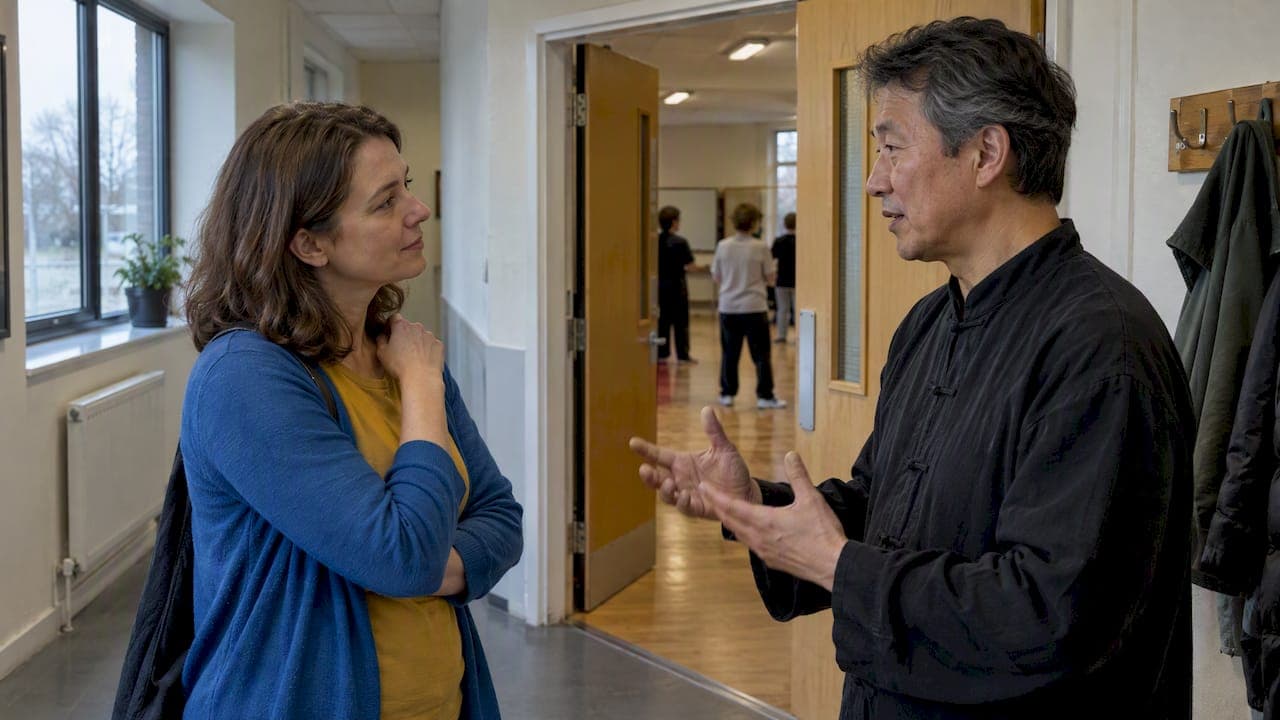
The right qigong teacher prioritizes your safety above all else, adapting movements to your body and explaining each principle in plain language, with a traceable training history you can verify. In-person instruction tends to suit beginners who want hands-on correction, while online classes offer gentle flexibility for busy lives. Whichever path calls to you, always ask for a trial class before committing.
TL;DR:
- Only attend teachers with clearly documented lineage, ongoing professional development, and transparent training records to ensure credibility in qigong instruction.
- Practice protocols typically require at least two sessions per week lasting 30 to 60 minutes over 12 to 24 weeks to achieve noticeable health benefits.
- Group classes are cost-effective but offer less individual correction, while private lessons provide personalized adjustments for injuries or mobility concerns.
- A good early indicator of skilled teaching is clear safety instructions, plain-language explanations, responsiveness to questions, and real-time posture modifications.
- When choosing online courses, verify instructor credentials and opt for programs that emphasize adaptability and practical health-focused techniques.
Table of Contents
- Where to find a qigong teacher, locally or online
- Types of qigong practice and the teacher background that suits your goals
- Group classes, private lessons, and online courses compared
- Signs of skilled teaching you can spot in a single class
- What experience and lineage should look like
- Personal fit: the qualities that make a teacher right for you
- How to use a trial class to make your decision
- Your three-step plan to choose and book your first class
- About the author and QigongStar's teaching approach
- What I look for before trusting a teacher
- How QigongStar supports your next step
- Sources
- FAQ
Where to find a qigong teacher, locally or online
Finding a teacher who feels right starts with knowing where to look. Local community centers and health services often host qigong for health and wellbeing sessions, usually taught by instructors connected to a specialist school or lineage. University continuing-education programs sometimes offer qigong as part of a broader wellness curriculum, which can be a gentle, low-pressure way to sample the practice. Specialist qigong schools, whether rooted in Five Animal forms or White Tiger traditions, tend to offer the clearest lineage and the most structured progression.
Online, your options widen considerably. Teacher websites and dedicated platforms often list course content, instructor backgrounds, and sample lessons, giving you a fuller picture before you commit. Social media can introduce you to a teacher's energy and teaching voice, though it rarely shows depth of training. Community listings and classifieds can turn up hidden gems, but they also carry more risk, since anyone can post a class with little oversight.
Wherever you search, read class descriptions with a discerning eye. Some listings lean on bold claims about instant transformation or miraculous healing, language that should soften your trust rather than build it. A grounded teacher tends to describe benefits honestly, as gradual and supportive rather than dramatic cures.
A few signals to watch for when scanning listings:
- Vague credentials: no mention of a lineage, school, or certifying body at all.
- Overpromising language: words like "guaranteed" or "instant" attached to health outcomes.
- No trial option: a teacher unwilling to offer a taster session or short consultation.
- Missing adaptation details: no indication the class can be modified for injuries, mobility limits, or chronic conditions.
- No way to verify experience: no teaching history, references, or public class record.
Trust builds gradually, the same way your practice does. A teacher worth choosing will welcome your questions rather than rush you toward a sign-up.
Types of qigong practice and the teacher background that suits your goals
Qigong is not one single practice. It is a family of traditions, each shaped by different intentions and lineages, and knowing the differences helps you match a teacher to what you actually want from your practice.
Health Qigong focuses on gentle, repeatable movement sequences designed to support circulation, flexibility, and nervous system regulation. It is the most accessible entry point for stress relief or general wellbeing. Breathing and dantian-focused qigong centers on regulating breath and cultivating internal awareness, often appealing to those drawn to meditation. Five Animal Qigong draws on the natural movement patterns of animals such as the tiger, deer, and crane, weaving playful, flowing motion into practice. White Tiger Qigong blends gentle movement with breath regulation and an emphasis on digestive and nervous system balance, often rooted in Chinese Medicine principles. Martial qigong, meanwhile, supports combat training and demands a different kind of physical conditioning altogether.
Matching teacher background to your goals:
- Health-focused learners benefit most from teachers trained in Health Qigong or a specific therapeutic lineage, such as Five Animal or White Tiger traditions.
- Martial arts students should seek teachers with documented training inside a recognized martial lineage, since the physical demands and intent differ substantially.
- Spiritually inclined practitioners often find breath and meditation-centered teachers, versed in internal cultivation, a better fit than purely movement-focused instructors.
Realistic commitment matters too. Systematic reviews of mind-body exercise show that many effective protocols involve at least two sessions a week, with sessions lasting 30 to 60 minutes across 12 to 24 weeks. That is a helpful benchmark when a teacher proposes a practice schedule, since anything far lighter may struggle to produce noticeable change.
Group classes, private lessons, and online courses compared
Format shapes your experience as much as the teacher does, so it is worth thinking through what fits your life before you book anything.
- Group classes build a sense of shared practice and tend to cost less per session, though they offer less individual correction.
- Private lessons allow a teacher to tailor pacing, cueing, and health adaptations directly to your body, which matters if you are managing a condition such as chronic pain or digestive trouble.
- Workshops suit those who want a deeper, concentrated dose of a specific form, like Five Animal or White Tiger Qigong, without a long-term commitment.
- Online courses and live-streamed classes bring the practice into your home, though you should check that the teacher offers clear verbal cueing and safety guidance since they cannot physically correct your posture.
Many students find a hybrid approach works best. You might begin with an online introductory routine to build familiarity with movement and breath, then transition to in-person sessions once you want hands-on refinement, or combine both depending on the week. Whatever you choose, make sure the format matches not just your schedule but your learning style. Some people absorb movement best watching a screen repeatedly; others need a teacher's eyes on them in the room.
Signs of skilled teaching you can spot in a single class
Good pedagogy reveals itself quickly, often within the first ten minutes of a class. A skilled teacher breaks movement into layers, offering a simplified version before building toward the complete form, and pauses to check that students are following safely rather than racing through a sequence.
Watch for these signs of thoughtful instruction:
- Clear safety cues: reminders about knee alignment, breath pacing, or when to ease off.
- Plain-language explanations: breath, intent, and alignment described simply, not buried in untranslated terminology.
- Responsiveness to questions: a willingness to pause and clarify rather than plow ahead.
- Visible progressions: movements that build logically from one to the next.
- Adaptability: real-time modifications offered for people with limited mobility or joint pain, a detail worth comparing against guidance on qigong contraindications for conditions that need special care.
Lineage claims deserve a measured response. A traceable training history matters, but it should sit alongside evidence-informed teaching, not replace it. A teacher who leans entirely on "ancient secrets" without explaining the mechanics of a movement is leaning on mystique rather than skill.
Pro Tip: If a teacher cannot explain why a movement works in plain terms, be cautious. Confidence without clarity is often a sign of overclaiming rather than mastery.

What experience and lineage should look like
Qigong instruction in the UK carries no statutory licensing requirement, so the responsibility for vetting a teacher falls largely on you. That said, voluntary standards exist and are worth checking. The Chartered Institute for the Management of Sport and Physical Activity lists qigong for health and wellbeing among recognized practitioner roles, endorsing qualifications and continuing professional development as markers of competence.
Before committing to a teacher, it is reasonable to request:
- Certificates from a recognized qigong school or lineage.
- CPD records showing ongoing training rather than a single certification from years ago.
- References from current or former students.
- Teaching history including how long they have taught and in what settings.
- Lineage details that explain which tradition and teacher they trained under.
For in-person classes held on commercial premises, local council guidance can add another layer of reassurance. Guidance on special treatment practitioners expects premises license holders to verify practitioner competence and maintain training records, even where no national qualification exists. Asking whether a studio follows this kind of practice is a fair, non-intrusive question. You can read more about why authentic teaching and lineage matter for building that trust over time.
Personal fit: the qualities that make a teacher right for you
Credentials matter, but so does the simple feeling of being understood in a class. The best teachers tend to share a few qualities: humility about what the practice can and cannot do, patience with beginners, clear communication, and honesty about the limits of evidence behind certain claims.
Practical fit factors worth weighing:
- Pace and class size: a smaller group or slower pace suits those newer to movement practice.
- Accessibility: seated or modified options if you have mobility limitations.
- Cultural sensitivity: respect for the tradition's origins without turning it into performance or spectacle.
- Communication style: whether their explanations genuinely land with you.
Red flags are worth naming plainly. Be wary of pressured sales tactics, claims that cannot be checked against any teaching history, or a teacher who brushes off questions about health conditions instead of offering real adaptations. For more on what separates a trustworthy guide from a flashy one, this breakdown of instructor qualities that matter most is worth a look.
How to use a trial class to make your decision
A trial class or short consultation tells you more than any website bio ever could. Approach it with a short checklist in mind.
- Observe the cueing. Does the teacher explain each movement clearly before demonstrating it?
- Watch for corrections. Do they notice and gently adjust posture, or does everyone move unchecked?
- Check for safety modifications. Are alternatives offered for anyone managing pain or limited mobility?
- Ask about their training. Where did they study, and how long have they been teaching?
- Ask about experience with health conditions similar to your own, such as digestive issues or chronic stress.
- Review their policies on refunds, trial transfers, and whether they can provide references from other students.
Pro Tip: Bring one specific health concern to the trial, whether it is a stiff shoulder or anxious energy, and see how directly the teacher responds. Their answer tells you more than any marketing page.
Your three-step plan to choose and book your first class
Turning everything above into action does not need to be complicated.
- Shortlist two or three teachers from trusted channels, checking credentials, lineage, and class descriptions before reaching out.
- Book a trial class or a short consultation, using the checklist above to judge cueing, safety, and overall fit.
- Commit to a realistic practice window, aiming for at least two sessions a week over several weeks, a pace supported by research on Health Qigong showing that many protocols use 12-week programs with 40 to 60 minute sessions to see meaningful change.
Give yourself permission to switch teachers if the fit is not right. A good practice should feel like steady support, not a performance you have to force.
About the author and QigongStar's teaching approach
Stella Bili is a certified qigong instructor and the founder of QigongStar, where she teaches holistic movement practices rooted in Chinese Medicine. Her work centers on gentle, accessible instruction for stress relief, digestive wellness, and overall vitality.
QigongStar's course focus includes:
- White Tiger Qigong, emphasizing breath regulation and digestive and nervous system balance.
- Five Animal Qigong, drawing on natural movement patterns for flexibility and energetic flow.
- Certification through the White Tiger Qigong School and Yoga Alliance, reflecting a documented training lineage.
- Flexible access through live virtual classes and self-paced, on-demand courses.
This structure gives readers a concrete example of what traceable training and a clear specialization look like in practice, the same qualities worth seeking in any teacher you consider.
What I look for before trusting a teacher
In my own vetting, adaptability outweighs pedigree every time. A beautifully traceable lineage means little if a teacher cannot soften a movement for someone with a bad knee or a nervous system on edge. I ask one question before anything else: can you show me how you would change this for my body? The answer, more than any certificate, tells me whether I am in safe hands.
— Stella
How QigongStar supports your next step
If you want instruction that adapts to you rather than the other way around, QigongStar offers a direct path to try it. Classes draw on White Tiger and Five Animal traditions, built around gentle movement, breath regulation, and real adaptations for stress, digestive discomfort, and burnout.
You can start small with a 30-Min Clarity Session at £60, a focused introduction that lets you feel the teaching style before going further. For a deeper experience, the 60-Min Deep Dive Online Session at £85 offers more guided time, while 60-Min Face-to-Face Qigong at £120 suits those who want in-person correction. Group Qigong Classes are also available, with pricing available on request.
Whichever you choose, every session is guided by a White Tiger Qigong Level 3 certified instructor also accredited by Yoga Alliance, with a focus on practical, targeted support for modern stress and digestive health. Explore the full course lineup and find the session that fits where you are right now.
Sources
For readers who want to verify the standards and evidence referenced throughout this piece, a few sources stand out. CIMSPA's regulated professions listing explains voluntary practitioner standards for qigong instructors. Systematic reviews of mind-body exercise outline realistic frequency and duration benchmarks, while Kingston Council's premises guidance shows how local authorities verify practitioner competence for in-person settings. For UK readers wanting to compare how other hands-on practitioners are vetted, this guidance on choosing a QHHT practitioner offers a useful parallel.
- Regulated Professions Register | GOV.UK — Chartered Fellow/Member of the Chartered Institute for the Management of Sport and Physical Activity
- Systematic reviews of mind-body exercises for older adults (PMC)
- Effects of Health Qigong on quality of life, physical function, and mental health in older adults: a systematic review and meta-analysis (Frontiers, 2026)
- Guidance on the qualifications and training of special treatment practitioners (Kingston Council)
FAQ
Do you need to be certified to teach qigong?
There is no statutory requirement to hold a certification to teach qigong, since the practice is not regulated by law. Voluntary standards exist through bodies like CIMSPA, which lists qigong for health and wellbeing among recognized roles and treats endorsed qualifications and CPD as evidence of competence.
How many times a week should I do qigong?
Most research-backed programs suggest practicing at least twice a week to see meaningful benefits. Systematic reviews of mind-body exercise note that effective protocols commonly use sessions of 30 to 60 minutes over 12 to 24 weeks.
Which is better for seniors, Tai Chi or Qigong?
Neither practice shows a clear advantage over the other for older adults. Evidence synthesis on cognitive and physical function outcomes suggests both Tai Chi and Qigong produce comparable benefits, so the better choice often comes down to which style and teacher feel right for you.
What is the best online qigong course?
There is no single definitive ranking of online qigong courses, since quality depends heavily on the teacher's training and how well the class adapts to your needs. Programs like QigongStar's online courses, built around White Tiger and Five Animal Qigong with certified instruction, are worth considering if you want traceable lineage paired with flexible access.