
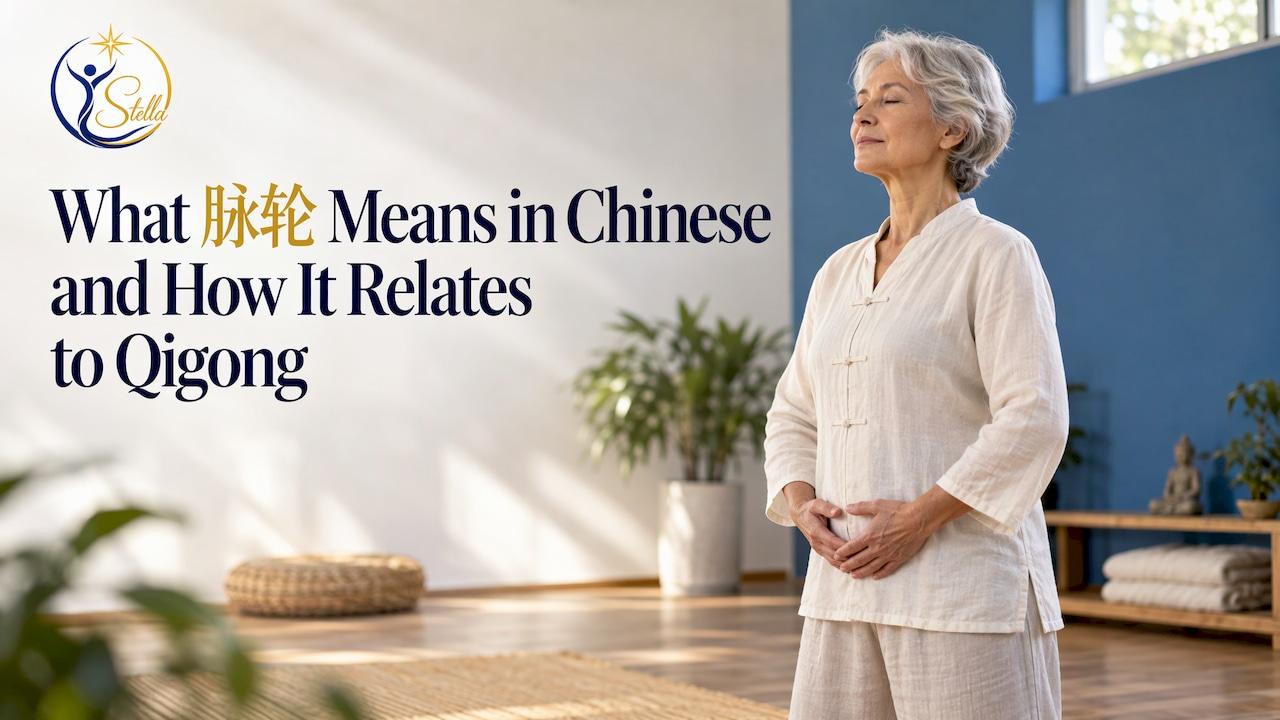
In Chinese, chakra is most often written 脉轮 (mài lún) or 轮穴 (lún xué), and the word simply means "wheel". Chakras are not an original Chinese medical idea. They come from Indian yoga traditions, while Chinese medicine and qigong describe the body's energy through qi, meridians and three dantians. The two maps overlap in spirit, and understanding both helps you choose a practice that feels right for your body.
This guide explains the Chinese terms, shows how the chakra system compares with the Chinese one, and describes where a gentle qigong practice fits if you came here looking for calm, better digestion or relief from stress.
Key Takeaways
- The word: Cambridge Dictionary gives 轮 or 轮穴 for "chakra", and 脉轮 is the common everyday form.
- The origin: chakras belong to yoga and South Asian traditions. Traditional Chinese medicine (TCM) uses qi, meridians and dantians instead.
- The comparison: yoga's seven chakras and TCM's three dantians serve a similar purpose as energy centres, but they are different maps.
- The practice: qigong uses gentle movement, breath and attention to support the flow of qi, with no need to learn the chakra system first.
- The care: qigong is generally considered safe, but it complements medical care and never replaces it.
What does chakra mean in Chinese?
The English word chakra comes from Sanskrit and means wheel or disc. Chinese translators have rendered it in a few ways:
- 脉轮 (mài lún): literally "channel wheel". This is the form you will see most in books, yoga studios and wellbeing websites. The 脉 part is the same character used in 经脉 (jīngmài), the word for meridians.
- 轮穴 (lún xué): "wheel point". Cambridge Dictionary lists this alongside 轮 and defines a chakra as one of seven centres of energy in the body in yoga and traditional South Asian medicine.
- 七脉轮 (qī mài lún) or 七輪: "the seven chakras", written 七脈輪 in Traditional Chinese characters used in Taiwan and Hong Kong.
The seven chakras are commonly named in Chinese as follows, from the base of the spine upwards:
| English | Sanskrit | Common Chinese name | Traditional location |
|---|---|---|---|
| Root | Muladhara | 海底轮 (hǎidǐ lún) | Base of the spine |
| Sacral | Svadhisthana | 腹轮 / 本我轮 | Lower abdomen |
| Solar plexus | Manipura | 脐轮 / 太阳轮 | Upper abdomen |
| Heart | Anahata | 心轮 (xīn lún) | Centre of the chest |
| Throat | Vishuddha | 喉轮 (hóu lún) | Throat |
| Third eye | Ajna | 眉心轮 (méixīn lún) | Between the eyebrows |
| Crown | Sahasrara | 顶轮 (dǐng lún) | Top of the head |
Translations vary a little between regions and teachers, so you may meet a different name for the sacral and solar plexus chakras in particular.
Is the chakra system part of Chinese medicine?
No. The chakra system is a yoga concept. A paper in the International Journal of Ayurveda and Pharma Research notes that chakras and nadis (energy channels) are basic concepts of yoga rather than of Ayurvedic medicine, and that scholars have since drawn correlations between the chakra system and the meridian theory of TCM.
The idea has an interesting history. According to the Routledge Handbook of Yoga and Meditation Studies, the chakra system traces back to texts written between the eighth and twelfth centuries CE across Hindu and Buddhist traditions. Early Buddhist texts placed four chakras at the navel, heart, throat and head. Later, these developed into a vertical line of six or occasionally seven chakras along the spine.
Chinese medicine developed its own picture long before the seven-chakra model became popular worldwide. It describes qi (vital energy) travelling through meridians, with the dantian (the "elixir field") acting as a reservoir. So when Chinese websites explain 脉轮, they often use meridians or the "governing and conception vessels" (任督二脉) as the nearest familiar comparison.

Chakras, qi, meridians and dantian: how they compare
It is natural to wonder whether these are the same thing under different names. A comparative paper in the Journal of Traditional Medicine describes yoga's subtle energy system through chakra, nadi and prana, and TCM's through dantian, meridian and qi. It counts 14 prominent nadis and 14 main meridians, and says chakras and dantians share a similar function as energy centres.
| Idea | Yoga tradition | Chinese tradition |
|---|---|---|
| Vital energy | Prana | Qi (气) |
| Energy channels | Nadis | Meridians (经络) |
| Energy centres | Seven chakras | Three dantians (丹田) |
| Common methods | Asana, pranayama, meditation | Acupuncture, acupressure, qigong |
The same paper observes that the three lower chakras sit between the base of the spine and the navel, in the area of the lower dantian. TCM names three dantians as energy centres (lower, middle and upper), compared with seven chakras in yoga.
A useful way to hold the two ideas: the chakras are like seven stations along the spine, and the dantians are like three pools of energy in the lower belly, chest and head. Neither is a physical organ you can find on a scan. Both are traditional ways of describing how attention, breath and movement can change how you feel.
If you would like to see how the Chinese map works in practice, our guide to qigong meridians walks through the main channels gently, and this comparison of the seven chakras and three dantians offers another angle on how the systems relate.
The lower dantian and your digestion
The lower dantian, a few finger-widths below the navel, is where most qigong practice begins. In Chinese medicine, this area is linked with the digestive organs, which is one reason slow belly breathing and soft, rotating movements are so popular with people who carry tension in the gut. Yoga links the same region with the sacral and solar plexus chakras. Different vocabulary, similar territory: the lower abdomen as a place to settle and soften.
What do chakras mean for emotions?
People often ask which chakra is linked with emotions. In popular yoga teaching, every chakra carries an emotional theme. The root chakra is associated with feeling safe and grounded, the solar plexus with confidence and personal power, the heart chakra with love, grief and connection, and the throat with self-expression. These are traditional associations used for reflection, not medical diagnoses. A tight chest or a knot in the stomach is a real sensation worth listening to, but it does not prove that a particular chakra is "blocked".
Chinese medicine has its own emotional map. Each major organ is linked with a feeling: the liver with frustration, the heart with joy and restlessness, the spleen with worry and overthinking, the lungs with grief and the kidneys with fear. Many people who come to qigong with stress or an unsettled stomach find this worry-and-spleen link a very natural way to understand why digestion and mood travel together.
What does the research say?
The honest picture is that chakras are a traditional framework rather than an established medical one, and researchers are still exploring them. A narrative review in the International Journal of Healing and Caring found sixteen peer-reviewed articles on chakras in PubMed, covering chakra locations, subtle anatomy and mind-body therapies. Its author concludes that, although studies are few, the evidence suggests chakras may be scientifically delineated in a way similar to acupuncture points and meridians.
A 2019 article on energy medicine in PMC notes that the seven chakras run from the base of the spine to the top of the head and are traditionally paired with endocrine glands: the adrenals with the root, the pancreas with the solar plexus, the thymus with the heart, the thyroid with the throat, the pituitary with the third eye and the pineal gland with the crown. Its author adds that more empirical data are needed.
For a wider look at what has and has not been established, this overview of chakra balancing and the evidence is a helpful companion read.
What matters for your day-to-day practice is simpler. Slowing your breath, softening your shoulders and bringing attention to your body are things you can feel within a single session, whichever map you use to describe them.
How qigong relates to chakra practices
Both traditions share a goal. The comparative paper cited above states that yoga and TCM each use specific methods to enliven prana or qi and to promote free flow of energy through subtle channels. In yoga those methods include postures, breathwork and meditation. In Chinese medicine they include acupuncture, acupressure and qigong.
In practice, that means a qigong class will not ask you to visualise seven coloured wheels. Instead, it will invite you to:
- Stand with soft knees and let your weight sink into your feet.
- Breathe slowly into the lower belly, the lower dantian.
- Move your arms and spine in smooth, unhurried arcs that mobilise the joints.
- Notice sensations such as warmth, tingling or heaviness without forcing them.
If you enjoy noticing subtle sensations, our practical guide to energetic body awareness shows how to build that skill step by step. If you are new to all of this, qigong for beginners is the gentlest starting point.
Practising safely
Qigong is gentle, but it is still a practice worth approaching with care. The US National Center for Complementary and Integrative Health (NCCIH) says that qigong is generally considered safe, and that reports of problems have been linked to unrealistic expectations or inappropriate practice. It also says that tai chi, qigong and yoga are generally safe for healthy people when done appropriately, while people with medical conditions or who are pregnant may need to modify or avoid some movements.
In practical terms:
- Keep your doctor in the loop. NCCIH advises that relaxation techniques should not replace conventional care or delay seeing a doctor about a medical problem, and suggests talking to your health care providers if you are considering one for a particular condition. This matters most with ongoing anxiety, persistent digestive symptoms such as IBS, or new symptoms you cannot explain. See your GP first for those.
- Move within comfort. Stay in a range that feels easy. Gentle practice should never cause sharp pain.
- Modify if you are pregnant, recovering from surgery or managing a joint condition. Read our guide to qigong contraindications and mention your situation to your teacher before you begin.
- Let expectations be modest. Practise regularly for a few minutes rather than expecting a dramatic shift on day one.
Where a guided practice helps
Reading about 脉轮, dantians and meridians is fascinating, but the benefit comes from doing. Many people with stress, burnout or an unsettled gut find that having a teacher who can adjust their posture, pace their breath and adapt movements for tired joints makes the difference between a practice they keep and one they abandon after a week.
Our sessions are taught by a White Tiger Qigong Level 3 certified instructor who is also accredited by Yoga Alliance. That combination is why many students who arrive curious about chakras from a yoga background feel at home: the language of breath, spine and attention is familiar, and the Chinese tools build on it.
Your gentle next step
If you would like to begin with a programme designed around calm and digestive comfort, Qigong for Stress Relief and Digestive Wellness is a one-off £116 online course you can follow at your own pace. You can find it, along with the one-to-one and group options, on our online qigong classes page.
One-to-one options include a 30-Min Clarity Session at £85, a 60-Min Deep Dive Online Session at £145 and a 60-Min Face-to-Face Qigong session at £165. Group Qigong Classes are also available, and you can view them on the same page.
If you prefer to explore a little more first, how qigong supports the body and our overview of mind-body modalities compared are good places to start.
Our perspective
When someone tells me they are curious about chakras, I hear a person looking for a way to feel more settled in their body. That is a wonderful place to begin.
We teach qigong rooted in Chinese medicine, so our language is qi, meridians and the lower dantian rather than seven wheels. I find this helpful for many people, because it brings the attention down to the belly, the breath and the feet. Those are the places stress and digestion tend to meet.
Our aim is a calm, regular routine that fits into a busy day: a few mindful minutes to release held tension, soothe the gut and gather your vitality. Whether you picture a chakra, a dantian or simply a warm, soft belly, the movement and breath do the work.
If you want company on the way, we are here to guide you gently, one session at a time.
Stella
FAQ
How do you say chakra in Chinese?
The most common word is 脉轮 (mài lún), and the dictionary form is 轮 or 轮穴 (lún xué). In Traditional Chinese writing you will see 脈輪. The seven chakras are 七脉轮 (qī mài lún).
Are qi and chakras the same?
Not exactly. Qi is the vital energy in Chinese medicine, while chakras are energy centres in yoga, where the vital energy is called prana. Research comparing the two systems says chakras and dantians serve a similar function as energy centres, but they belong to different traditions and maps.
How can I tell if a chakra is blocked?
There is no medical test for a blocked chakra. Traditions use themes such as feeling unsafe or struggling to express yourself as prompts for reflection. If you have physical symptoms, anxiety or digestive problems, speak to your GP, and treat gentle practice as support alongside their care.
Do I need to understand chakras to start qigong?
No. Qigong starts with posture, breath and slow movement, and you can begin as a complete beginner. Our complete beginners' guide explains what to expect in your first sessions.
Sources
- CHAKRA in Simplified Chinese, Cambridge Dictionary
- International Journal of Ayurveda and Pharma Research
- Cakras, Routledge Handbook of Yoga and Meditation Studies
- Subtle energy system of human body based on energy model of Yoga and TCM
- Is there scientific evidence for chakras? International Journal of Healing and Caring
- Energy Medicine: Current Status and Future Perspectives, PMC
- Anxiety and Complementary Health Approaches, NCCIH
- Chronic Pain and Complementary Health Approaches, NCCIH
- 5 Things To Know About Relaxation Techniques for Stress, NCCIH
- Chakra Balancing Benefits: What Helps and What the Evidence Says
- TCM vs. Chiropractic in Singapore