
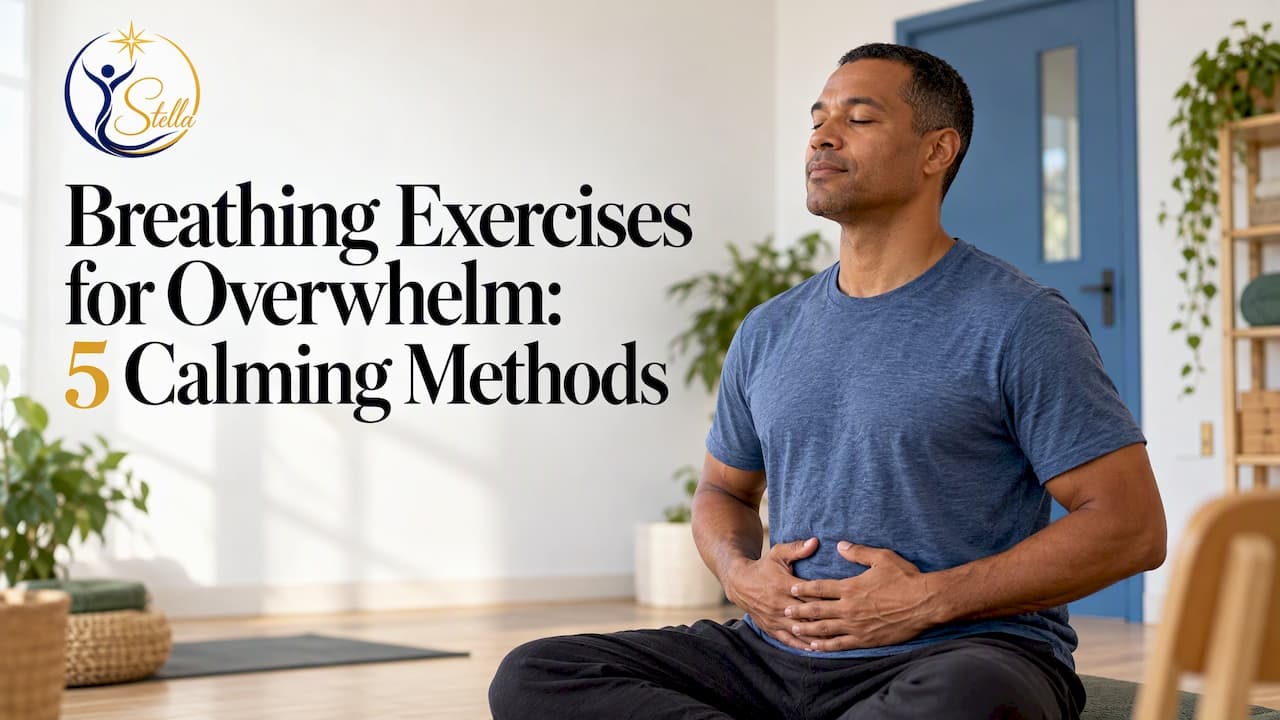
When everything lands at once, the quickest way to steady yourself is to slow your exhale. Breathe in gently through your nose, then breathe out for longer than you breathed in, and repeat for a few minutes. The five exercises below all work on that principle. Each one is simple enough to do at your desk, in the kitchen or on a train platform, and each can melt the sense of being swept along a little at a time.
Key Takeaways
- A longer exhale than inhale is the common thread in the most useful calming breaths: slow abdominal breathing, cyclic sighing and longer-exhale counting.
- Aim for at least five minutes. The NHS advises repeating its exercise for at least 5 minutes and making it part of your daily routine.
- Keep the breath soft. Forcing deep or fast breaths can bring on dizziness, which can feed the very worry you are trying to settle.
- Practise when you are calm, so the exercise is familiar when you need it.
- If stress keeps getting the better of you, speak to your GP. Breathing is a support, not a substitute for care.
Table of Contents
- Why breathing helps when you feel overwhelmed
- Before you begin: set yourself up gently
- Five breathing exercises to try
- Which exercise should you choose?
- How long and how often to practise
- If focusing on your breath feels uncomfortable
- Our perspective
- Learn it with a teacher
- When to stop, and when to seek help
- FAQ
- Sources
Why breathing helps when you feel overwhelmed
Overwhelm feels like a mental problem, but the body carries much of it: a tight chest, shallow upper-chest breaths, a racing pulse. Breathing is the one part of that stress response you can steer directly.
NHS inform describes it simply: controlled breathing acts as a signal to the brain that everything is okay, which helps switch off the body's alarm system. One researcher's explanation is that diaphragmatic breathing stimulates the vagus nerve, sending signals to the brain that activate the parasympathetic, rest-and-digest side of the nervous system.
The NHS describes the general aim as shifting from upper-chest breathing to breathing low into the abdomen. You do not need to understand every detail of the nervous system to feel the difference. You only need a method you can remember when your thoughts are loud.

Before you begin: set yourself up gently
A little preparation makes every exercise easier.
- Loosen what is tight. The NHS suggests loosening restrictive clothing and keeping a supportive posture, whether you are sitting, standing or lying down.
- Let your shoulders drop. Rest one hand on your lower ribs or belly so you can feel the breath move there.
- Choose a comfortable seat. An upright, easy spine gives your diaphragm room to move. If you spend long hours at a desk, why posture affects health is worth a read, and our own qigong for posture routine takes five minutes at your desk.
- Keep the breath quiet and easy. Think of fogging a window, not filling a balloon.
If you feel lightheaded at any point, stop and breathe normally. Breathing too quickly, deeply or irregularly can cause dizziness, faintness and chest pain, and those sensations can themselves become a cause of anxiety. Gentle is always the aim.
Five breathing exercises to try
1. Slow abdominal breathing
This is the foundation, and the one to learn first.
- Sit or lie comfortably, one hand on your belly.
- Breathe in slowly through your nose, letting your belly rise under your hand while your chest stays fairly still.
- Breathe out slowly through your mouth or nose, feeling your belly soften.
- Continue for five minutes, letting each breath be a little slower than the last.
The University of Michigan Anxiety Program recommends practising slow diaphragmatic breathing twice a day for 10 minutes to train in a calmer breathing style. Think of that as the long-term goal. On a hard day, five minutes is a perfectly good start.
2. Longer-exhale breathing
This is the easiest method to remember in the middle of a difficult moment.
- Breathe in through your nose for a count of four.
- Breathe out for a count of six, with soft lips.
- Repeat for several minutes.
If six feels like a stretch, choose a count that suits you, such as three in and five out. The principle matters more than the numbers. You can also lengthen the exhale by counting, humming or pursing your lips, which can enhance the calming effect of breathwork.
If panic is part of what you are feeling, our guide to slowing your exhale first for panic attacks goes into more detail.
3. Cyclic sighing
Cyclic sighing is the practice that has some of the clearest research behind it. In a controlled study, cyclic sighing, which emphasises prolonged exhalations, produced a greater improvement in mood and a lower respiratory rate than mindfulness meditation. The same paper says a daily five-minute practice shows promise as a stress management exercise.
Here is how to do it:
- Breathe in through your nose until your lungs are comfortably filled.
- Without breathing out, take a second, shorter sip of air through your nose to top them up.
- Let out one long, unhurried breath through your mouth, as if sighing with relief.
- Repeat for up to five minutes, letting the sigh grow slower.
Keep the inhales small and the exhale effortless. You are not trying to take the biggest breath possible.
4. Box breathing
Box breathing adds a pause, which gives a busy mind something steady to follow.
- Breathe in through your nose for four.
- Hold gently for four.
- Breathe out for four.
- Hold gently for four.
- Repeat for a few minutes.
If holding the breath feels uncomfortable, shorten the pauses or leave them out and simply keep the in and out breaths even. Box breathing is a good fit when your mind is racing and a count helps you stay anchored. If your body is already tense or your breathing is fast, a longer exhale is usually kinder than a hold.
5. Breathing with a gentle movement
Some people find it easier to breathe well when their hands or arms have something to do. Raise your arms slowly as you breathe in, and lower them slowly as you breathe out for longer. This is the idea behind qigong breathing: unhurried movement and breath moving together. Our qigong breathing for beginners guide and the 10 minute bone breathing practice are good places to start, and our seven minute vagus nerve qigong reset is a short sequence for when you want something a little more flowing.
Which exercise should you choose?
| Situation | Try | Why it suits |
|---|---|---|
| Racing thoughts, can't switch off | Box breathing | The count gives your mind a task |
| Tense, wound up, need to settle fast | Cyclic sighing | One long exhale at the end of each breath |
| Feeling shaky or close to panic | Longer-exhale breathing | Simple, no holds |
| Want a daily habit | Slow abdominal breathing | Builds a calmer baseline |
| Sitting still feels impossible | Breath with gentle movement | Movement gives restless energy somewhere to go |
If you feel anger rising rather than anxiety, these breathing exercises for anger may also help in the heat of the moment.
How long and how often to practise
A breathing exercise works a little like exercise for the body: the benefit builds with repetition.
- Minimum useful session: five minutes. The NHS recommends repeating its exercise for at least five minutes and says you get the most benefit by practising regularly as part of your daily routine.
- Longer practice: a review of breathing practices for stress and anxiety found that effective programmes avoided sessions under five minutes and fast-only paces, and included guided training, multiple sessions and long-term practice.
- Train in, don't only react: the Michigan team suggests using breathing to train in a calm style rather than only as a response to anxiety.
A realistic pattern for most people is five minutes after waking, a few quiet minutes before the busiest part of the day, and a few more in the evening. Link it to something you already do: the kettle boiling, the moment you sit down at your desk, the last email of the day.
The same review noted that interruptions and inadequate training for highly technical practices may make otherwise promising approaches ineffective. In practice, that is a good reason to keep your routine simple and, if you want to go deeper, learn from a teacher.
If focusing on your breath feels uncomfortable
For some people, paying attention to the breath makes things worse. If that is you, there are gentler ways in.
- Shorten the session. One minute is still a start.
- Keep your eyes open and rest them on a fixed point, or look out of a window.
- Skip the holds. Choose longer-exhale breathing with no pauses.
- Count something else. Count the exhale only, and let the inhale take care of itself.
- Move first. A few slow arm circles or a short walk can make stillness easier.
- Change position. Lying down, sitting or standing: use whichever feels safest.
None of this means you are doing it wrong. The right method is the one you can do without strain.
Our perspective
Overwhelm is rarely only about your to-do list. It is a whole-body state, and in our teaching we meet it with the whole body: the breath, the spine, the shoulders, and the slow, rhythmic movement that gives the breath somewhere to go.
We teach that a calm breath is a skill to cultivate, and a skill is learned through gentle, repeated practice with guidance. That is why our classes pair slow breathing with simple qigong movement, so you can feel the exhale lengthen and the body soften rather than just reading about it.
Our instruction is led by a White Tiger Qigong Level 3 certified teacher who is also accredited by Yoga Alliance, with a background in professional wellness and digital communications. That mix shapes our programmes for stress, digestive health and the pressures of modern working life. We design them to feel welcoming for beginners, with no experience needed and no pressure to get it perfect.
If you take one thing from this page, let it be this: five calm minutes a day, repeated, can become a steady place to return to.
Stella
Learn it with a teacher
Reading about breathing is a start. Feeling it guided, with someone adjusting your posture and pace, is where it begins to settle into your body.
We offer online and in-person qigong sessions built around calm breathing, stress relief and digestive wellness. The 30-Min Clarity Session costs £85 and is a focused place to begin. The self-paced Qigong for Stress Relief and Digestive Wellness course is £116 one-off, so you can practise in your own time. A 60-Min Deep Dive Online Session is £145, and a 60-Min Face-to-Face Qigong session is £165.
If you would like to understand the movement tradition behind our breathing work, you can also explore White Tiger Qigong or our Five Animal Qigong course.
When to stop, and when to seek help
Stop any exercise if you feel dizzy, faint, tingly or you notice chest pain. Return to normal, unforced breathing, and if the feeling persists, seek medical advice. Breathing exercises are a self-help tool. They do not replace assessment or treatment.
NHS inform advises contacting your GP if you are struggling to cope with stress or if your current coping methods are not giving relief. If you live in Scotland, the Breathing Space helpline on 0800 83 85 87 is open from 6pm to 2am Monday to Thursday and 24 hours at weekends, according to the same page.
If overwhelm has become a regular part of your working life, our guide to managing chronic stress sets out a broader approach, and how qigong calms the nervous system explains why slow movement and breath work so well together.
FAQ
What is the fastest breathing exercise for overwhelm?
Longer-exhale breathing is the quickest to learn. Breathe in through your nose for four, and out for six with soft lips. Even a minute can take the edge off, though aiming for five minutes gives you more.
Can breathing exercises make anxiety worse?
They can if the breathing is too fast, too deep or forced, as this may cause dizziness or chest tightness. Keep it soft and slow, shorten the session or skip breath holds. If it keeps feeling uncomfortable, stop and talk to your GP.
How long before breathing exercises start to work?
Many people notice a calmer feeling during a single session, but the lasting benefit comes with regular practice. The NHS recommends making it part of your daily routine and practising for at least five minutes at a time.
Is cyclic sighing better than box breathing?
In one controlled study, cyclic sighing produced a greater mood improvement than mindfulness meditation. Box breathing was not the comparison. The better choice is the one that feels comfortable and that you will actually keep doing.
Should I learn breathing exercises with a teacher?
It is not essential, but guidance helps, especially if you are new to this or find focusing on your breath uncomfortable. A teacher can adjust your pace and posture and show you how breath and gentle movement work together.
Sources
- Breathing exercises for stress, NHS
- Controlled breathing exercise, NHS inform
- What to do if you are struggling with stress, NHS inform
- Abdominal breathing overview, Guy's and St Thomas' NHS
- Brief structured respiration practices enhance mood and reduce physiological arousal, PMC
- Breathing Practices for Stress and Anxiety Reduction, PMC
- Take a Deep Breath, PMC
- Slow diaphragmatic breathing, University of Michigan Anxiety Program
- What is breathwork? And do I need to do it? The Conversation